English
 Dutch
Dutch Japanese
 Hindi
Hindi Italian
 Spanish
 French
 German
 Chinese
 Korean
 Arabic
 Hebrew
 Russian
 Portuguese
 Danish
 Czech
Czech Polish
 Swedish
Need help?
 +977 9767994912


Trip Duration
5 Days
Trip Difficulty
Easy
Max. Altitude
4,500m / 14,764ft.
Activity
Trekking
Destination
Nepal
Group Size
1-16 Pax
Accommodation
3 star Hotel
Meals
Breakfast, Lunch, Dinner

Need help?
Talk to trip expert
If you are one of those people with limited days to spend in Nepal but are longing to experience a Himalayan hike, our Short Mardi Himal Trek might just be the experience for you. One of the best things about the Mardi Himal Trek is the flexibility of the itinerary. You can adjust it to as short as 3 days or as long as a week.
The short version of the trek is basically a fast-paced trek to the Mardi Himal Base Camp, it’s a practical choice for those who can trek 8 to 9 hours per day and still enjoy the trek. But on the other hand, for most people, this is not the optimal way to reach Mardi Himal. On the opposite spectrum, this trek can also be extended to 7 whole days by adding in a couple of destinations within the neighborhood of the standard itinerary.
The extended version is a good way to explore the Annapurna villages it requires a whole week. So, the optimal line is somewhere in between, going for a 5-day itinerary seems to be it. 5 days is not too much nor too short, you can explore the region while trekking at a standard pace for 5 to 6 hours per day.
If you are really into experiencing nature at its finest, passing through beautiful forest lands and farmlands, and are an avid country life enthusiast, the Mardi Himal Trek is one of the best journeys for you. We have successfully taken hundreds of guests to this destination and not a single one of them had complaints about the destination. Here’s a detailed breakdown of the trek to help you decide if you want to go on this great journey to the Himalayas.

Our first day of the Mardi Himal Trek begins in Pokhara where we will get on a ride to Kande. The Jeep ride will last around 1.5 hours taking us to an altitude of 1770 meters above sea level. There are a lot of street sellers, most of them are considerate of the visitors while some of them get on your face to try and sell different ornaments. The most popular ones they sell are Tibetan lucky charms which, in our opinion, are not worth it; it has no religious value and are just replicas of the original.
From Kande, we will get our stuff and trek to Pothana. This little section of the trek will take about 2 hours, ending at 1840 meters. The section starts with a descent over stone steps that turn to a well-paved dirt road. The path soon turns to stone steps as we get close to Australian Base Camp.
We will take a little break at Pothana, get our Annapurna Conservation Area permits validated at the checkpost, and continue the trek to Pitam Deurali. This final stretch of today’s trek only lasts about 50 minutes taking us to 2100 meters of altitude.
Note: Make sure that you are well packed, check to make sure you have not left anything behind at your hotel, and check that you have packed all your essentials. You might be able to buy your daily needs during the trek but the higher you go the more you will have to pay for. Even the most basic necessities are priced 2 or 3 times the original price since it is harder to transport things there.


Waking up in Pitam Deurali, we will have a filling breakfast, the go-to choice is bread with butter or jam, boiled eggs, and some kind of veggie as a side. But pancakes, toasts, and sandwiches are available throughout the itinerary which is the result of the modernization of the villages. Tibetan bread, Muesli, Chapati, etc. are also great options for breakfast during the Mardi Himal Trek.
The local government sets the rate for food prices. It is deemed illegal if any eateries try to overwrite the government-fixed prices. The more your ascend, the higher the price of food.
From the lovely village of Pitam Duerali, we will walk about 2.5 hours to reach Forest Camp at 2520 meters of altitude. From there, it will take two additional hours to get to Low Camp where you are set to see your first sight of snow during the 5 days Mardi Himal trek if you are on the right time.
Today’s trek is rather short, we just have to trek for about 3.5 hours to reach High Camp. First off, we will set off on a trek to mid-camp which is just a couple of shops set up at a midpoint. You can buy snacks, and beverages, and have some tea there with a short photo session if you would like. It takes about 2 hours to get there.
From mid-camp, we will continue the trek and get to high camp in about 1.5 hours of trek. This is the highest sleeping location of the Short Mardi Himal trek. Since we are at over 3500 meters of altitude, you might notice the short and quick breath while hiking up. This is because the oxygen content in the air has decreased but once you stop trekking the breathing should go back to normal.
While you are at high camp, you should try something called Mars Roll, it is basically a Snickers bar wrapped in a light dough with some kind of food on the top. This particular food is a famous staple there as it is full of energy and calories which you need to walk long hours each day.
From high camp the views are stunning, you can see clouds of lake floating below your height. Compared to low camp, high camp is much more scenic and interesting. The night/early morning view of the sky is great as well since there is considerably less light pollution to hinder the true view of the night stars.
From the high camp, it will take us a little over an hour to reach the Mardi Himal viewpoint at 4300 meters of altitude. The trek starts at 7 in the morning, we will leave our heavy bags at our lodge room and get on the path to the viewpoint. Since our porters will be carrying your heavy bags most of the time you do not have to worry about the weight. Just focus on the trail and the scene, and leave the rest to us.
The viewpoint offers the best view, obviously, but the real deal is the base camp since you are technically standing on a part of a Himalayan mountain. But getting to the summit of the viewpoint is a little challenging as we have to climb a sloped cliff with a massive drop.
We will have a little photo session at the viewpoint and after about 1.5 hours of additional hiking, we will reach the Mardi Himal Base Camp which is the climax of the Mardi Himal Trek. On the way, you will have to get over snow and icy patches that are slippery and there are a couple of viewpoints on the way up that are marked with colored stripes on stones.
After we are done with the sightseeing, we will travel back our steps and get to high camp, followed by a descent to low camp. The afternoons in Himalayan regions get cloudy really quickly, causing limited visibility which is why we set off early in the morning and have to get back by afternoon. Getting all the way down to Low Camp will take us about 3.5 hours. Day 4 of the Short Mardi Himal trek is the longest trekking day.
From Low Camp, we will trek for approximately 2 hours and 20 minutes to reach Sidhing from where we will get on a jeep to Pokhara. This road ride lasts about 3 hours (max) and has lots of scary-looking turns with cliffs; it will be an exciting ride to day the least.


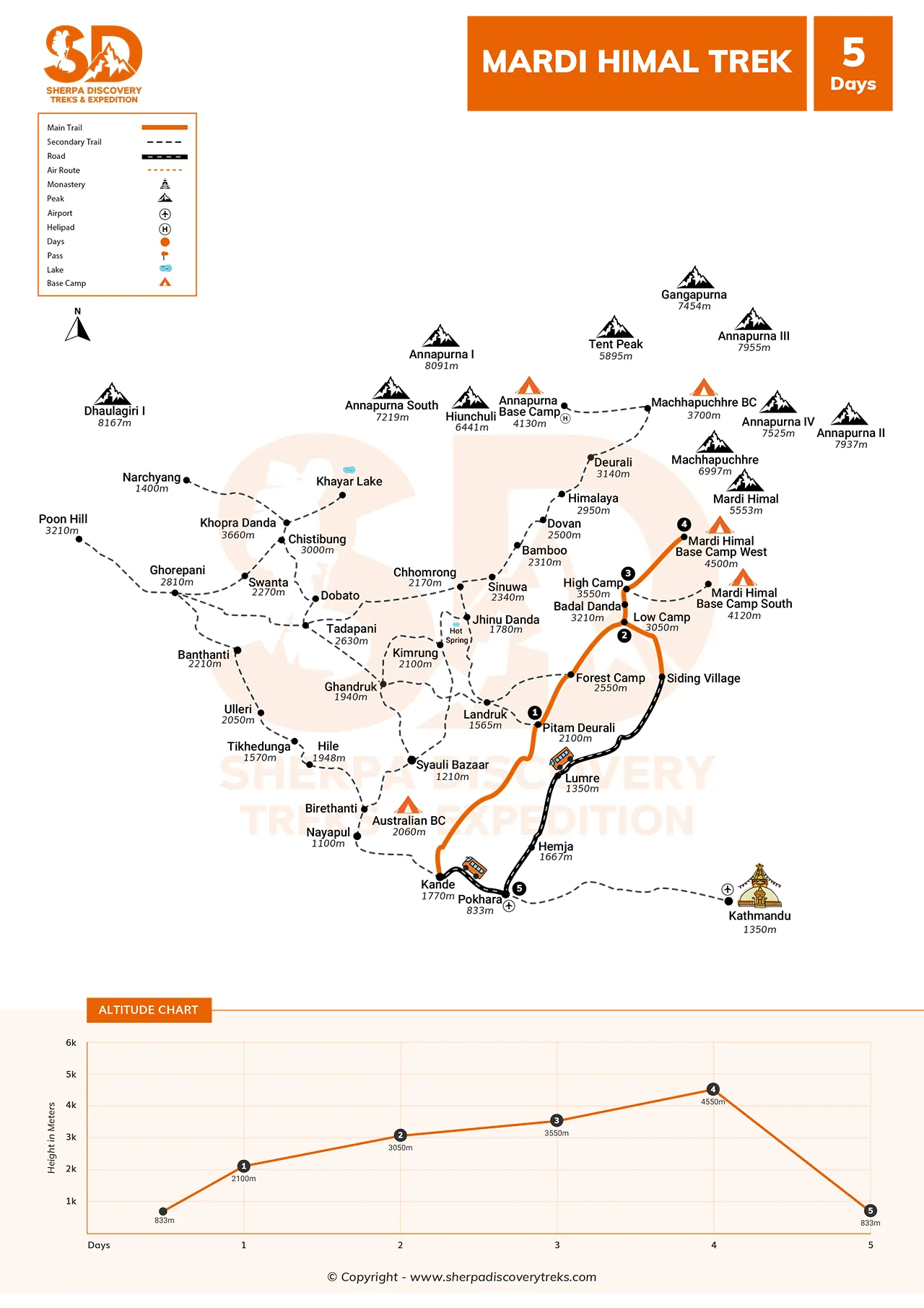

The Mardi Himal trek starts in Pokhara where we will get on a Jeep to Kande. After we get there, we will shortly begin our trek to Pitam Deurali, a lovely village full of scenic hills. From there, we will move to Low Camp the next day and spend the night there. On the 3rd day of the 5 days Mardi Himal trek, we will get to the high camp which is yet another scenic stay. The 4th day is the ultimate day of the Mardi Himal Trek as we will be reaching the Mardi Himal Base Camp. On day 5, we will trek down to Sidhing and get on an exciting Jeep ride to Pokhara.
The Short Mardi Himal Trek is not difficult at all. It is, in fact, one of the best beginner trekking destinations in Nepal and even kids as young as 10 years have been on this trek. The itinerary spans only 5 days which is perfect for those with less time to spare but most importantly it is short which translates to an easy trekking experience with minimal physical requirements.
The trails themselves are not difficult, except for some stone step sections that require good stamina and leg muscles to complete in one go. But since we will be stopping quite frequently, you do not need to possess such qualities.
The best option for the Mardi Himal Trek is autumn. This season is generally full of clear skies, great visibility, and rare rainfall making it a great time to step outdoors and experience nature. During this season the peaks and mountains are in full glory as they are covered in snow and not blocked by heavy clouds. This is the best time to view the high Himalayas.
The weather is stable and most predictable during spring which means that your
Short Mardi Himal Trek is in safe hands. Autumn is also the season of festivals in the hilly region of Nepal which calls for an additional experience of festivals in Nepal. These festivals are full-blown celebrated in public (most of them) and it’s always a delight to watch them. Since autumn is so good, you can expect a little crowd at popular destinations such as Mardi but other than that, it’s all good.
Another great option for 5 days Mardi Himal trek is spring. During this season, the flowering plants and trees display their vibrant colors which seem like something out of a fairyland. The day temp is adequately warm while the night temp is on the cooler side. Just like autumn, the skies are clear for the most part with some rain since.
If you are not able to make it in spring or autumn, you can also do the Mardi Himal Trek in summer but it gets hot during the daytime which can be an issue while day trekking.
Yes, the Short Mardi Himal Trek is a very beginner-friendly trek that has attracted first-timers and beginners from all over the world. It is one of the best options for beginner trekking destinations as it offers a beautiful view and reward at the top of the base camp while being a relatively easy trek. We have sent so many parents with their kids on this 5 days Mardi Himal trek and both generations love the experience.
On average, you have to walk 5 hours each day which is very doable and once you get to the base camp, it’s all descent while returning. The altitude of the trek is also limited to 4500 meters above sea level which is a safe altitude, meaning altitude sickness has relatively less chance to strike you. Even if you do get altitude sickness you can just walk it off by getting down to a lower elevation and spending some time there before hiking back up.
Despite going up to a Himalayan mountain, you do not have to worry about altitude sickened during your Mardi Himal Trek since we will only be reaching a maximum height of 4500 meters. Altitude sickness starts from 3500 meters of altitude but under 5000 meters it is not very harmful and can be dealt with by dropping down a couple hundred meters of elevation.
In addition to that, we will be following all the preventive measures for altitude sickness which should help us avoid it. You are most likely to not suffer from altitude sickness following the measures suggested by our 5 days Mardi Himal trek guide. However, you may suffer from loo while day trekking in the sun which is not as harmful as altitude sickness but it is a minor inconvenience.
Accommodation is largely limited to tea houses, lodges, and inns but the best option, in our opinion, is homestay. The villages in the Annapurna region have a communal understanding of hosting visitors in their homes, on a turn basis. This means you do not stay in an establishment but rather in an authentic village home, where traditional home food is served, and you stay with the locals. However, this option is not available at every point of the Mardi Himal Trek.
On the other hand, establishments like tea houses, lodges, inns, and hotels are owned by the locals or the village committee, your expenses here fuel the economy of the village. The rooms are basic here but you will be given all the comfort they can provide. You have to remember that getting even the basic necessities in such a hardly accessible region of the world is not an easy thing to do, so expecting modern services is out of limits.
Bathrooms are shared, there is a communal hall that also acts as a kitchen, and hot showers are usually charged extra. Laundry services are available for the most part while heating is not a concept in the region. The communal hall is heated by the heat of the kitchen fire but your rooms will be cold if you are planning to visit in winter. In such a case, sleeping bags are life savers.
When it comes to food, your best bet is to play it safe and go vegetarian for the entirety of the Mardi Himal Trek. Meat is available throughout the trek but some of the eateries in the region still do not have proper freezers. If you are certain that they are cooking frozen meat, you may order them. The main dish you should try is Dal Bhat which is almost readily available, it’s just rice and lentils served with sides of veggies/meat and chutney. Other dishes include thukpa, chowmein, and momo, along with some Western dishes such as pancakes, sandwiches, pasta, macaroni, etc.
For drinks, you should stick completely to tea and water, maybe a couple of energy drinks if you are feeling down. Bottled water is available throughout the Mardi Himal Trek but as we go up the trail, the price goes up as well. Being a responsible agency, we recommend visitors bring along a reusable and refillable water bottle to minimize the waste. There are many natural water sources along the way that the locals drink straight out of but since you are not used to it, you should use a water purification tablet instead.
Our Short Mardi Himal trek itinerary requires trekkers to travel from Pokhara to Kande on a jeep and a return ride to Pokhara from Sidhing at the end of the 5 days Mardi Himal trek. Both of these instances are covered by our trek package.
Every trekker doing the Mardi Himal Trek is required to have an Annapurna Conservation Area Entry Permit and a Trekker’s Information Management System (TIMS) card. Both of these permits will be covered by the Short Mardi Himal trek package.
As per our experts, we recommend trekkers to train for at least 2 weeks before the start of the trek. Going on runs or hitting the gym 4 to 5 times a week should be enough to prepare you for the Mardi Himal Trek. Cycling and swimming are also great options to build your endurance capacity. Your primary goal should be to strengthen your lower body which includes your leg muscles.
Core strengthening exercises are also a valid form of training but make sure that stamina is built. Another great workout session is climbing stairs or doing the stairs machine at the gym. Since you will be climbing a whole lot of stone stairs it only makes sense to practice it physically.
By the end of your preparation session, you must be able to walk for 4 to 5 hours a day. During the trek, we will be taking many breaks in between to take a breather.
The Annapurna region villages have multiple access points which translates to many alternative routes. Here are some of the best and most practical alternative routes.
Day 1 Trek from Ghandruk to Forest Camp
Day 2 Trek from Forest Camp to Low Camp
Day 3 Trek from Low Camp to High Camp
Day 4 Hike to Mardi Himal Base Camp and return to High Camp
Day 5 Hike down to Sidhing Village and drive back to Pokhara
Day 1: Drive from Pokhara to Landruk and trek to Forest Camp
Day 2: Trek from Forest Camp to High Camp
Day 3: Trek to Mardi Himal Base Camp and return to High Camp
Day 4: Trek to Sidhing Village and drive back to Pokhara
Day 1: Trek from Ghandruk to Forest Camp
Day 2: Trek from Forest Camp to Low Camp
Day 3: Trek from Low Camp to High Camp
Day 4: Trek to Mardi Himal Base Camp and return to High Camp
Day 5: Trek from high camp to Low Camp
Day 6: Trek from Low Camp to Pothana
Day 7: Trek from Pothana to Kande and drive back to Pokhara
Day 1: Drive from Pokhara to Kande and trek to Forest Camp.
Day 2: Trek from Forest Camp to High Camp.
Day 3: Visit Mardi Himal Base Camp; drop back to Sidhing Village and Jeep drive to Pokhara.
Our 5 days Mardi Himal trek is reasonably priced at USD ______ per head. This trek package will cover things like wages for guides and porters, transportation costs, permit fees, standard accommodation costs, breakfast, lunch, and dinner every day, and more. You will be given a briefing on the includes and excludes of the trek package; you can also ask our trek guide if you have any queries. Cash is king in the highlands of Annapurna and there are no ATMs there for you to cash out, so make sure you cash out at Pokhara.
The Short Mardi Himal trek is a pretty well-facilitated trekking destination given it’s very popular among the local tourists. About 16000 tourists visited the Mardi Himal Base Camp in 2024 which may not sound like much but in the context of Nepal, it is a great number. The villages of the region are fully facilitated with running water and electricity, so you can expect a comfortable stay.
Internet is available for the most part of the Mardi Himal trek but some establishments tend to charge you a couple of bucks for using WiFi. If you want to avoid this, you can use a Nepalese sim card to access the internet but truth be told, cell connectivity is not very reliable during the trek.
Expenses that are not mentioned to be inclusive of the Short Mardi Himal trek package are your extra expenses. This includes tips for the porters and guides, emergency evacuation services, visa fees, medical and travel insurance, international flight expenses, and more.
The Mardi Himal trek is a great short trek to the highlands of Annapurna offering you the chance to visit the Mardi Himal Base Camp, try out local dishes, watch live cultural performances, and more. It’s not just a trek it offers a wide variety of experiences and we are sure you are going to love it.
Please note that unforeseen circumstances such as political issues, natural calamities, and others can make a difference in the experience we have explained. In such cases, we will try our best to provide you with another similar trek package or do our best to continue the trek.
Although not many, there are a couple of luxury lodges that we will come across during our Mardi Himal trek. If you prefer, we can arrange a luxurious stay during your trekking days. Make sure that you let us know about your preferences during the booking phase so we can work on it right away. Upgraded accommodation is not a part of the Short Mardi Himal trek package, your ultimate bill will be adjusted accordingly.
Pokhara is the most longed-for destination in Nepal. Its stunning viewpoints, laidback vibes by the lake, and inspiring Annapurna range view is too much for anyone to ignore. Pokhara has been named the tourist capital of Nepal and we can see why. Tourists rarely regret visiting this city and we are all for it. If you want to go around Pokhara with a guide and vehicle, we are here to assist you in every way.
We will take you around the city, visiting iconic destinations like Sarangkot, Methlang, Kristi, Pame, etc. There are a plethora of places to visit in Pokhara and one day is simply not enough but we will do our best to make the most of it. Note that, this is an add-on which means it is not a part of the Mardi Himal trek package.
The Mardi Himal Trek covers around 45 kilometers of distance back and forth. The trek itinerary can be designed to last for anywhere from 3 to 7 days but the sweet spot is right in the middle.
Yes, you are legally required to have a licensed guide with you if you are visiting any of the protected areas within Nepal such as the Annapurna Conservation Area Project. While porters are not a legal mandate, they carry all your heavy stuff allowing you to focus on the journey.
Altitude sickness mostly hits you while you are asleep, especially when you sleep at a high elevation. To avoid this, we must always hike a little higher than the place we are going to sleep. However, given the altitude of the trek, there is no need to worry about high risks of altitude sickness. Nevertheless, you must practice the preventive measures.
You can get these permits sin Board of Tourism offices in either Pokhara or Kathmandu or at any of the authorized trek agencies such as ours.
Yes, teahouses are an inseparable part of the Annapurna region as they are the closest thing to a motel in the highlands. Teahouses provide snacks, beverages, and simple dishes while also being a little inn.
When it comes to drinking water, there are two major sources, bottled water and local spring water straight from tap or ground. The locals of the region grew up drinking the mineral-rich spring water straight from the source with no purification. However, since you are not used to it, you might get an upset stomach. The best option for you is to get bottled water or use water purification tablets.
Yes, when you are trekking above the altitude of 4000 meters above sea level you must be insured since it covers the medical expenses in the rare case that you need immediate emergency services.

Need help?
Talk to trip expert