English
 Dutch
Dutch Japanese
 Hindi
Hindi Italian
 Spanish
 French
 German
 Chinese
 Korean
 Arabic
 Hebrew
 Russian
 Portuguese
 Danish
 Czech
Czech Polish
 Swedish
Need help?
 +977 9767994912


Trip Duration
14 Days
Trip Difficulty
Moderate
Max. Altitude
5,416m / 17,769ft.
Activity
Trekking
Destination
Nepal
Group Size
1-16 Pax
Accommodation
3 star Hotel
Meals
Breakfast, Lunch, Dinner

Need help?
Talk to trip expert
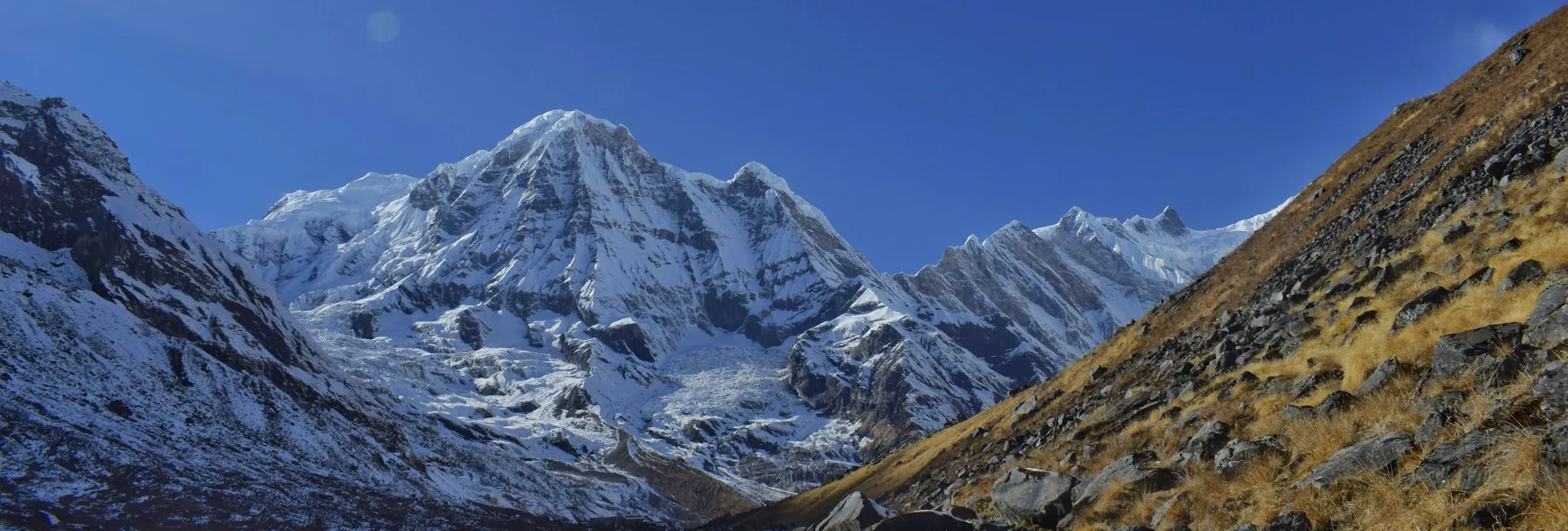
Fishtail, Dhaulagiri, Annapurna, Thorong La, Manang, and Mustang barren mountain desert, Hinduism, and Buddhism- this is what our classic Annapurna circuit trek 14 days journey is all about with a little bit more flare of the Poon Hill Viewpoint.
For years, the Annapurna circuit trek has remained as the great classic trekking route in Nepal but it still is a very interesting and exciting trip adventure. It will enable you to walk almost completely around the Annapurna massifs that ranges between 7000 to 8000 m in elevation. Thus the trip is also referred to as Annapurna Round trek.
Additionally, the changing vegetation, the climate, the unique mud and brick houses, the costumes, and the religion of the population also make the Annapurna circuit trek route unique as a whole.
You will see everything within these 14 days: the beautifully close features of Lamjung (6983 m), Annapurna IV (7525 m), Manaslu (8163 m), Tilicho (7134 m), Pisang (6091 m), Fishtail (6993 m), Khatung kang (6484 m), Hiunchuli (6441 m), Annapurna I (8091 m), South (7219 m), Gangapurna (7455 m), Annapurna II (7937 m), III (7555 m), Gundang (5312 m), and Nilgiri Peaks.
You will walk through the subtropical forests, icy rocks faces and glaciers of the Annapurna area. You will meet different tribes from Hindu Chhetri and Brahmin to Buddhist Gurung and Mananges. You will also meet the extraordinary Thakali locals of Kali Gandaki Valley known for their hospitality and hoteliership.
As for our Annapurna circuit trek itinerary, in the initial days, you will journey through the Lamjung Valley green fields, forest, small villages, and up and down hills to Jagat.
Then you will follow the course of the Marshyangdi River in the Manang Valley and walk through its Tibet-like villages and terrain. After Manang, you will enter the Jar Sang Khola valley abruptly and set to face the challenge of the 5416 m high Thorong La Pass recognized as the world’s tallest pass.
Once at the top, you will have the unparalleled views of Dhaulagiri, Manaslu, Hiunchuli, Nilgiri, Lamjung, and Annapurna. Then you will descend to the large sanctuary of Muktinath where a temple has been built over an eternal flame as an appearance of Shiva.
The last segment of our Annapurna circuit trek 14 days adventure will then lead you to the world’s deepest valley of Kali Gandaki. From here, you will proceed towards the unusual viewpoint of Poon Hill standing at 3210 m- yet another astounding spot to see one more time the phenomenal beauty of the Nepali Himalayas.
You will then end the Annapurna circuit trek in Tikhedhunga from where you will transport to Pokhara – the most stunning place to recover from the fatigue of the trek.
Truly, this is the trek in Nepal that you should not miss out on as a true hiker. If you really want to see what the Annapurna circuit trek 14 days adventure can literally offer you, then consider taking it in autumn and spring.

We will commence our Annapurna Circuit trek 14 days journey with a local bus ride to Bhulbhule of about 8 hours. We will leave Kathmandu through Kalanki and immediately we will climb the Thankot Pass that surrounds the Kathmandu Valley.
In clear weather, we will have a phenomenal view of Ganesh Himal, Lamjung Himal, Langtang Himal, and Annapurna. The road of the Prithvi Highway will now descend and run along the Trishuli River.
We will reach Mugling in about 4 hours where we may stop for lunch. Then, our journey will continue towards Dumre. Now leaving the main track leading to Pokhara, we will turn right into the mountain land of Besisahar beside the Marshyangdi River.
Now the unpaved road will take us through Khudi towards Bhulbhule- our first mountain village for the night in the Annapurna.


The exciting walking part of our Annapurna circuit trek itinerary begins from today. From Bhulbhule, we will head to Ngadi. Our Annapurna circuit route will now navigate us through various settelements such as Dobhantar, Ghermu, and Bahun Danda ultimately taking us inside Lamjung Valley in Syangje.
The path ahead now is slightly challenging featuring steep climbs and narrow roads littered with rocks and gravel. As we trek, we will soon reach Jagat, where we can admire the grandest views of Manaslu along with the Annapurna range.
We have a bit of difficult walking today as we depart from Jagat and engage in around two hour of uphill trek towards 1430 m high Chamje Village.
The path will now turn more rugged and constricted as we ascend steeply to Tal where we will be at 1700 m elevation. At this point, we will be in beautiful Manang Valley where the terrain seems like Tibetan highlands.
Now, hiking along the dry dirty path, we will pass through Karte and reach Dharapani shortly.
Walking through the immensely beautiful landscape, we will face steep rock faces, and waterfalls and reach Bagarchhap Village (2160 m) beautifully seated with its small monastery.
We will have another 1.5 to 2 hours of walk through Danakyu to Timang. About three quarters of an hour before Timang, the path goes steeply uphill through a forest.
From Timang, we will continue walking through Lata Marang (2400 m) and Koto seated beside the stunning Phu Khola before finally reaching Chame. From here, we can look straight at Annapurna II and Lamjung Himal.
From Chame, we will resume our upstream trek along the Marshyangdi River and reach Bhratang Village. After we traverse the hanging bridge here, we will pass the impressive, 1500-meter-high granite walls of Paungdi Ridge of Dhukur Pokhari.
We will then reach the first village called the Lower Pisang which lies at 3200 m in height. For a more beautiful view and comfortable sleep, we will climb 100 m more and arrive at Upper Pisang.
From our lodge, we can directly look at the amazing profiles of Annapurna and Pisang Peaks.
From Upper Pisang, we will climb quietly through the high colored mountain slopes towards the authentic village of Ghyaru (3670 m). The Annapurna I now shows its full size while Gangapurna, Annapurna II, III, and IV, Tilicho, and Lamjung Peaks will also quietly lurk behind.
We will have to climb through two more authentic mountain villages of Ngawal (3657 m) and Bragha (3450 m). Now, we will have to climb for another thirty minutes to finally rest our feet at the Manang Village.
In Manang, we will rest for one day to acclimatize by watching the village life, the white peaks of Annapurna, and glacier masses. After breakfast, we can go and see the blue/gray glacier lake of Gangapurna or further on undertake a short ascending journey towards 4130 m high Bodzo Gompa or the Chongkor viewpoint.
Later, we can just wander through the town and attend a short lecture on Acute Mountain Sickness.
The approach to the main high point of the Annapurna round trek to the Thorong La Pass is coming near now. From Manang, we will steeply climb the rising path that will direct us towards Tengi Manang (3650 m) situated in the Jar Sang Khola valley.
Next, we will constantly keep on climbing till we are at Ghunsang Village (3890 m). now, we will travel northward and start to see yaks grazing on the lush hillsides. Soon, we will arrive at Yak Kharka, which sits just above 4000 m.
Here, the landscape is dominated by rocky formations and towering mountains. We will continue towards Upper Yak Kharka for a while before heading to Letder.
Today we will first walk in the morning to the end of the valley, where it is blocked by enormous rock walls. We will then climb above following the Thorong River to 4500 m of Throng Phedi which is the base camp of the high Thorong La Pass.
After we have our lunch here, we will walk another hour and a half and around 425 m up to the High Camp of the Pass where we will be spending the night.
The big advantage of an overnight stay in the High Camp is that tomorrow’s pass day is less long and difficult.
Finally, the highest elevation of our Annapurna circuit trek map and the big day of the Pass is on our doorstep. We will get up early to start trekking and climbing before sunrise.
From High Camp, we will have to ascend for about 600 m to the Thorong La Pass. We will have a few hurdles of small hills to climb and descend and there can be sometimes snow on the path.
However, the ascension of the pass is perfectly achievable by everyone. At the top of the pass, we can see prayer flags have been placed all over but the magically striking features of the high mountains will steal the spotlight that includes Hiunchuli, Fishtail, Manaslu, Nilgiri, Lamjung, Dhaulagiri, and the astounding Annapurna I.
Now, we will get on with our 1600 m downward trail which we will do very calmly. We will trek past the small hamlets of Rani Pauwa, Ekle Bhatti, and Khinga before arriving at Muktinath – a magical place of pilgrimage for Hindus and Buddhists.
Early in the morning, we will take the opportunity to visit the Muktinath temple where we can see the eternal flame burning on top of a mountain stream. If we are up for it, we can also follow the custom and take a bath under the 108 cold water jets to get rid of our bad sins.
Now, we will take the local bus and descend to the Kali Gandaki Valley and the fortified village that forms the entrance to Upper Mustang: Kagbeni.
The road from here is very beautiful, initially on the bottom of the Kali Gandaki valley, between Annapurna and Dhaulagiri! Driving past the stunning rain shadow villages of Lower Mustang such as Dagarzong and Jomsom, we will reach Marpha, the apple town of Nepal.
After trying some apple brandy here, we will proceed with our drive through Dhonga, Kobang, Larjung, Kokhethanti, Dhampu, and Kalopani and then reach Ghasa.
Here, we will have to drive through the river gorge to travel through Dana and reach the tropical village of Tatopani. There are warm springs nearby where we can immerse for the regeneration of our faded energy.
After exiting Tatopani, we will cross the river and head right to hike through the forest villages of Birauta and Ghara. We will then begin ascending through Ghopte Kharka and reach Shikha Village.
Now, the trail mostly runs through the terraced cultivated land of Phalante and Chitre. Now, we will walk through a forest with crooked trees and reach the humid environment of Ghorepani- literally, the place where horses get water
Early morning before the sun wakes up, we will set on to climb for about an hour to the unique viewpoint of Poon Hill. We will look at the deep gorge of the Kali Gandaki with Dhaulagiri and Annapurna (I, II, III, and South) on both sides.
There are also Manaslu, Nilgiri, Fishtail, Tukuche, and Gangapurna waiting patiently for our admiration. After returning for breakfast in Ghorepani, we will now descend through the beautiful forest to Ulleri.
After climbing down the 3300 stone steps, we will arrive at Tikhedhunga where we can ride along the asphalted road to Pokhara via Birethanti and Nayapul.
Early morning, we will take a tourist bus back to Kathmandu through Trishuli and Thankot. Then you can do some looking around, do some shopping and prepare for the return flight to your home.
It is possible to take a flight to Kathmandu from Pokhara. The costs are not included in the travel price. You can indicate when booking our Annapurna circuit trek 14 days journey whether you want to fly.


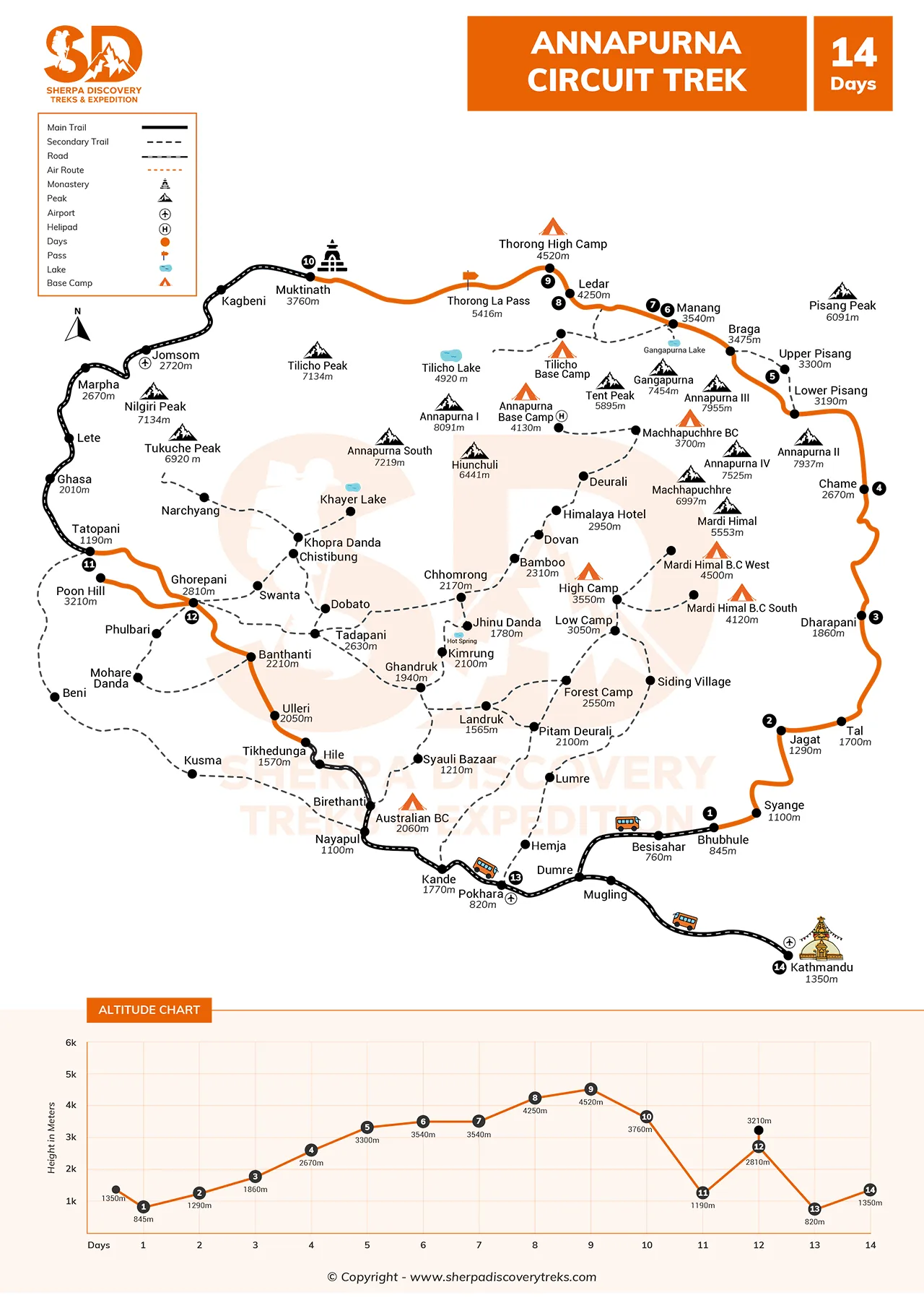

During the Annapurna circuit trek 14 days journey, we will experience large differences in altitude. As a result, the climate during our Annapurna round trekking varies from subtropical monsoon climate to mountain desert climate.
The rainy season falls in the summer spanning from the beginning of June to the mid days of September. The Marshyangdi Valley will see an enormous amount of rain with the possibilities of landslides.
However, the Manang and Kali Gandaki Valley with lower Mustang lie in the rain shadow so they often remain bone dry and desert-like even in monsoon.
The winter spanning from the mid days of December and ending till February shower the Thorong La Pass with snow fall sometimes blocking its path accompanied by strong chilling winds in the lower Mustang.
Thus, the best season for the Annapurna circuit trek are during the intermediary season of fall/autumn stretching from mid September to the last days of November and the spring time starting from the beginning of March till the end of May.
These times are characterized by bright, transparent skies and generous sunshine, with daytime heat persisting at 22 to 27 degrees Celsius. However, near Thorong La Pass, you can feel much cold with heat lying between 5 to 10 degrees Celsius. The landscape also turn very enviable with the outburst of colors from pink to fiery orange.
The Annapurna circuit trek route is classified as category three at difficulty level which means the hike is not that difficult and anyone above 15 years of age can successfully engage in this adventure.
On the first week, we will follow the course of Marshyangdi River from about 1200 m to 4500 m elevation. The daily walking stages are also not that really long spanning from 5 to 6 hours most of the time.
The differences in altitude are also never more than 800 meters in one day. So you have time to adapt to the Annapurna air quietly before starting the climb to the Thorong La Pass.
The crossing of the Pass however, should not be underestimated which rises to 5416 m in altitude. The Pass crossing needs 1600 m of ascent and descent on the same day which can be pretty tiring for some particularity for the new ones.
Likewise, most of our night stays will occur in between 3000 m to 4900 m where wind, cold, and sometimes snow can create an uncomfortable environment.
And, during the return via the Kali Gandaki Valley, the heat can be intense. Thus, a good determination, physical and mental resilience, and endurance will be needed for this journey.
As specified earlier, the category three Annapurna circuit trek 14 days journey has been made for anyone aged 15 years or above. Perhaps, our Annapurna circuit trek itinerary is even suitable for first-timers who are advancing their adventure to the high mountain elevation of Nepal.
For the past few years, the Annapurna circuit trek route has seen advancement in infrastructure such as roads, lodges, and technology. So the route is now mostly wide motorable track and the dirt track are also devoid of any technical hardships.
Plus, there are lodge accommodations that now provide comfortable amenities and the elevation is also lower as compared to other mountain circuit trekking adventure in Nepal.
Still, you should not forget that you will be trekking around the tenth tallest peak and crossing the Pass which height even surpass some of the high mountains around the world.
Plus, you will be walking through forest, rock slopes, cliffs and high mountain desert where unpredictability reigns. So if you are up for the long walks, the adventurous terrain, and posses high stamina, health and endurance, then do not hesitate to join our Annapurna round trek journey.
However, certain medical conditions related to the respiratory, musculoskeletal, and circulatory systems as well as a general dislike for trekking can restrict some individual from engaging in this journey.
The altitude sickness generally known as the Acute Mountain Sickness (AMS) is one of the probabilities that you may face during our Annapurna circuit trek itinerary.
Generally, starting from the elevation of 3000 m, the oxygen concentration in the air start to decrease and it reduced to almost half at the elevation of 5000 m or above.
Such less oxygen amount in the air trigger the symptoms of AMS even in those who are in great shape. Mostly, we have seen the manifestation of only common and mild conditions of AMS in our participants such as disrupted pattern in sleep and appetite, exhaustion, headache, and nausea with shortness of breath.
This, to enhance your chances of a successful trek, you should pay attention to what your guide says and follow his recommended acclimating walks during the day off we have set aside in Manang.
Also, focus on maintaining a balanced diet, ensuring adequate rest, and mentally preparing for the physical challenges ahead. Staying hydrated is also very essential so aim to drink 4 liters of water per day of hiking.
Starting from 3000 m elevation, lessen your pace and allow your body to slowly get used to the Annapurna air. Please be assure that our Annapurna circuit trek itinerary includes a very well prepared acclimatization plan.
We have an extra day in Manang and less strenuous walking days leading up to the Thorong La Pass so you will be fully prepared for the adventure that lies ahead.
The Annapurna circuit trek route is definitely not an easy path but it is also not that challenging as well. Generally, you can compare this trek with climbing six flights of stairs on foot.
Thus a certain level of physical preparation is crucial for the adventure since you will be on foot for several days on the journey. If you are new, or if you have joint concerns, then you can start training yourself two months before to build up your physical strength.
Just remember that you have to pace yourself and allow sufficient breaks between workouts. To elevate your physical shape, you can engage in low-impact exercises like walking, running, cycling, and swimming.
You should also give importance to cardiovascular workouts that elevate your heart rate, such as skipping rope. Don’t forget to strengthen your calf muscles as they are those group of muscles that will endure more when you are walking and climbing.
So practice stair climbing with a light-weight backpack to enhance your leg strength. Running uphill is another excellent way to build calf strength.
You can also integrate long runs, bike rides and extended hikes which can in fact strengthen all the core muscles of the body.
During our Annapurna circuit trek 14 days journey, we have carefully looked after all aspects of your transportation, accommodation, and meals.
Your journey will begin with a comfortable local bus ride from Kathmandu to Bhulbhule from where you will start to walk towards Annapurna.
After reaching Muktinath, a local bus will take you to Tatopani Village and from Tikhedhunga, a private jeep or van will take you to Pokhara, where a tourist bus will complete your return trip to Kathmandu.
As for the lodgings, you will have one-night stay in a lovely three-star hotel in Pokhara including a delightful breakfast. Along the trek, you will stay in warm and cozy twin-sharing rooms of the beautiful fine mountain lodges.
Most lodges in Jagat, Dharapani, Chame, Pisang, Manang, Muktinath, Tatopani, and Ghorepani will have attached bathrooms with hot showers and WiFi.
However, at Bhulbhule, Yak Kharka, and Thorong High Camp, accommodations will be in standard double-sharing rooms without attached bathrooms.
For dining, we will serve three hearty meals each day (dinner, breakfast, and lunch) throughout your trek. At least one time, you must taste the Dal Vat and Momo. There will also be options of pasta, chicken, mutton, tuna, pizza, eggs and noodles.
After you confirm your participation in our Annapurna round trek, we will proceed to submit a request to the Nepal Tourism Board Office in Kathmandu for two compulsory permits: the TIMS/Trekkers’ Information Management System card and the ACAP/Annapurna Conservation Area Project Permit.
The ACAP permit allows you to trek through the protected regions of Annapurna while the TIMS permit help authorities to track your whereabouts in case of an emergency rescue situation.
The associated price for ACAP is NPR 3000 per hiker and for TIMS is NPR 2000 per hiker. We will be managing the required permit application process for you.
Yes, from 2023, travel insurance has been made obligatory for all high trekking journey in Nepal including the Annapurna. Besides, it will also give you a fulfilling an secure trip knowing that in emergencies, health crisis or accidents, it will carry your financial liabilities on its shoulder.
Yes, the Ncell mobile network will perhaps offer better coverage than the Namaste network throughout the Annapurna region. You can either use the virtual eSim or the physical SIM as per your convenience.
You can proceed but it is not advisable. We have divided the trail segment considering the acclimatization guidelines. You will stay in the designated villages for the night because they fall within the acceptable altitude range for daily travel. If you progress too fast, you will suffer from AMS.
They are very positive and friendly which shows in their every interaction. They will consistently approach you with a warm smile and are eager to assist in any way possible
Yes, they are two different trips taking place in the Annapurna area. The Annapurna base camp trek will directly lead you towards the base camp of Annapurna I while the Annapurna circuit trek is a loop route that takes you around the Annapurna massifs.

Need help?
Talk to trip expert