English
 Dutch
Dutch Japanese
 Hindi
Hindi Italian
 Spanish
 French
 German
 Chinese
 Korean
 Arabic
 Hebrew
 Russian
 Portuguese
 Danish
 Czech
Czech Polish
 Swedish
Need help?
 +977 9767994912


Trip Duration
15 Days
Trip Difficulty
Difficult
Max. Altitude
5,360m / 17,585ft.
Activity
Trekking
Destination
Nepal
Group Size
1-16 Pax
Accommodation
3 star Hotel
Meals
Breakfast, Lunch, Dinner

Need help?
Talk to trip expert
If you ask about the most striking high mountain trek in Nepal, the answer must be the Dhaulagiri circuit trek. Mysterious deep river valleys, wild rivers, dense forests, alpine meadows, glaciated mountain deserts: the Dhaulagiri circuit trek comes pretty close to the idea of wilderness.
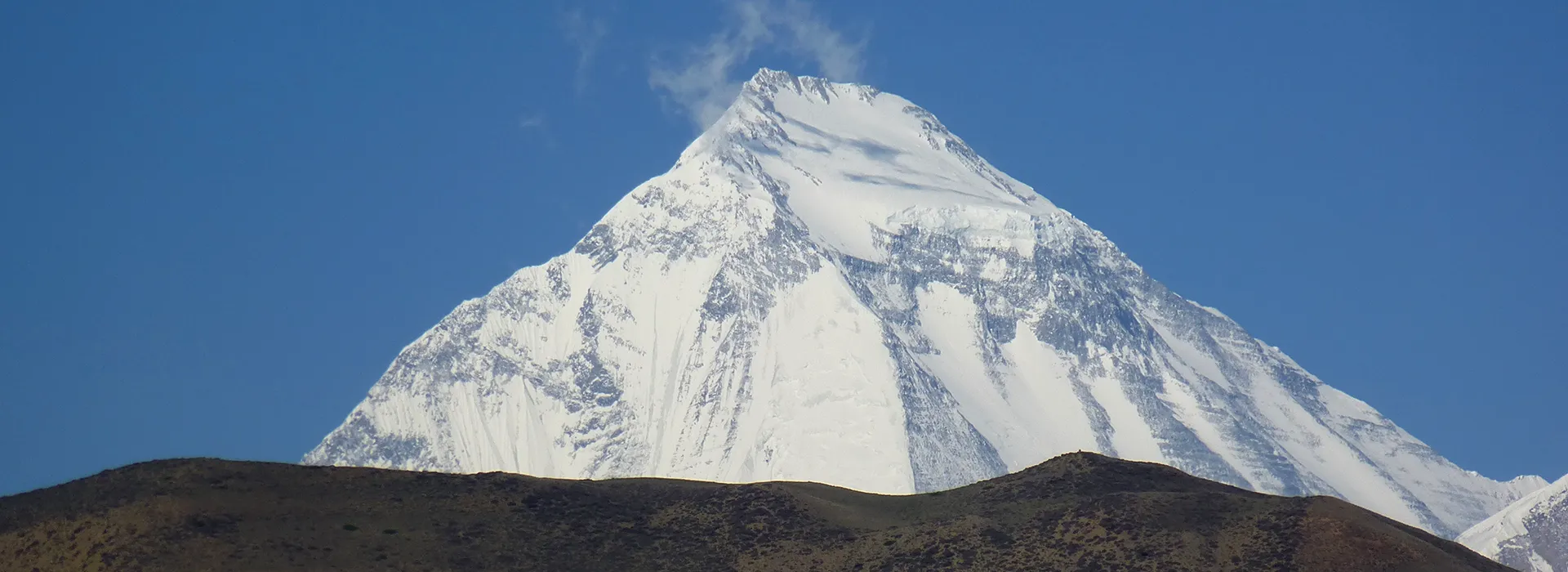
Our 15-day journey of the Dhaulagiri circuit trek leads you through a very remote region of the western section of Nepal, amidst the well-known Annapurna circuit and the isolated Dolpo region. This tour will take you around the White Mountain better known to the World as the seventh tallest Himalayan Peak of the planet: the mighty Dhaulagiri that stands at 8167 m above sea level.
Always accompanied by this impressive elevation, you will climb through all of Nepal’s vegetation zones into the complete solitude of the Dhaulagiri group. From banana and citrus trees, through jungle, past high alpine pastures to high mountain terrains, more variety is hardly possible.
However, the queen stage of our Dhaulagiri circuit trek involves the crossing of one of the highest unglaciated passes in Nepal, the Dhampus Pass (5,200 m). Then, comes the King stage when we will set foot at the Dhaulagiri Base Camp and overcome the mighty French Pass at 5360 m while descending to the secret gem of Hidden Valley.
Prepare to be astonished by the breathtaking views of Dhaulagiri mountain range, Gurja Himal, SitaChuchura,ManapathiPeak,Chhonbarban Glacier, Tukuche Peak, Thapa Peak, Mukut Himal, Tashi Kang Peak, and numerous other majestic peaks.
Then, the forward journey will take you past many other famous peaks into the enchanting Kali Gandaki Valley of Jomsom where you return to civilization.
Additionally, our Dhaulagiri circuit trek offers you the opportunity to experience the wild nature of the high mountains and meet only a few people who live isolated from the rest of the world according to their old traditions. Ethnic groups such as the Gurung, Chhetri, and Magar live in this northwestern region of Nepal. We will hike through their simple, original villages and see herds of yaks and sheep.
In these small towns, the absence of lodges and Buddhist icons, so common in other areas, will make us perceive a feeling of remoteness and isolation, making it ideal for those looking for an intense and prolonged experience.
If you want to experience Nepal in all its facets, then don’t miss out on this wonderful trek. Right now is the best time to undertake our Dhaulagiri Circuit trek. If this timing doesn’t work for you, consider the upcoming autumn season as another favorable option. Remember to book your tour in advance to secure your seats and avoid missing out on this fantastic opportunity.
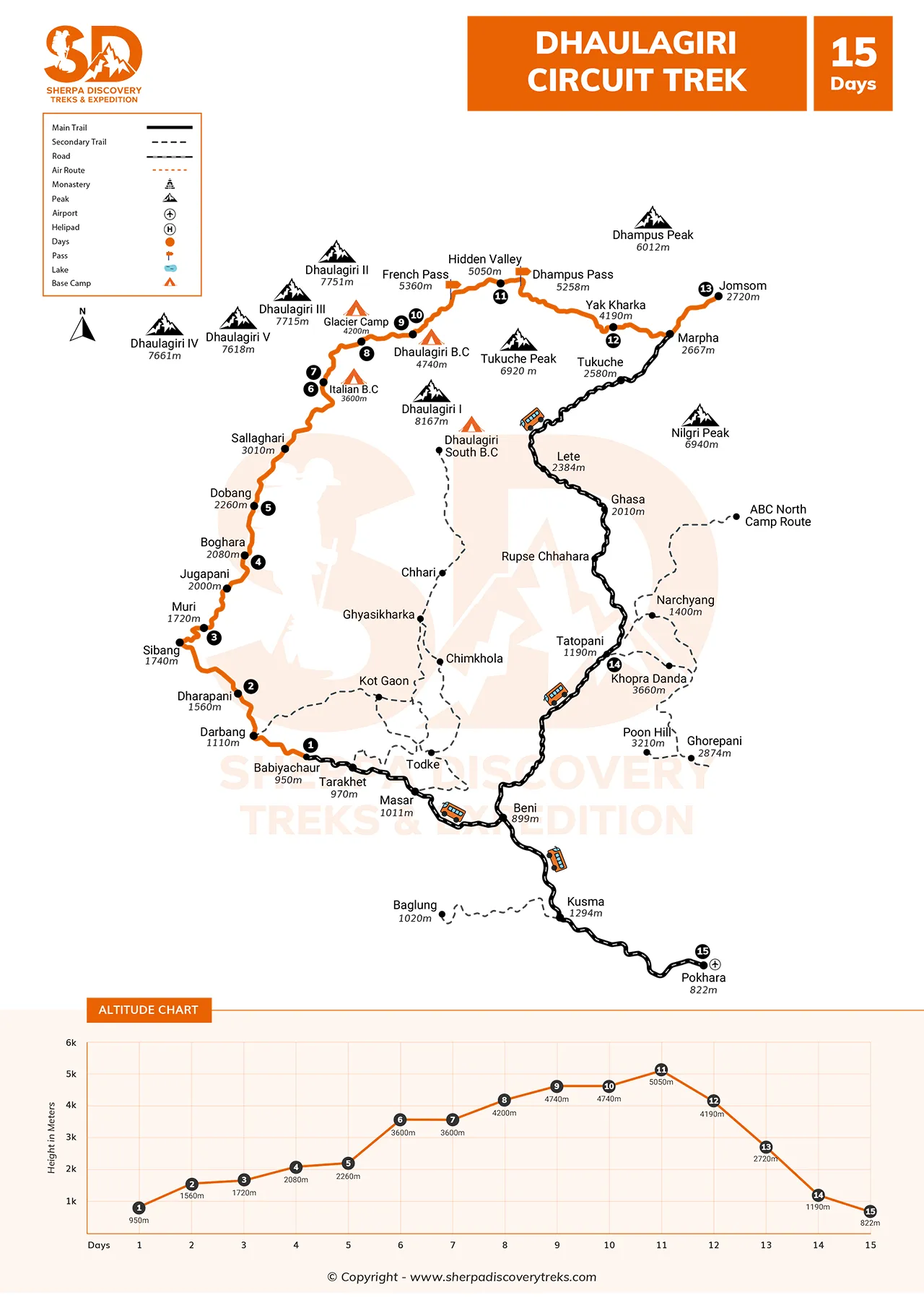
Our Dhaulagiri circuit trek starts with a drive from Pokhara to Beni and then Babiachaur. Then the trek begins through a steep high-altitude trail taking us through the quaint villages of Dharapani, Muri, Boghara, and Dobang. These hiking days will follow the Myagdi Khola River leading us to the Chhonbarban Glacier, at the foot of Dhaulagiri.
The landscape now changes from manicured farmland to barren, often snow-capped rocky mountains, all with views of Dhaulagiri and other Himalayan giants ahead. As we ascend to Italian Base Camp and Glacier Camp, the predominantly Magar villages become smaller, until the final days are spent walking in areas without permanent settlements.
After a rest day at Dhaulagiri Base Camp, we will climb the glacier slope, cross the French Pass (5,360m) and enter Hidden Valley. Then, we will continue over the Dhampus Pass and descend to Jomsom, the gateway to Mustang. From Jomsom, we will return to Pokhara via Tatopani.

After a luxury breakfast in Pokhara amidst the breathtaking mountain spectacle, we will now get ready to drive along the winding road to our destination village of Babiachaur.
The long road passes through the green valley and spectacular agricultural areas parallel to the Myagdi River. After about 4 hours of driving, we will reach the small village settlement of Beni where we will stop to eat our lunch. This small village is situated at the confluence of two mighty rivers: the Kali Gandaki and Myagdi.
After enjoying our lunch, we will resume our drive passing several small yet beautiful villages of Beni Mangalghat, Singa, and Tatopani. The path then takes us to Babiachaur past one more settlement of Simalchaur.


We will leave Babiachaur after breakfast and officially begin our trek to the Dhaulagiri Circuit. Initially, a flat trail through rice terraces will take us to Dabang in approximately three hours. At Dabang, there is a police checkpoint where our permits will be verified.
Continuing our journey with a gentle hike along the Myagdi Khola, we will arrive at Shahashradhara from where we will cross a hanging bridge over the Duk river to arrive at Ratorunga.
Now a gentle uphill walk from here will finally take us to Dharapani where we will spend a comfortable night with delicious dinner. Enjoy the amazing spectacle of Churen Himal, Dhaulagiri I, III.
After departing from Dharapani, we will ascend slowly, through rice field terraces to the large village of Takam (1670 meters) and then to Sibang. Take a break and observe the breathtaking spectacle of Dhaulagiri and Gurja Himal.
Resuming our walk, we will now traverse the small town of Mattim and descend to Gattikhola. The path now moves to Phalai Gaon and Dharakhola from where it becomes narrower, gaining height over the Myagdi River that falls vertically at the bottom of the gorge.
After crossing the suspension bridge, we will now gently climb to Muri a community village of Magars the ethnic tribe. It is a relatively large village with excellent camping sites and, weather permitting, superb views over the Gurja Himal and the Dhaulagiris III and IV.
Our day begins with a dizzying descent to the river through terraced fields. We will then cross a bridge after which a steep climb to the ridge begins. We will continue ascending for approximately an hour to the top of the beautiful Pass at 1607 m. The pass offers us the remarkable sight of Mt. Ghustung South.
We will now descend through rugged terrain and dense jungle past the settlements of Mahatala and Naura. After about an hour, we will arrive at the village of Boghara. This village will be the last populated place that we will find until the end of the trek. The entire Dhaulagiri range will be visible from the village along with the beautiful Manapathi Peak.
From Boghara, we will hike through corn fields before ascending a steep slope to the ridge. From here the path becomes a gentle uphill slope. This will be the norm throughout the Dhaulagiri circuit trek: continuous ups and downs through very exposed terrain.
Moving onward, we will climb the stone steps carved into the rock to reach Lipse. We will then continue walking through a thick mountain jungle, gently uphill, to Dobhan. It is a fairly large clearing in the forest with two cabins and a large area for tents.
If we don’t find space in the cabin, we will set up the tent and spend the night.
From this day, the real adventure begins. Past Dobhan, we will walk along the Myagdi Khola. After a steep descent to the bottom of the gorge, we will cross it over a precarious bridge and ascend, along a steep slope, through bamboo forests.
We will then cross two landslide-prone areas and reach Sallaghari. We will then ascend through the thick forest for a while. Then we will hike across the glacier terminal watching the impressive views of Tukuche and Dhaulagiri I.
Now a final climb along the slippery route will deposit us at the Italian Base Camp located on the line where the vegetation disappears due to the altitude.
Today’s rest day is best used for an acclimatization hike to get used to the high altitude. The surrounding alpine pastures offer plenty of options for this. After a long breakfast with the massive Dhaulagiri up front, we will explore the Italian Base Camp and hike to the small ridge.
From the ridge, we can observe the mighty western slope of Dhaulagiri. If we are fortunate enough, blue sheep may come along to greet us.
We leave the Italian Base Camp early and climb up to the Glacier Camp. The path there leads along a path to the moraine of the former glacier tongue, which is now a dead ice cauldron. The path goes steeply down the moraine on the other side, through the cauldron, and on the other side over grass mats and scree up to the Swiss Base Camp (3,750m).
Now we enter the increasingly narrow Chhonbarban Glacier Gorge, above which the walls rise almost 4,000 meters high. After the narrow corridor widens again, we reach the glacier of the same name, on which the Japanese Base Camp (4,150m) is also located. A stone’s throw higher is our overnight camp, the Glacier Camp in the middle of the rubble-strewn glacier.
After setting up our tents, we will now relax in between the massive giants of Dhaulagiri II (7751 m), Dhaulagiri III (7715 m), Dhaulagiri IV (7661 m), and Dhaulagiri V (7618 m), and Sita Chuchura (6611 m).
Day on the snow and ice of the glacier. Today we have a spectacular route in which we have to zigzag to avoid ice cracks and small pools of frozen water. Once we overcome this stretch, we will climb over the wide Chhonbarban Glacier on a completely snow-covered path, making the progression quite easy.
Soon we will find the moraine through which we slowly ascend to Base Camp. Although there may be some garbage on the ground from the expeditions that frequent the area, at the heights the scenery is impressive. Watch the massive rise of Dhaulagiri I (8,167m) and Tukuche Peak (6,920 m) in front of you.
Acclimatization day. Under the enormous northern wall of Dhaulagiri, we will spend the day exploring the base camp of the 7th tallest mountain on the planet. With a bit of luck, we may meet expedition teams heading to conquer the summit and talk to them about their experiences.
On this day we will walk for many hours at high altitudes. We will ascend the Chhonbarban Glacier, turn left, and climb, almost vertically, to a small hill. After a few hours, we turn towards the west and slowly climb to the French pass (5,360 m) which is also the highest elevation of our entire Dhaulagiri circuit trek.
We can see the Hidden Valley to the northeast and so are several peaks such as Mukut Himal, Tukuche Peak, Tashi Kang Peak, Mukut Himal, Sita Chuchure, Mount Dhaulagiri range, and Dhampus or Thapa Peak.
After a photo stop at the top of the pass, we will now cross the picturesque Hidden Valley to the Hidden Valley Camp.
After breakfast in the treasure of the Hidden Valley, we will now ascend along a gentle path to the Dhampus Pass. The Pass blesses us with the incredible panorama of the Annapurna range, Dhampus Peak, and Tukuche Peak.
After admiring the views, we will now gradually descend to the pastures of Yak Kharka. With a little luck, you might spot snow leopard tracks.
A very picturesque path awaits us today with the impressive mountain views of Dhaulagiri to the southwest, the Annapurna and the Nilgiri to the east, the Kingdom of Mustang in the distance to the north, and the deep valley of the Kali Gandaki under our gaze.
The path will take us down sharply again to Marpha (2,670 m). A final stretch of track will continue, without ups and downs, to the populous town of Jomsom where we will dine and rest comfortably for the night.
Our trekking day draws to an end as we drive next to the Kali Gandaki River, following the winding trail through the forest towards Tatopani. Upon arrival, we will treat ourselves to a relaxing natural hot water bath, a well-earned reward after many days on foot.
After our breakfast, we will once again board our bus and commence our drive along the captivating Kali Gandaki River. After approximately three hours, we will arrive at the town of Beni, where we will take some time to explore this little town.
Then, we will make our way back to Pokhara, traversing a scenic trail that displays the picturesque rural landscape of Nepal.



We recommend the Dhaulagiri circuit trek in autumn from September to November as these months offer the most stable weather conditions in the Dhaulagiri region reducing the weather-related risks.
The dry autumn weather increases the likelihood of experiencing a stunning day while trekking, offering unobstructed views of both well-known Himalayan peaks and lesser-known ones. As winter snow melts, paths to base camps and mountain passes become clear.
The spring months of March, April, and May are also ideal, with lush forests and active wildlife. However, during June, July, and August, the isolated Dhaulagiri region receives double the average annual rainfall of the country making it unfavorable to trek in summer. The winter period from December to February, blankets the entire region in thick layers of snow. Therefore, caution must be exercised when traversing the trail towards the high mountain summits, as the heavy snowfall can pose risks.
Our 15-day Dhaulagiri circuit trek is an unforgettable expedition that will take you to the foot of the massive peak of Dhaulagiri known to the world s the seventh tallest peak on the planet. The peak towers at an altitude of 8167 m above sea level.
Throughout this trekking journey, the highest point of our ascent will be at French Pass which stands tall at 5360 m above sea level. Our journey commences from the small town of Beni which is located 303 km west of the vibrant Nepal capital Kathmandu.
The Dhaulagiri Circuit Trek spans over 180 km that takes at least two weeks to complete the journey on foot. Over the course of 15 days, each day, we will cover an average distance of 16 km.
The Dhaulagiri circuit trek, which takes 15 days to complete, involves 10 days of actual hiking. During this trek, there are two days set aside for acclimatization at Italian Base Camp and Dhaulagiri Base Camp. Throughout the 10-day journey, you will be required to walk for an average of 5 to 7 hours each day.
However, when it comes to trekking, the route to Dhaulagiri is often seen as more challenging than the trails leading to Everest or Annapurna. The hiking journey involves crossing multiple steel and wooden bridges, as well as streams, with numerous ups and downs that can be sometimes steep and sometimes gentle, affecting the duration of daily walks.
During our trek, the most delightful and easiest day will be on the 13th day when we make our way from Yak Kharka to Jomsom. The picturesque path adds to the enjoyment of our descent. However, the 11th day will be the most strenuous as we tackle the French Pass and descend into Hidden Valley walking 7 to 8 hours on this day.
The Dhaulagiri Circuit is undoubtedly the toughest trek in Nepal suitable for trekkers with previous experience of trekking at altitudes above 5,000 m. Multiple days have to be spent trekking on snow with overnight stays inside tents.
In addition, trekkers have to deal with demanding long day hikes through humid jungles and glaciers. There are exposed sections with a risk of falling in slippery terrain. The precarious bridges over some streams and some torrents that can be dangerous after heavy rain. There are areas with poor visibility like the Hidden Valley or the Chhonbarban Glacier where it is easy to get lost.
The other risk the Dhaulagiri Circuit trek presents is the risk of altitude sickness. Thus, we designed our tour with a gradual, slow ascent, which enables acclimatization. To make the trekking days more bearable, we have planned two acclimatization days at Italian Base Camp and Dhaulagiri Base Camp.
However, it still is a high-altitude trek with relatively low temperatures all year round at Italian Base Camp, Dhaulagiri Base Camp, and the mountain Passes of French Pass and Dhampus Pass. Adding to the difficulty is the overnight stay in tents during the trek. Unlike at Everest and Annapurna, there will be no cozy shelters along the route where we can at least spend a warm night.
The Dhaulagiri Circuit trek is specifically designed for experienced trekkers who have already visited Nepal. It offers great rewards to those who are well-acquainted with high-altitude trekking. However, it is not recommended for beginners due to various challenging factors. These include the high altitude, remote location, camping trail, steep inclines and declines on glacial terrain, and the absence of adequate shelters along the route.
Additionally, the trek involves crossing two high mountain passes where the use of crampons and ice axes may be required. Therefore, we recommend starting with either the Everest Base Camp or the Annapurna trek to gain the required skills before taking on the Dhaulagiri Circuit trek.
If you are considering the Dhaulagiri circuit trek, you should be aware that it is best suited for individuals with an active lifestyle, as the journey involves challenging terrain, remote locations, camping accommodations, and unpredictable weather conditions.
To prepare for this trek, therefore, we advise you to engage in physical and mental training. Activities such as jogging, walking, running, squatting, push-ups, pull-ups, and light backpack hiking can help build the required endurance.
We also recommend you start your trekking journey with simpler treks like the Everest base camp trek, Ghorepani trek, or Annapurna trek to gain the necessary experience before attempting the Dhaulagiri circuit trek.
If our itinerary seems very long and arduous to you, then we also present a second option for the Dhaulagiri circuit trek. In this second approach, your starting point will be Beni of course but then from Beni, you will hike through the old-fashioned villages of Ghyasikharka, Phedi Camp, and Odar Camp. The route further will then lead you to the Dhaulagiri South Base Camp eliminating the demanding crossing of high mountain passes.
For those who also wish to gain some climbing experience, you can also integrate Dhampus climbing into the program. Before descending to Yak Kharka from Hidden Valley, you can go on to climb the summit of Dhampus or Thapa Peak at 6012 m.
The Dhaulagiri circuit trek will take you to some impressive heights above 5000 m therefore altitude sickness during the trek is common. Although our tour is planned in such a way that we do not climb a higher level than recommended in one day, some members may experience the symptoms of altitude sickness. Please note that altitude sickness can occur regardless of gender, age, or fitness level.
The symptoms of altitude sickness differ from individual to individual, some people detect it much earlier, and in some do not appear at all. Symptoms include headache, feeling tired, nausea, dizziness, rapid breathing, rapid pulse, and loss of appetite. It can be prevented and treated with adequate rest, food, and acclimatization. Additionally, to help remove the symptoms within a few hours, you can take Diamox and if you are feeling only mild headache, then Ibuprofen can help.
Please inform our guide about your condition who may postpone your trip for one or two days and take you to a lower altitude where you can feel comfortable.
As part of our Dhaulagiri circuit trek, we offer comfortable standard or deluxe rooms in Pokhara for twin or double sharing, complete with breakfast. During the trek, your accommodation will be in mountain lodges along the route, where you will share rooms with fellow travelers of the same gender.
During the entire trekking journey, our kitchen crew will accompany you who will take care of tent setups at the camps whenever required. Our porter will be responsible for carrying all the essential kitchen utensils, equipment, and tents.
Breakfast is provided for free while staying in Pokhara. Lunch and dinner are not included as there are various dining choices available in the city. Throughout the trek, breakfast, lunch, and dinner will be offered in the mountain shelters. The food options can be limited to Dal Vat Tarkari, noodle soup, spaghetti, fried rice, etc. During camping, our kitchen staff will prepare breakfast, lunch, and dinner.
Regarding transportation arrangements, we have arranged for a private transfer from Pokhara to Beni and Babiachaur. On our way back, we will utilize a public bus to reach Tatopani, and then proceed to return to Pokhara via another private transfer.
The Dhaulagiri circuit trek is an extraordinary trekking journey in some of the unique settings of Nepal. The trekking route lacks the basic infrastructure that supports the development of Western tourism so please do not expect flawless communication, gadget charging, and WIFI connection along the route.
However, the local NCELL and NTC mobile networks have expanded their coverage to include most villages in Nepal. Till the village of Boghara, you may have good mobile networks that will also allow you to use the internet data packages. But as you ascend to the high-altitude camps, the networks may not be accessible. We do provide satellite phones for emergency situations.
As for WIFI, the mountain shelters in the area do offer WIFI or internet services, but it is important to note that the prices can be considerably higher. And the connections may not always be reliable. You can also charge your gadgets in the lodges using the basic adapter which can cost you an additional fee for the service.
At the camps, however, the service may not be available so we recommend you carry extra batteries and charge your power banks full when available.
The Trekkers’ Information Management System fees (TIMS) and Annapurna Conservation Area Permit (ACAP) are mandatory for our Dhaulagiri circuit trek. Our guide will acquire these permits for you, and the service cost is already covered in our package.
We advise you to take insurance in advance that includes the additional option of Sports and active recreation. Since most of the routes in the Dhaulagiri circuit trek are at high altitudes, you need to select the Mountain Trekking option in your insurance (it should be valid from an altitude of 1,500 m to above 5000 m).
Yes, you can buy or rent the necessary gear and equipment either in Kathmandu or Pokhara. Please consult our guide who will assist you with purchasing or renting equipment at a cheap price.
No, we will provide you with tents for camping adventures in the base camps. Our porter will carry these tents and our crew will put up the tent for you.
If your family members are healthy, suffer from no chronic ailments, and have had the experience of high-altitude trekking in Nepal, then yes they can.
Yes, you can climb the Thapa or Dhampus Peak or you can stay for a few more days in Pokhara.

Need help?
Talk to trip expert