English
 Dutch
Dutch Japanese
 Hindi
Hindi Italian
 Spanish
 French
 German
 Chinese
 Korean
 Arabic
 Hebrew
 Russian
 Portuguese
 Danish
 Czech
Czech Polish
 Swedish
Need help?
 +977 9767994912


Trip Duration
14 Days
Trip Difficulty
Moderate
Max. Altitude
5,364m / 17,598ft.
Activity
Trekking
Destination
Nepal
Group Size
1-16 Pax
Accommodation
3 star Hotel
Meals
Breakfast, Lunch, Dinner
US$ 1350
We offer group discounts
Total Cost:
US$ 1400

Need help?
Talk to trip expert
Lets face it, the road to conquer Everest is not for everybody as it is journey where many threats and danger always lurks. Although the summit of Everest may seem very distant, you can always take our Everest Base Camp trek 14 days adventure- a journey that will let you gaze upon the magnificent Everest peak up close.
With our Everest Base Camp trek, you will get to traverse the beautiful terrain of Nepal for 14 days, starting from the mountain’s base and making your way to the iconic Base Camp of Everest itself.
This camp is forever linked to the remarkable expedition of Edmund Hilary and Tenzing Norgay in 1953. Since then, this legendary campsite has become a part of various history making moments and has become a pilgrimage for climbers and trekkers like Mandy Moore, Bear Grylls, and Mike Posner.
The Everest Base Camp lies in the heart of the beautiful National Park of Sagarmatha of the Khumbu Valley in eastern corner of Nepal at the towering altitude of 5364 m. And right next to it is the impressive black walls of Kala Patthar that rises to 5644 m elevation above sea level.
Our Everest Base Camp trek 14 days journey aims to not only guide you to these two extraordinary locations but also to immerse you in the rich Sherpa culture along with the breathtaking natural beauty of the Khumbu region.
Your EBC trek will begin with an exciting mountain flight to Lukla. From this point, you will start your trek into the stunning Dudh Koshi Valley. When at Namche, you will be able to appreciate its beauty along with the remarkable opportunity to eat lunch at the highest luxury hotel in the world.
After this, your Everest trekking journey will take you to the Imja Khola Valley, where you will explore the largest Tengboche Monastery and gain a deeper understanding of the ancient Buddhist culture of the resilient Sherpa people, who make every mountain adventure in Nepal possible.
Once you are in Dingboche, you will have the chance to climb the 5083-meter-high Nagarjun Ridge, adding another achievement to your adventure.
Then your Everest base camp trek adventure will lead you to the high glacial settlement of Lobuche. Traversing the magnificent Khumbu Glacier, you will journey to Gorakshep which is recognized as one of the highest settlements of the world.
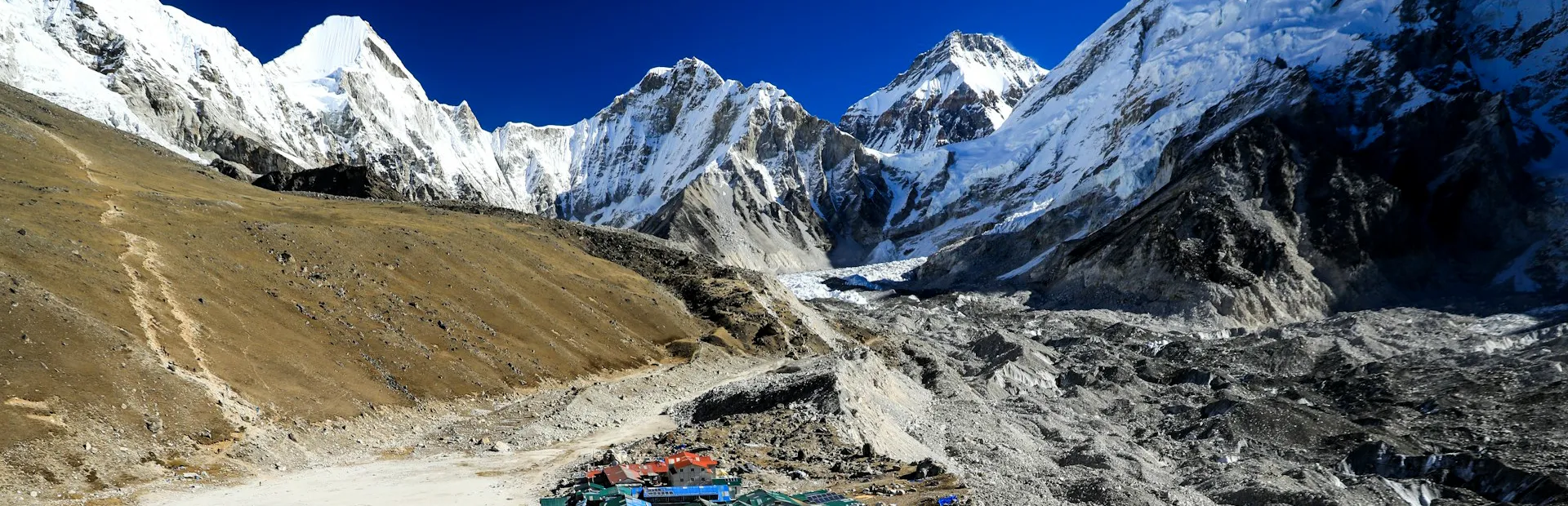
Now, the momentous time of your Everest Base Camp 14 days journey has arrived as you finally find yourself standing at the stunning Everest Base Camp Trek. Here, you can admire the beauty of the ever-present Khumbu Icefall, as well as the impressive peaks of Nuptse, Khumbutse, and Lhotse.
However, the true highlight awaits you the next day when you ascend the formidable Kala Patthar. Get ready to be awestruck by the grandeur presence of Everest itself.
In addition, the stunning close profiles of Makalu (8485 m), Cholatse (6440 m), Pumori (7161 m), Taboche (6495 m), Lhotse (8516 m), Thamserku (6608 m), Baruntse (7162 m), Ama Dablam (6812 m), Island (6165 m), Khumbutse (6639 m), Lingtren (6749 m), Changtse (7543 m), Lobuche (6119 m), and Nuptse (7861 m) will also capture your attention.
After capturing these unforgettable moments with the eternal icy walls, you will retrace your feet along the same circular route back to Kathmandu.
The allure of the Everest Base Camp trek 14 days journey is its welcoming nature that accommodates all individuals of any experience levels; even those who are inexperienced in trekking provided they have an excellent level of physical fitness.This expedition is ideally suited for the transitional seasons of spring and autumn.
So are you ready to experience the most unforgettable travel adventure of your life? If so, reserve your place on our Everest Base Camp trek, and together we will stand at the base of the highest point on Earth.

Hello and welcome to the mesmerizing land of Sagarmatha (Everest). As soon as you get out of the exit door of TIA, you will find our enthusiastic staff waiting to receive you with open arms.
He will assist you with the loading of your baggage, then will take you to your assigned lodging located in the bustling tourist hub of the city.
Please take your time to briefly recover from the long exhausting flight. Once all the trekkers of our Everest Base Camp trek 14 days journey are in the capital, our guide will offer a quick orientation about our Everest Base Trek 14 days itinerary.
He will also lend a hand in reviewing your gear and acquiring missing one at a very reasonable price. If time is still on your hand, you can explore the historic lanes of Kathmandu Durbar Square for a while.
In the evening, treat yourself with the delightful cultural Nepali meal specially the tasty momos. We suggest you an early bedtime to prepare for our early morning departure to Lukla.
During the unfavorable or poor climatic condition and during the heightened air traffic in autumn and spring, the Nepal Aviation authorities often reroute the Lukla flights operating from Kathmandu to the airport of Manthali in Ramechhap district.
In such time, we may need to leave for Ramechhap around midnight and take the road journey spanning around 4 to 5 hours to reach the Airport. We will facilitate your journey with a private transfer and we also request you to land in Kathmandu as early as possible.


Our adventure of the EBC trek initiates with the stunning morning flight over Everest, Makalu, Kanchenjunga, and Langtang landing us at the most exciting and unusual airstrip of the world- the Tenzing Hilary Airport of Lukla.
Here, we will meet and get to know the local Sherpa group that will accompany us on the journey. With a direct view of 6187 m Kongde Ri, we will proceed with our gentle and romantic route along the Dudh Koshi River.
Soon, we will meet the local authorities at the small checkpost who will review our permits. Then, we will resume our downstream walk towards the Sherpa hamlets of Chheplung, Chaurikharka, and Thadokoshi.
6367 m high Kusum Kanguru will be directly in our sight then as we advance our feet towards Ghat. Phakding will soon arrive with sacred Khumbila (5761 m) upfront. Here, we will spend the first exciting mountain night beneath the Everest.

Continuing with our Everest trekking journey, we will one more time start to hike beside Dudh Koshi which will soon lead us to a solidly built suspension bridge.
The characteristic up-and-down moving trail will direct us to Benkar and then to Monjo. Now, we are properly inside the renowned Everest National Park.
The majestic spectrum of Thamserku (6608 m) will delight our eyes as we start to advance upward to Jorsale. We will now have to put up an effort to climb the rising forest path that will lead us to the 60 m-long Hilary Steel Bridge.
Down below, the Dudh Koshi gracefully meets the Bhote Koshi. The holy Taboche Peak (6495 m) will be present to heighten our excitement.
Now a steady climb will take us to Top Danda from where the last very sharp stretch of around 300 m will finally take us to Namche- the largest and one of the most striking Himalayan towns to see Nuptse (7861 m), Everest (8848 m), Kongde Ri, and Lhotse (8516 m).
Today, we will have altitude acclimatization for the Everest Base Camp Trek. We will be adapting to the altitude and air by hiking or walking around to learn about the culture of the land.
We will have a very special experience as we hike upstream towards Khumjung Village and discover the lively atmosphere of its local Gumba (Monastery) along with the incredible chance to see the real Yeti scalp.
On our way down, we will definitely stop by the 3880 m Everest View Hotel. This Japanese built luxurious hotel is the tallest in the world and offer the magnetic views of Everest in the distance, along with Lhotse, Thamserku, Ama Dablam, Nuptse, and many other peaks.
By the end of the day, we will once again be relaxing in the Namche town.
We will gently trek along the side of the ridge for a while gradually making or way towards the Valley of beautiful Imja Khola. Now a short but thrilling crossing over the hanging bridge will lead us to the vertically climbing trail.
We will soon find ourselves atop the 3250 m high Phungi Thenga. We will take a brief break from our climb here and immerse ourselves in the stunning scenery.
It’s now time to drive ourselves for two more hours through the beautifully framed rhododendron jungle to reach the flat high grounds of the largest Tengboche Monastery.
The magnificent large Buddha statue, stupas, and intricate wall paintings will be something to feat our eyes on. On the other hand, the magnetic profiles of Lhotse, Ama Dablam, Nuptse, and Everest is another attraction here.
A moment later, we will now settle down for a restful night at a nearby lodge.
From Tengboche, the gently rising path will take us to Deboche. We now have to be ready for the steepening trail as we near the suspended bridge that crosses the Imja Khola.
After traversing this bridge, the ever climbing trail will first take us to the 3900 m high village of Pangboche- another remarkable Sherpa hamlet with stunning monastery with Yeti scalp.
We will start to notice the gradual transformation of the terrain from now on. The rich forest tapestry give way to the barren alpine desert like landscape which is beautiful in itself.
Advancing further inside the valley of Imja Khola, we will met by Lobuche River which will show us our way towards Dingboche known for the potato farming and of course the wonderful display of Ama Dablam (6812 m) and Island Peak (6165 m).
One more day to facilitate our adjustment to the higher altitude of Dingboche. We can either rest of at the village and just explore the surrounding or we can choose to conquer the 5083 m Nagarjung ridge or Nangkartshang peak.
The trek towards this ridge is not complicated and long; and within two to three hours, we will already be at its top witnessing the marvelously close and detailed features of Makalu, Ama Dablam, Lobuche Peak, Thamserku, Baruntse, Cholatse, Island Peak, Taboche, Nirukhang, Chopola, and Khankaru.
After fully appreciating the magnificent sights, we will return to our shelter for some much-needed relaxation.
From Dingboche, we will start to see the extensive glacial valleys in the distance. Absorbing the view, we will make our way over the rocky terrain and progress towards Dughla Village (4500 m) via the Dusa pasture.
Now, a demanding steepening trail will lead us for about an hour finally settling us atop Dughla Pass (4830 m). The mass of lungtas and some erected stone structures here remind us of the climbers who have tragically lost their bodies on Everest.
We will honor their memory and take a moment to capture our senses with the remarkable views of Lobuche and its base camp along with Cholatse (6335 m) and Taboche (6367 m). Be prepared to walk upward along the ridge of the Khumbu Glacier till we are at Lobuche.
Pumori (7161 m) and Lobuche dominate the sky here with the relatively thin air that will quickly exhaust us so we will retire to our beds as soon as possible.
This day will test our strength and resilience. From Lobuche, we will resume to climb the side icy and glacial walls of Khumbu Glacier. Here we can see ice ponds and icebergs drifting down below the Glacier.
The path will now sharply steepen as we near the Thangma Riju Pass or Lobuche Pass. Pumori, Khumbutse, Nuptse, and Mahalangur range along with Everest can be seen amicably from here.
Next, a straight vertical ascent along the Changri Glacier awaits us as we near Gorakshep. This is a very sandy and desolate area with few shelters for the trekkers of the Everest Base Camp trek.
We will stop for lunch at Gorakshep and then continue climbing towards the Everest Base Camp. The trail for 3 to 4 hours sharply rise towards the ridge of the glacier until we are the Everest Base Camp itself.
Its beauty touches the heart as all around us will be the eternal Himalayas of Lhotse, Khumbutse, Nuptse, and Pumori along with the very old sharp Khumbu Icefall.
Unlike to the belief, Everest will be not be in front of our eyes here. After taking pictures and admiring the beautiful scenery of Everest Base Camp, we will take our tired feet back to Gorakhshep to spend the night.
Finally, the highlight and the highest day of our Everest Base Camp 14 days journey has arrived. Awaken by the alarm set at 3 am, we with our group will set on to climb the iconic Black walls of Kala Patthar.
The climb though not technically challenging, demands effort due to its steep incline, taking about 1 to 2 hours. Here we are atop Kala Patthar, where the majestic theatrical show of the sparkling Peaks of Khumbutse, Amadablam, Lingtren, Pumori, Changtse, Lobuche, Lhotse, Nuptse will be in front of our eyes.
But Everest will certainly steal the highlight with its grandeur and beauty. After some beautiful admirable moments with these giants, we will now take our feet back to Gorakshep. After a hot meal, we will now walk back down towards Lobuche, Dughla Pass and Dughla to reach Pheriche.
We are back in the vibrant jungle atmosphere once again.
From now on, we will have gentle downhill path which will help us walk longer and is much less tiring than climbing up. Following the old road up, we will walk back inside Dudh Koshi Valley and pass through small Sherpa villages of Pangboche, Deboche, Tengboche, and Phungi Thenga to reach Namche.
Today is the last day of our Everest trekking journey in the Himalayas. The road is mainly downhill so we will not lose much energy today to reach Lukla.
The scenery is as rich as the first day we set foot here meandering us back through Jorsale, Monjo, Benkar, Phakding, Thadokoshi, Chheplung, and Chaurikharka towards Lukla.
Based on the arrangements by the authorities, we will either head back to Manthali or Kathmandu. In case of Manthali flight, our private transport will be there to travel us back to Kathmandu.
Now, your tour guide will take a leave and our company representative will give you a farewell dinner and a trip completion certificate set about the journey to conquer Everest Base Camp trek.
Your EBC trek adventure has come to an end, and now you will leave the breathtaking beauty of Nepal, and head towards TIA for your return home. We are confident we have served you well and you will keep us in your memory for the next trip to Nepal.


If you like to make the most of your Everest Base Camp trek 14 days journey, then you must select the best period that will not only offer you stunning scenery but also a more enjoyable trekking experience, free from harsh weather.
One such ideal season is the fall or autumn period beginning from September month and lasting till November days. During this time, you can experience a delightfully mild climate with stunningly clear skies. The daytime heat hovers around 6 to 22°C, but nights can be quite cold, dropping to between 2 and -5°C.
Another beautifully pleasant time will be spring commencing from March and lasting till May. The landscape of the Everest National Park is covered with a riot of colors and heat will be comfortable around 14°C to -10°C.
The summer months commencing from June and ending till August shower the Khumbu with heavy rain heightening the risk of landslides and avalanches.
The winter months starting from December and continuing till February bring in the coldest heat in Khumbu which can dip to -5°C enveloping the region in the thick white blanket of snow. So this season is reserved for only experienced hikers.
The Everest Base Camp trek is an exhilarating adventure that offers a medium level of challenge to its enthusiastic hikers. This circular trek spans 130 km beginning and concluding in Lukla.
The trek’s highest elevation will be at Kala Patthar and the maximum overnight sleep will be at Gorakshep. The 14 days journey includes an 11-day walking segment that consists of 5 to 6 hours of hiking experience every day on average.
The trail throughout is devoid of any technical demands so no special gear is essential. The well-signposted route also elevates the easiness of the journey.
However, there are high alpine rocky and slippery glacial paths to be overcome. In addition, some days will be more arduous than others especially the trekking part towards Namche and towards Everest Base Camp Trek itself.
However, the prime threat will come from the fluctuating elevation. You will find yourself over 4000 m most of the trekking days and the thin air of the region can tire you fast. Therefore, the risk of acute mountain sickness makes this journey slightly difficult for the new hikers.
The Everest trekking journey is a journey of respect but it is also not overly difficult for those who are willing to take it on. With a mediocre challenge, the absence of technical demands, the well-built and signposted route, and the availability of flights and accommodations make this trip ideal for first-time visitors to Nepal.
However, you must have a very good and optimum fitness, health, and mental fortitude to be a part of our Everest Base Camp trek 14 days journey.
We like to reinforce that the adventure of the Everest Base Camp trek is open to everyone, from teenagers to the elderly. However, individuals with existing health problems related to the heart, lungs, or kidneys must see their doctors before taking on this journey.
The Everest Base Camp trek takes place along the alpine path at high elevations where the threat of acute mountain sickness (AMS) or altitude sickness looms as you keep on climbing and gaining elevation.
This condition doesn’t see age, sex, fitness, body type, or experience. In fact, it can strike anyone at any time of the journey. The most common manifestation includes disrupted sleep pattern, nausea, headache, breathlessness, and tiredness.
However, if you acclimatize well to the dry air of the Khumbu Valley, you may avoid acute mountain sickness altogether. To aid in your adjustment, we have set aside a day off in Namche and another in Dingboche, where you will engage in short acclimatization walks.
This strategy will allow you to gain altitude while sleeping at lower elevations, a fundamental rule of proper acclimatization. Additionally, as a responsible hiker, you must keep yourself hydrated frequently during trekking.
So aim for 3-4 liters of plain or electrolyte-rich water a day and maintain a gradual pace. In the high environment of the alpine heights, rushing can be very harmful to your body.
You may reach your overnight village earlier but it can leave you too fatigued to continue the next day. Our guide has a good knowledge and training in tackling the AMS so you must inform him as soon as you notice to feel any type of bodily discomforts.
You can also take the diuretic drug called Diamox starting from Kathmandu which will help you adapt quickly to the high air.
You don’t need to be an athlete to take part in our Everest Base Camp 14 days journey but preparing your body and mind is essential. You should certainly begin preparing yourself a month in advance, rather than waiting until the last minute.
You should focus on activities that mirror the conditions of the high trek such as stair climbing in tall buildings and hiking in hilly areas. If you are a walking or jogging person, then prioritize inclines over flat surfaces to build your strength and endurance.
You should also engage in any vigorous exercise that raises your heart rate, like running or cycling. You can also start going to the gym to work on your stamina with treadmills or stepmills.
In addition, incorporate strength exercises like squats, pull-ups, jogging, and push-ups to enhance your fitness level. And, don’t forget to meditate so as to prepare your mind and enhance your mental endurance.
You will have a three star hotel accommodation in the double sharing room in Kathmandu while a cozy warm guesthouses or tea houses will be your resting place during trekking.
Breakfast will be available each morning in Kathmandu while three time meals of breakfast, dinners, and lunches will be provided daily during trekking.
We have also well taken care of your transportation details for your Everest Base Camp 14 days journey. With the private airport transfers (in and out of TIA), we will also be looking after your Lukla flights (Manthali or Kathmandu).
A private transfer will also be organized for your road journey to Manthali in Ramechap.
For our EBC trek, we will need a permit from the local municipality of Khumbu as well as a permit for unrestricted access to the protected area of Sagarmatha (Everest) National Park.
The local municipality permit can be acquired in Lukla, while the park permit is available in either Kathmandu or Lukla. You don’t have to stress about the process or fees, as these have already been included in our total Everest Base Camp trek package cost, and our guide will manage all the necessary paperwork.
Yes, from 2023, travel insurance has become a compulsion for all trekkers engaging in remote high-altitude trekking in Nepal. Besides, travel insurance will facilitate quicker helicopter evacuations when required and lessen your financial liabilities should any unwanted and unexpected events occur during the trek.
Of course, you can rely on the physical or virtual sim cards of Namaste or Ncell for your mobile connectivity. With these local networks, you can also take advantage of the 4G service. There are also prepaid Airlink or Everest Link WiFi cards available at Lukla and Namche.
Certainly, the lodges along the Everest trekking route are now equipped with electricity so you can charge your devices at any time, although there may be an additional fee for this service.
Because the peak is hidden by the enormous walls of Lhotse Peak and Nuptse Peak.
Yes, the Everest Base camp is not a location or spot but it is a campsite chosen for the climbers who aim to summit Everest. Right now, it is near Khumbu Glacier, and in the past, it used to be at Gorakshep.

US$ 1350
We offer group discounts
Total Cost:
US$ 1400
Need help?
Talk to trip expert