English
 Dutch
Dutch Japanese
 Hindi
Hindi Italian
 Spanish
 French
 German
 Chinese
 Korean
 Arabic
 Hebrew
 Russian
 Portuguese
 Danish
 Czech
Czech Polish
 Swedish
Need help?
 +977 9767994912


Trip Duration
13 days
Trip Difficulty
Moderate
Max. Altitude
5,357m / 17,575ft.
Activity
Trekking
Destination
Nepal
Group Size
1-16 Pax
Accommodation
3 star Hotel
Meals
Breakfast, Lunch, Dinner

Need help?
Talk to trip expert
Exploring the Gokyo region and visiting its pristine blue lakes is an experience every trekker must once live. Our Everest Gokyo Lake Trek package is made with just that in mind. Not only do we offer you the Gokyo Lake trekking experience, but also a sightseeing day in Kathmandu.
The Gokyo region is less crowded in comparison to the Everest Base Camp experience, which makes it a great option for those who want to experience the wild nature in seclusion. However, since the trail follows the standard EBC trail for a couple of days, you can expect to meet a bunch of trekkers on the way. Less crowding also means less demand, which results in less facilitated accommodation. But to be honest, the accommodations are just fine; however, you will not get a reliable internet connection as you would in Everest.
The Gokyo Lake trekking experience is something that cannot be fully expressed in words. The beautiful scenes of the region and the feeling you get when you hit the climax of the trek are not easily describable. If you are a trekker, you should understand this. Apart from the scenes, the village and the locals of the region are very welcoming; you will not feel neglected or rejected while interacting with the locals.
Although it gets a little cold in the upper part of Gokyo Lake Trek, we will always provide you with enough sleeping bags to make sure you are warm and protected from the harsh cold air. The Everest Gokyo Lake Trek has a bunch of challenging aspects, but that is a part of the journey, and overcoming them makes you feel like you have achieved something.
Overcoming the obstacles, we will guide you to the Gokyo Lakes, and as a parting gift, we will take you around the Kathmandu Valley. Let’s learn all the details of this Everest Gokyo Lake Trek.

Kathmandu is the capital city of the nation, and most of the international flights take off and land here, except for a couple of other airports in the western region. Coming to Kathmandu will be an exciting journey in itself, as there is an element of anticipation, and the city will not disappoint you. While you are flying above the land of Nepal, you will definitely see a bunch of peaks up in the north unless the view is blocked by clouds.
At the airport, you are required to get your tourist visa approved before leaving. For this, it is mandatory for you to provide proof of recommendation, proof of return flight tickets, a valid password (6 months), two passport-sized photos, and a bank receipt of visa fee payment. You can ask for an application form at the immigration desk and pay your dues at the bank counter nearby.
Kathmandu can be confusing for some, so if you want to visit some place for the time being, you can ask our guide for a recommendation.


Your flight from Kathmandu to Lukla will definitely be the one you remember for years since it is exciting and scenic, to say the least. This flight lasts only 35 minutes, but if you were to walk to Lulka, which is a viable option if you are up for the challenge, it would take 2 days. After we reach Lukla, we will take a look around, finding ourselves in immense greenery and a remote location.
Grabbing our bags, we will begin our trek to Phakding. Our porters will be responsible for the heavy bags while you have to have a light daypack with you. This daypack’s primary purpose is to have easy access to water and energy bars. You can also put your phones and camera in it, which is recommended.
Day 2 of the Gokyo Lakes Trek requires only 3 hours of trekking to reach Phakding, and we will only cover a distance of 6.2 km. Since Phadking is at a lower altitude compared to Lukla, it works best as a preventive measure of altitude sickness. One of the ways to steer clear of altitude sickness is to climb high but sleep at a lower elevation compared to the peak elevation of the day’s trek.
As we reach the end of Lukla, we will be required to get to the Khumbu Pasang Lhamu Rural Municipality Office at a checkpost. The trek guide will help you get this permit without any cost, as the expense is covered by the Gokyo Lake trekking package
Day 3 of the Gokyo Lakes Trek requires almost 11 km of trekking, which can be covered in about 6 hours. We will gain 825 meters of altitude today, reaching a final altitude of 3440 meters at Namche Bazaar. Since we have 6 hours of trek to cover, we will start out early in the morning. We should be ready to move at 8:30 AM sharp.
First off, we will cross Zamfute, home to a small hydropower project, which is rare in the Everest region. From there, another notable place would be the waterfall at Toktok village. This waterfall is best seen in the season of Monsoon (June to September). Moving on, we will get to Monjo, where we have to obtain our Sagarmatha National Park permit.
Passing multiple hanging suspension bridges from Phakding, we will get to Jorsale, our lunch spot. Note that Jorsale and Monjo are the same place; they just have different names for it. After a heavy meal, we will resume the trek and get to Mislung, where we will get our permits checked at a checkpost.
During today’s trek, you will get to see views of Everest, Thamserku, Kongde, and Taboche peaks. We will also pass a couple of Sherpa villages and settlements on the trail as we make our way, passing by mani walls, stupas, and fluttering prayer flags.

Acclimatization day is also known as rest day since there is less trekking and more roaming around and resting. Namche Bazaar is a lively little town, and there is so much to do here that you will be busy the whole day. You can visit the multiple museums there to learn about the Sherpa culture, the brave pioneer mountaineers, or you can hike up a little to get wide views of the nearby peaks, or you can go around the town visiting the establishments and the local bazaar.
If you decide to go on a short acclimatization hike, we will take you to the Everest View Hotel. The most famous hotel in the Everest region, and it’s a luxurious one as well. From Namche it’s a 5.4 km hike to Everest View Hotel, which takes about 2 hours to reach.
The open balcony of the Everest View Hotel is one to not miss. The view it offers is a stunning combination of the spacious valley and the high peaks in the distance. After we are done with the hike, we will get back to Namche Bazaar and spend the rest of the hours visiting a few places within the town.
Today is the day we part ways with the standard Everest Base Camp itinerary; up to this point we were on the same track. We will move towards the Gokyo region, aiming for Ngozumpa Glacier. Getting out of Namche involves hiking up a little with views of Everest, Kantega, Nuptse, and Ama Dablam.
We will first arrive at Kyangjuma and stop for a short break; you can have a cup of warm tea to energize yourself or a granola bar, anything that gets you fired up. From there, we will get to Sanasa and get off the EBC trail to get to Gokyo Valley. The trail then gets steep and passes through a thin forest. Woodlands in the higher region are sparse as the conditions are harsh and only specific types of trees grow there.
Continuing the trek, we will soon reach Mong La, a beautiful and calming village where we will have our lunch. After an energizing meal, we will descend down to Phortse Tenga; this junction point joins the EBC trail with the Gokyo Lake trekking route. As we have descended, we need to regain the altitude, which means hiking up again. This time through a moss-covered green rhododendron forest following the slopes of the Dudh Koshi valley.
Since this portion of the Everest Gokyo Lake Trek lies on the shaded part of the valley, it can get a bit colder in comparison to the previous trails. You might even see frozen waterfalls and small streams.
As we reach an altitude of 4040 meters, we will arrive at the village of Dole, where the treeline is almost non-existent. Through forests, steep trails, and plains, we will reach Dole and end day 5 of Gokyo Lake trekking.
Day 6 of the Everest Gokyo Lake Trek is an easy trekking day. We need to take it slow as we have now reached the 4000-meter mark. We will begin the day trek at around 9 in the morning, following a ridge that takes us out of Dole. As we get out of the village, the landscape changes to tiny grass patches and small bushes with no trees in sight.
However, the lack of trees is a sign that we have now reached the absolute Himalayan altitude, and this means scenes of high peaks will be throughout the hike. Today you will see Mt. Kantega, Cho Oyu, Cholatse, and Taboche.
Moving further, we will get to the village of Luza, which sits at 4340 meters altitude. This village is seasonal, meaning people migrate and live there only during the peak travel season. This is due to the fact that the village receives heavy snowfall during the winter, and heated houses are not a thing in the Everest region.
At Machhermo, you might see some trekkers having a hard time coping with the altitude, but since we are taking it slow, we will be safe from it.
The village of Machhermo can get quite cold, and sometimes the water in toilets freezes as well. Day 7 of the Gokyo Lake trekking is the day we reach the Gokyo village. First things first, we will descend to Pangka, which is not a village but a spot with only one teahouse and a grazing field for local cattle. From there, the path combines with the moraine following an icy stream. After about 20 more minutes of trekking, we will get to see the Longponga Tsho Lake, which is one of the 6 Gokyo Lakes. Unlike the other Gokyo Lake Trek0, this one does not have that signature blue turquoise color.
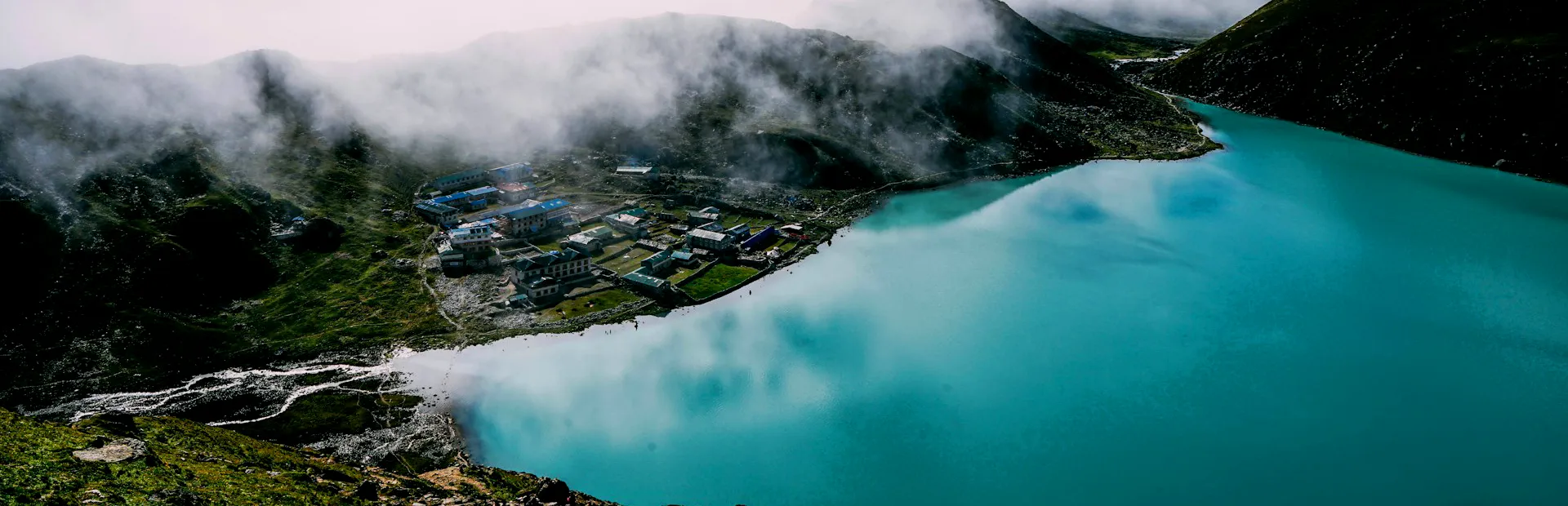
Following our first lake visit, the trail turns plain, and soon enough we visit another Gokyo Lake, Taboche Tsho. Continuing our trek through the valley, we will soon reach Gokyo Tsho, which is the biggest of the 6 Gokyo Lakes. Our final destination of the day, Gokyo village, is visible and nearby the lake.
Machhermo to Gokyo is just about 6 km, which takes at most 3 hours as we will be taking it slow to avoid altitude sickness. Since we will have plenty of time on our hands, we will climb the ridge behind the village for a spacious view of the Ngozumpa Glacier. This is the largest of its kind in the entire Everest region and is covered in pebbles and loose soil. A few cracks in the glacier reveal the icy insides. After a while we will get back to the village, ending the day 7 of Gokyo Lake trekking.
Getting out of bed in Gokyo village can be the hardest challenge of the Everest Gokyo Lake Trek. As one would assume, it is very cold where streams and waterfalls freeze. But you got to get out of comfort and warmth with all your might since we have a challenge to conquer. Today is the day we will climb up the Gokyo Ri viewpoint.
The trail to Gokyo Ri starts with a steep ascent, which can be exhausting as there is less oxygen at such altitude. We will divide the hike into bite-sized goals to make it more doable for you. Even if you are more than capable of climbing it easily, you should follow the pace of the guide, as he knows how not to get altitude sickness.
Taking short breaks throughout the hike, we will get to the top in about 2 hours, covering a tiny distance of 1.5 km in the process. From the summit, you will see the signature blue water of the Gokyo Lakes paired with the multi-colored Buddhist prayer flags. The top of Gokyo Ri reaches 5360 meters above sea level, which allows for an uninterrupted, clear view of the glaciers, peaks, and lakes nearby.
After spending some time at the summit, we will descend back to our accommodation for lunch and spend the rest of the hours getting back to Dole and getting some much-needed physical rest.
The next morning, it will again be a challenge to leave the warmth of your bed, but we have to get to Namche Bazaar; the trek continues no matter what. From Dole, we will first trace back our steps to Mong La village and continue on to Namche after a short break. Arriving at Sanasa, we will stop for lunch and get to our destination in about 2.5 hours, covering 4.3 km in total.
Day 10 of the Everest Gokyo Lake Trek is accompanied by a descending trail most of the way combined with scenes of distant peaks in the background. The Dudh Koshi River is our guide, and we’ll follow it all the way to Lukla, the place where our journey began. There is not another way out of the Everest region. We will not be getting on a flight back to Kathmandu on the same day, as only morning flights are available.
The following morning, after a restful night in Lukla, we will pack our bags and get on a flight out of Lukla. After getting to Kathmandu in about 35 minutes, we will get to rest at our hotel for the night.
The next day is also an exciting day of the Gokyo Lake trekking, as we will take you on a sightseeing day tour to visit the attractions of the Kathmandu Valley. If you are interested in visiting any particular place, we can arrange it for you and add it to the day’s itinerary.
Day 13 is the end of the Everest Gokyo Lake Trek, and we will drop you off at the airport as per your flight schedule. We hope that you had a time of your life trekking with us and to see you again.


The standard Everest Gokyo Lake Trek itinerary takes you through more remote villages of the Everest region than the standard EBC trek. More remote villages translate to tougher trails, but it also means the landscapes are more untouched and pristine. There are a few steep sections on the Gokyo Lake trekking route, but other than that, you should not have a problem hiking.
Another aspect of difficulty is the sheer coldness and high altitude resulting in a lesser oxygen. level in comparison. For instance, the oxygen level in Gokyo village is 45% less than sea level. In conclusion, the Everest Gokyo Lake Trek is graded as a moderate-level trek.
The best seasons are definitely autumn, when the nature goes through a dry phase, and spring, when the flowers bloom. These seasons are preferable for their lack of rainfall trait; however, this does not mean that there is absolutely zero chance of rainfall. You might just encounter one out of the blue; the weather is very unpredictable in the mountains. Another viable option is to do the Everest Gokyo Lake Trek in the summer season.
The maximum altitude of the Gokyo Lake trekking takes us to is 5357 meters above sea level, which is prone to altitude sickness, but we will not be spending much time at such a high altitude. Spending the night at high altitude can cause altitude sickness, but we will take the necessary preventive measures to avoid it as much as possible.
We will be going on short acclimatization hikes throughout the Gokyo Lake trekking journey, keeping ourselves well hydrated, and climbing high but sleeping low, which is the best way to prevent it.
Accommodation in the Everest region is well facilitated, especially in the lower region; the same can be said for the Gokyo region, but some villages just have the bare minimum facilities. There are no options to upgrade your accommodation in the Gokyo region, as what is provided is our only option.
Food and drinks are hard to come by in the region, and it is basically all covered in snow; crops do not grow in such extreme conditions, and even trees have a hard time growing, which is why you will only see small patches of grass and small bushes. Basically, food and drinks are transported from other lower region villages. You will get dishes like Sherpa stew, Rildok, veg curry, Dal Bhat, Thukpa, and other local dishes.
Pick up and drop off on a private vehicle to and from the airport, a flight from Kathmandu to Lukla and back, and a vehicle for Kathmandu sightseeing are the transport services we provide you during this Gokyo Lake trekking journey. These are covered by your trek package.
Permits for the Everest Gokyo Lake Trek are the Khumbu Pasang Lhamu Rural Municipality Permit and the Sagarmatha National Park Permit. In addition to that, you will also need to have a TIMS card. All three of these permits are covered by your Gokyo Lake trekking package.
To prepare for your highland Everest Gokyo Lake Trek, you will have to train for about 8 weeks before you are set to arrive in Nepal. For your trek training, you need to focus on building stamina, engaging your core, and training your calves and glutes. Your legs are the only mode of transport for the trek, so make sure it’s capable of handling the requirement.
If you have an underlying condition that might be affected at any point during Gokyo Lake trekking, you must consult with your doctor before you make any move. We don’t want you to leave the trek midway or to call a rescue helicopter for you.
The Everest Gokyo Lake Trek is a long way into the barely accessible highland villages of the Gokyo region, which roughly translates to everything being more expensive locally. Even daily commodities can be as high as double or triple the standard rate, and the food can be said to have the same inflation. Providing services and conveniences during the trek costs a hefty amount. Keeping that in mind, we have come up with the price: USD ____ per person.
Some of the Gokyo region villages are not on good terms with 24/7 electricity availability; this means that you might face some power outages during your time there. However, the locals also rely on solar energy, so you will not have to sit in darkness when the night falls. Other than that, you should not have any issue charging your electrical gadgets.
The internet is not available throughout the Gokyo Lake trekking route, but there is a solution for this. You can buy a WiFi link service that covers the entire trek. This service will cost you about $30, which gives you 20 GB of usage. The accommodations we stay in have WiFi connections, but they might charge you a couple dollars as a usage fee.
Emergency rescue operation, visa fees, flight to and from Nepal, additional food and accommodation, any kind of beverages, additional fees such as hot showers, WiFi fee, etc. at highland accommodation, and anything that has not been mentioned as inclusive of the Gokyo Lake trekking package are your extra expenses.
Maybe you would like a bit of luxury before and/or after a humbling, accommodating experience throughout the trek. Keeping this in mind, we offer upgraded accommodation, preferably a 5-star stay or a 4-star as per your preference. This upgrade is not a part of the Gokyo Lake trekking package, and the surplus charges will be adjusted in the total amount.
If you want to experience a private helicopter ride to or from Lukla that is more scenic than the standard flight, we can arrange it for you. This private helicopter ride is not available only in the morning, unlike the flights to Lukla, which means that you get a more flexible schedule. As previously stated, upgrades are not a part of the standard Everest Gokyo Lake Trek package.
Yes, if you book a trek with us, we will make it happen. But in cases like national strikes, unprecedented natural disasters, and other uncontrollable hindrances, we will have to postpone your trek to the nearest suitable date. For instance, if our main destination went through an avalanche, it’s useless to do the trek right away as it takes weeks to remake the trekking trail and clear out the debris
Yes, but to a certain limit. If you cancel your trek well before the start of the trek, we will refund you 80% of the total transaction. The later you cancel your booking, the less refund you get. This is done as we have to spend resources on working out your booked date from the moment you confirm the booking.
Not only do we provide experienced guides, but we also have region-specific guides that are native to the land or have years of experience hiking the same route.
No, the Everest Gokyo Lake Trek is not meant for beginners. You must have at least a couple of sessions of trekking experience before you can confidently take this on.
Yes, the Gokyo region is safe for traveling. The route we will take for this trek is not avalanche-prone. The only thing that can get you is altitude sickness.

Need help?
Talk to trip expert