English
 Dutch
Dutch Japanese
 Hindi
Hindi Italian
 Spanish
 French
 German
 Chinese
 Korean
 Arabic
 Hebrew
 Russian
 Portuguese
 Danish
 Czech
Czech Polish
 Swedish
Need help?
 +977 9767994912


Trip Duration
20 Days
Trip Difficulty
Difficult
Max. Altitude
5,143m / 16,873ft.
Activity
Trekking
Destination
Nepal
Group Size
1-16 Pax
Accommodation
3 star Hotel
Meals
Breakfast, Lunch, Dinner

Need help?
Talk to trip expert
Dramatic, lush, varied, remote, breathtakingly beautiful landscapes, and very far from the beaten track. These are the features of the fantastic Kanchenjunga base camp trek in the northeastern corner of Nepal. We are particularly pleased to present you our 20-day Kanchenjunga base camp trek regarded as one of Nepal’s most impressive treks with accommodation at small local teahouses.
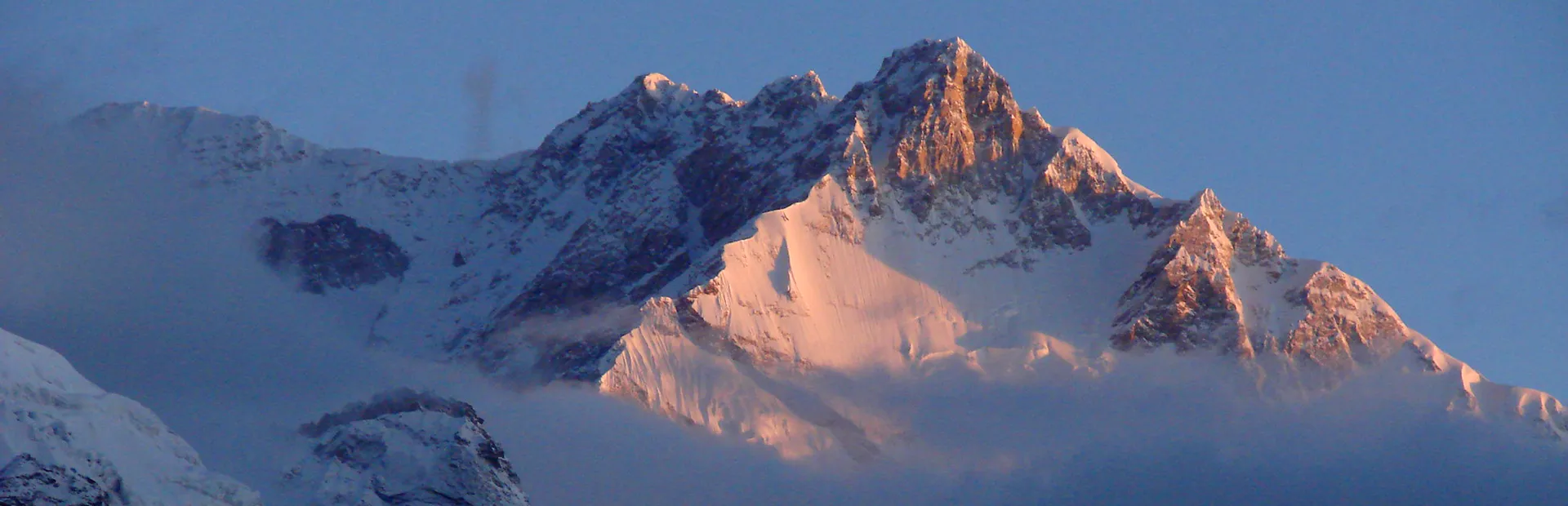
Kanchenjunga, the sacred Peak, is the third tallest snow-capped Himalaya in the world at 8586 m and rests exactly on the border between Nepal and India (Sikkim). At its feet, between rice terraces and rhododendron forests, runs the Kanchenjunga base camp trek that will lead you to the Northern Base camp and southern base camp of the mountain.
Made accessible in 1988, the Kanchenjunga base camp trek is organized under the utmost care to protect the region’s authenticity and natural beauty. World Wide Fund For Nature/WWF stands behind this region which has now become a sanctuary for snow leopards and the adorable red panda.
Both the base Camps are the true paradise for photography enthusiasts – the panorama of the ice-armored north and south face of Kanchenjunga is unparalleled. Whereas, the incredible views of Langpo Glacier, Drohma RiJannu, Makalu, Everest, Chamlang, Baruntse, Rathong, Kabru, and many more create a nature amphitheater in the Himalayan nature.
On the other hand, the exceptional Kanchenjunga base camp trek will also dare you to overcome not one, not two, not three but four high Mountain Passes of Sele Le (4290 m), Sinion La (4440 m), Mirgin La (4480 m) and Sinelapcha (4646 m) en route making this journey a unique experience even for experienced and persistent hikers.
Additionally, this trek also takes you on a cultural journey through the life of Rais, Limbus, and Tamangs of the Kiranti tribe while the highly elevated quaint settlements of Kanchenjunga give us glimpses of Tibetan Buddhisms of great Sherpa People.
The remote location with its still unspoiled Nepalese mountain is also one of the factors that set the Kanchenjunga base camp trek apart and appealing. It is particularly recommended if you have already got to know the more well-known trekking areas in the Nepalese Himalayas.
We proceed from the capital to Bhadrapur via a small flight and drive to Taplejung. Then traversing the unique settlements of Chirwa, Lelep, Amjilosa, Gyabla, Ghunsa, and Lhonak, we make our way towards the North Base Camp of Kanchenjunga.
Then directing our path back to Ghunsa, we will cross the Sele Le Pass and overcome the high Sinion La, Mirgin la, and Sinelapcha Passes to advance to Cheram from where we will step into the South Base Camp of kanchenjunga base camp trek. We will then advance to Torongding, and Yamphuding tackling some ridges along the way.
A day of trek will then lead us to Khebang and Khamdime from where we will drive to Bhadrapur taking a flight back to Kathmandu.

Our adventure to Kanchenjunga Base Camp trek begins with an early morning flight from Kathmandu to Bhadrapur. The 45-minute flight offers an incredible panorama of the high Himalayan mountains including Everest, Lhotse, and Kanchenjunga itself.
As we land at the Bhadrapur Airport, our local crew will greet us. Then, we will have our lunch in Bhadrapur enjoying the Indian-influenced markets. Then, we will drive to Taplejung from where our trekking adventure will begin.
The long winding trail will take us to IIlam and Phiddim before finally arriving at Taplejung- the Limbu Village in eastern Nepal.
Point to Remember:
There is also an option of a direct domestic flight to Taplejung from Kathmandu which generally operates on Monday, Wednesday, and Friday. If you wish to avoid the long road drive, we can wait for one of these days to board a direct flight.


Officially commencing our hiking journey today, we will leave Taplejung after breakfast and walk along the Tamur River shore past the terraced lands of Mitlung Village.
Marching forward, we will then cross a long steel bridge and begin to climb gently passing the tiny Limbu and Tamang settlement of Sinuwa. The trail then climbs down to Tawa Village from where we will again climb up through the farmlands and some ridges. Next, the Thiwa River will greet us along the route. After crossing the river over a bridge, we will arrive at Chirwa.
Departing from Chirwa, we will climb along the glacial Tamur Koshi River. The wild tropical forest gives way to rice terraces and tea plantations. The relatively picturesque trail will then take us to Taplethok from where the area of Kanchenjunga National Park begins.
We will pass the checkpoint where our permits will be checked, then we will relax in a tea house. Next, the flat road paved with stone slabs will make our walk pretty easy. However, eventually, a steep climb will begin through Temewa leading us to the Sherpa Village of Lelep. It is also the headquarters of the Kanchenjunga Project (KCAP).
From Lelep, the trail follows the Simbu River. We will cross the river and climb steeply the narrow route that will take us to Sekathum. The path then runs along the northern bank of Ghunsa Khola, leading us closer to Kanchenjunga Base Camp.
We will then overcome a steep climb over stone steps to Gayabari (2150m). The top rewards us with the beautiful view of a waterfall. Then, the downhill hike will not be steep taking us along the grassy slopes of Jongim and Solima.
The ascending trail will lead us to Chanjalung Danda (2530m), from where we will see the first panorama of the snow-capped Himalayas. We will then hike down to reach Amjilosa.
A trail with a mixture of coniferous and deciduous trees as well as bamboo plants will lead us to Thanyani Village. From here on, the trees will gradually become less.
The path now becomes narrower and is sometimes somewhat exposed. After the usual ups and downs, after a very steep climb, we will reach Gyabla Village- a local Sherpa Village without whom the many hikes to the high Himalayas wouldn’t have been possible.
After resting in the lodge, we can stroll around to see the beautiful waterfalls and cute little pandas feeding on the bamboo trees.
After exiting Gyabla, we will continue to follow the river and cross several earth and rubble passages until we reach Phale resting at 3250 m. The charming Sherpa village with a small monastery invites us to take a break, where we can come into contact with the friendly residents and monks.
The subsequent path will then take us crossing the river to Ghunsa. In this Tibetan village, there are a few shops and you can shower, charge batteries, surf the internet, or call home for a small fee.
Acclimatization and rest day in Ghunsa. If the weather is good, the very steep climb to a viewpoint decorated with prayer flags is worthwhile. At an altitude of around 3950 m, we will have an excellent view of the summit of Jannu (7710 m) and the 6000m peaks in front of it.
If you don’t want to go today, you can spend the day in the village and its surroundings.
We will leave Ghunsa after breakfast, and walk through fairy-tale larch forests. The trail then gradually continues upwards along the river taking us to Rambuk Kharka (3720 m).
It is a beautiful spot to enjoy our lunch with the incredible backdrop of Mount Jannu, Sobi Thongje (6652 m), Phole Peak (6645 m), and Ghabur Peak (6044 m).
After a lunch break, we will cross the Ghunsa Khola River and after a steep climb, we will reach the tree line. The last section of the trail leads over a landslide on a path that is slightly exposed in places. Shortly, we will arrive at our overnight village of Kambachen.
From Kambachen, the path initially leads pleasantly flat and later over scree and moraines to Ramtang (4350 m), where we will stop for lunch at the remains of a small monastery.
In the next section, we will walk along the northwestern terrain of the Kanchenjunga glacier. After crossing a river, we will reach Lhonak resting by the lake of the same name where we can find a large selection of shelters, almost like Gorakshep.
The glacial village is also a remarkable site to observe Mount Gimmigela (6415 m), Kanchenjunga, Tent Peak or Kirat Chuli (7365 m), Mera Peak, and many more.
Today’s stage will take us to the highlight of the Kanchenjunga Base Camp trek- the northern Kanchenjunga base camp aka Pang Pema. The path along the glacier is rocky and tiring. However, the magnificent view of the impressive Kanchenjunga massif along with Yalung Kang (8510 m), the Ramtang Peak (6700 m), Taple Shikar (6,341 m), Chang Himal (6750 m), Langpo Glacier, and Drohma Ri make up for the hard climb.
After a long rest in the base camp, we will descend for about 3 hours to Lhonak.
We will walk on a familiar path, but with completely new perspectives, that will lead us to Ramtang and Kambachen where we will take a short lunch break. Finally, we will descend back to Ghunsa to rest overnight.
Behind Ghunsa, our path initially climbs gradually through a forest of rhododendrons and junipers. For about 1 hour, we will then climb very steeply to the Tamo La Pass (3940 m). Once we reach the Pass, the path leads gently up and down over the second pass, the Sele Le (4290 m) to the Sele Le camp at about 4395 m.
Up here, we can have a good view of the peak chains of the Sarphu Mountains, Makalu, and possibly also the Syamdo Kangri Mountains. In the Sele Le camp, there are few tea houses built with basic facilities. They will be our accommodation for the night.
Today we will cross three Passes which is quite strenuous, especially when there is snow, but if the weather is good we will be rewarded with wide panoramic views.
The two-hour climb will first take us to 4440 m high Sinion La Pass. Then overcoming constantly up and down and over large areas of scree and snow we will reach the striking Mirgin La Pass (4480 m). To the northwest we can see Makalu (8463 m) in the distance and, if the weather is clear, even see Mount Everest (8848 m).
Finally, we will pass two lakes and reach Sinelapcha Bhanjyang (4646 m). The southern peak of Kanchenjunga along with a panorama of Kabru peaks, Rathong, Jannu, Makalu, Chamlang Ridge, and Kokthang is very impressive. After a rest, we will descend very steeply past Jor Pokhari Lake to Cheram.
Leaving Cheram behind, we will follow the Simbuwa Khola River through rhododendron forests along the Yalung Glacier to arrive at Ramche. Enjoy the illuminating peaks of Rathong and Kabru en route. We will make a short stop at Ramche for our lunch, then we will climb to the 3870 m high Kanchenjunga South Base Camp aka Yalung Base Camp.
It is worth spending some time at the base camp with the three Peaks of Kanchenjunga all above the elevation of 8000 m: 8420m, 8586m, and 8474m.
After the exploration of the camp, we will head back to Cheram via Ramche for our overnight sleep.
Leaving Cheram, we will exit the gorge nearby and reach the Y junction route. One route will march towards the Sele Le Pass which we will avoid of course. The second path turning left will be our trail for today which will lead us to Torongding.
The lush rhododendron forest with diverse flora and fauna by the Simbuwa River will now take us to Anda Phedi from where we will hike down gently towards Torongding.
Our route today initially goes up and down slightly before we reach a very steep path up to the pass of Lamite (Lasiya) Bhanjyang (3415 m). In the first two hours, steps and a path often covered with leaves lead quite steeply downwards.
Then, we will cross the Amje Khola river over a suspension bridge and reach the village of Yamphudin also called Sherpagaon (Sherpa village) – on a beautiful path.
In the afternoon, we can rest or walk through the lush rice and vegetable terraces and get to know the everyday life of the villagers.
We will descend leisurely through rice, grain, and millet fields to the Kabeli Khola River. Then, we will overcome two fairly steep passes today. First, we will climb Otham Pass, and later, we will ascend the Kedan La Pass or Ekchana Bhanjyang (2070 m).
The second Pass offers an ideal place for a long lunch break with the opportunity to meet the locals and enjoy a beautiful panoramic view. Then we will go downhill again through the villages idyllically situated on the green slopes to reach Khebang.
Beyond Khebang, our trail today leads us along a few steep ridges. One of them is the Apple Danda which is known for its scenic beauty. Then, marching forward, we will cross the enchanting Jor Pool where we will stop to eat our lunch. Then we will tackle another ridge of Simal Danda before arriving at Khamdime.
We have a long road journey ahead of us. Bidding farewell to Kanchenjunga, we will drive from Khamdime to Bhadrapur. The initial path will be along the off-beaten dirt road which later turns into a wide well-paved Highway. After reaching Bhadrapur, we will check into our accommodation for a good night’s rest.
We will drive from our hotel to Bhadrapur Airport early in the morning to fly back to Kathmandu. Once in TIA, we will then transport you to your hotel where you can rest for some time. You will still have time to explore the unique atmosphere of the capital.


If you are planning for the Kanchenjunga base camp trek, then March-May of Spring and September-October-November of Fall are the best times.
The Spring months bring warm days with temperatures reaching 25 degrees Celsius but night temperatures in the Base Camps and High Passes sometimes drop to zero. However, the route is often cleared of snow, with gurgling rivers, streams, and waterfalls along the route. The ridges are often painted with a crimson hue from rhododendrons and the jungle revive with colorful birds and various animals.
In autumn, forests and mountains become variegated with a riot of colors. Starting from the second half of September, snow sometimes falls at night, which quickly melts during the day. Autumn hikes are good for their complete solitude, the special smell of the forest, when you can feel the approach of winter in the cool air.
The Kanchenjunga Base Camp trek covers a vast distance of 220 km and needs at least 20 to 22 days to complete. The thrilling begins with a flight from Kathmandu to Bhadrapur, covering a distance of 297 km in just 45 minutes. Taplejung serves as the starting point for the trek, located 262 km away from the capital. Taplejung is situated 244 km away from Bhadrapur.
The highest point of our entire journey will be at the North base camp of Kanchenjunga base camp Trek, situated at 5140 m. Whereas the highest overnight stop will be at Lhonak, at an altitude of 4785 m. We will walk approximately 15 to 25 km each day to complete the trek within the designated timeframe.
Our 20-day itinerary for the Kanchenjunga base camp trek includes a 17-day hiking journey, during which we will be walking for approximately 5 to 7 hours each day. Throughout the trek, we will experience a variety of terrains, ranging from lush forests to glacial paths, steep climbs, and gentle and enjoyable walks. These diverse landscapes will be the highlights of our hiking days.
On day 6, we will have the easiest and shortest walking day, as we will only be walking for 3 hours from Gyabla to Ghunsa. However, the most challenging day of the trek will be on day 13, when we will need to overcome three passes over 4400m to reach Cheram from Sele le.
The Kanchenjunga base camp trek is one of the most challenging journeys in Nepal that involve long stages with single stages often comprising a long walk and often with sometimes challenging differences in altitude and three Passes above 4400 m to overcome.
The stage requiring a climb to Northern Base Camp, and crossing of three Passes of Sinion La, Mirgin La, and Sinelapcha demand a technical level. Whereas, the stay at high altitude can even last more than a week.
Therefore, this trek is for hikers, in excellent physical shape and with experience on different terrains. The hours of walking vary on average from 5-6 hours a day with peaks of 7-8 hours or more for some stages.
However, we have designed our itinerary to promote regular and correct acclimatization with a rest day at Ghunsa and a short 3 to 4-hour acclimating walk before approaching the arduous day of reaching the North Base Camp and crossing three Passes.
The Kanchenjunga Base Camp trek should not be taken lightly. It is a demanding trek not only because it is a remote area, but also because of the terrain and the paths that are followed. The accommodation will be in simple mountain huts or shelters with basic comfort. Therefore, you must have ample patience and team spirit to be able to tackle the unexpected difficulties the trek may present.
In addition, kanchenjunga base camp trek setting foot at two base camps and crossing three or four high mountain Passes en route is a challenging task. One of the main risks is the high altitude and the probability of altitude sickness which may take a severe form.
Therefore, it is wise to first accumulate the experience of high-altitude trekking in Nepal with the Everest or Annapurna trek before going on in Kanchenjunga base camp trek.
It is useful to prepare before the Kanchenjunga base camp trek with light weekend excursions, wearing shoes that will also be used for the trekking trip, which avoids the problem of blisters on the feet.
Additionally, undertaking some excursion in the high mountains in your home country perhaps with an overnight stay in a hut, certainly won’t hurt and we always encourage it.
And if you are a first-timer trekker in Nepal, then we encourage you to first participate in Ghorepani trekking, Annapurna trekking, and Everest Base Camp trekking, then Kanchenjunga base camp trek.
For a different experience, you can choose to begin your journey at the South base camp of Kanchenjunga and then make your way to the North base camp. To do so, you will fly from Kathmandu to Biratnagar and then proceed with a drive to Thumbeding or Ganeshchock. From here, your exhilarating adventure begins as you pass through Yamphudin, Tortong, Cheram, Ramchaur, and Ghunsa, to reach both the Southern and Northern Base Camps.
Alternatively, you can approach either the northern base camp or southern base camp to reduce your hiking days. When venturing to the Northern base camp of Kanchenjunga, the first stages will be the same till you step into the base camp. Then, you will retrace your steps to Ghunsa, Taplejung, and Bhadrapur.
For the approach to Southern base camp, the hiking begins from Taplejung then you will traverse Lali Kharka, Pumphe Danda, Yamphuding, Torongding to Tseram.
The high altitude and the problems associated with it must always be taken into consideration during the Kanchenjunga base camp trek. Although we have carefully designed our itinerary to ensure proper acclimatization during the trek, we cannot guarantee that altitude sickness will not occur.
As our journey advances, so does the elevation so it is very important to drink enough during trekking. Sometimes, you may have headaches, dizziness, sleep loss, loss of appetite, and breathing difficulty.
You can take Diamox if the symptoms are mild as we have listed above. Within a few hours, you will feel comfortable to go on with your trek. However, if you don’t feel any comfort, please consult our guide who after evaluating your condition will take you to a lower height where you can feel normal again.
We are a reputable trekking agency in Nepal that will cater to all your needs. We will organize your trek, and take care of your transport logistics, the necessary permits, overnight stays, or even meals.
We provide round-trip airfare between Kathmandu and Bhadrapur, as well as private transportation during a drive from Bhadrapur to Taplejung and Khamdime back to Bhadrapur. The airport pick-up and drop-off services at Kathmandu Airport, and Bhadrapur airport will also be in private transportation.
We provide hotel accommodation in Kathmandu and Taplejung including breakfast. Lunch and dinner in the capital and Taplejung will be on your own. You can expect the best available mountain lodge accommodation during your trek.
We offer full board meals (Breakfast, Lunch, and Dinner) with tea/coffee throughout the trek. Pancakes, chapatis, bread, eggs, dal bhat, momos, pasta, pizza, noodles, and some meat dishes are available in the lodges en route.
There is good mobile network reception of NTC or NCELL when traversing the villages at relatively low altitudes. As you journey through the remote terrain, pass through the dense forests, cross the glacial terrain, and arrive at base camps, the connection is often lost. We have satellite phones for communication during any emergencies.
With the increase in the distribution of electricity, the mountain lodges en route have electricity and often receive electricity thanks to small hydroelectric systems or solar panels. You can then recharge your batteries for a small fee. However, we recommend carrying charged and spare batteries for trekking in base camps or using portable solar panels.
You can use the internet with your NTC or NCELL mobile networks. In Kathmandu, Bhadrapur, and Taplejung, you may have free WIFI. When trekking, you can take advantage of WIFI in the lodges with a minimal contribution.
For the Kanchenjunga base camp trek, it is necessary to have the Kanchenjunga Conservation Area Project Entry Permit (KCAP) and Restricted Area Entry Permit (Rap) for Taplethok and Yamphudin. Our guide will take care of acquiring these permits for you.
Trekking to the South Base Camp of Kanchenjunga is easier than hiking to the northern camp because of the short itinerary, and easy terrain.
No, there are lodges and tea houses built along the route eliminating the need to stay in tents. Only if we decide to spend the night in the base camps do we need the tents but our itinerary doesn’t involve overnight rest at the camps.
Yes, there are a few options available for example you can climb the Jannu Peak, or Peak 5950. however, special climbing permits are needed to climb these peaks and you also need separate climbing gear so advance preparation is needed if you also want to combine the climbing expedition with the trekking to Kanchenjunga.
Absolutely! If you have less time and you think you are not ready to undertake the long journey, then you can either trek to North or South Base Camps.
Yes, we will be traversing some high-altitude and remote regions of Nepal where the probability of altitude sickness, injuries, and accidents cannot be ignored. So your insurance should include helicopter evacuation, medical costs, and high-altitude trekking above 5000 m.

Need help?
Talk to trip expert