English
 Dutch
Dutch Japanese
 Hindi
Hindi Italian
 Spanish
 French
 German
 Chinese
 Korean
 Arabic
 Hebrew
 Russian
 Portuguese
 Danish
 Czech
Czech Polish
 Swedish
Need help?
 +977 9767994912


Trip Duration
18 Days
Trip Difficulty
Difficult
Max. Altitude
5,190m / 17,028ft.
Activity
Trekking
Destination
Nepal
Group Size
1-16 Pax
Accommodation
3 star Hotel
Meals
Breakfast, Lunch, Dinner

Need help?
Talk to trip expert
The Lower Dolpo Trek is one of the least-traveled trekking destinations of Nepal. Located in the northwestern region of Nepal, in the rain-shadow of the Dhaulagiri Himalayas, this region borders Tibet and practices Tibetan-influenced culture and tradition. This trekking destination is a very secluded experience in the barren highlands of the Dolpo region.
Most of the communities there are Tibetan Buddhists, but there are a few villages that still practice the centuries-old Bon religion, even older than Tibetan Buddhism. The Bon culture is nothing like Buddhism, but is closely related. The unique culture of the Bon communities is something that you will definitely find interesting and captivating. Villages like Ringmo, Parli, and Dho Tarap are some great Bon communities.
Since the region is highly influenced by Tibetan Buddhism, naturally, there are a plethora of gompas, countless chortens, and long mani walls all over the Lower Dolpo Trek route. Some notable gompas that we will visit are Ribo Bhumpa Gompa, Sandul Gompa, Shipchuar Gompa, Dhoro Gompa, Mekhyim Gompa, and more. The aesthetics of the traditional Tibetan architecture will definitely entice you as the monks in the gompa chant away sacred texts.
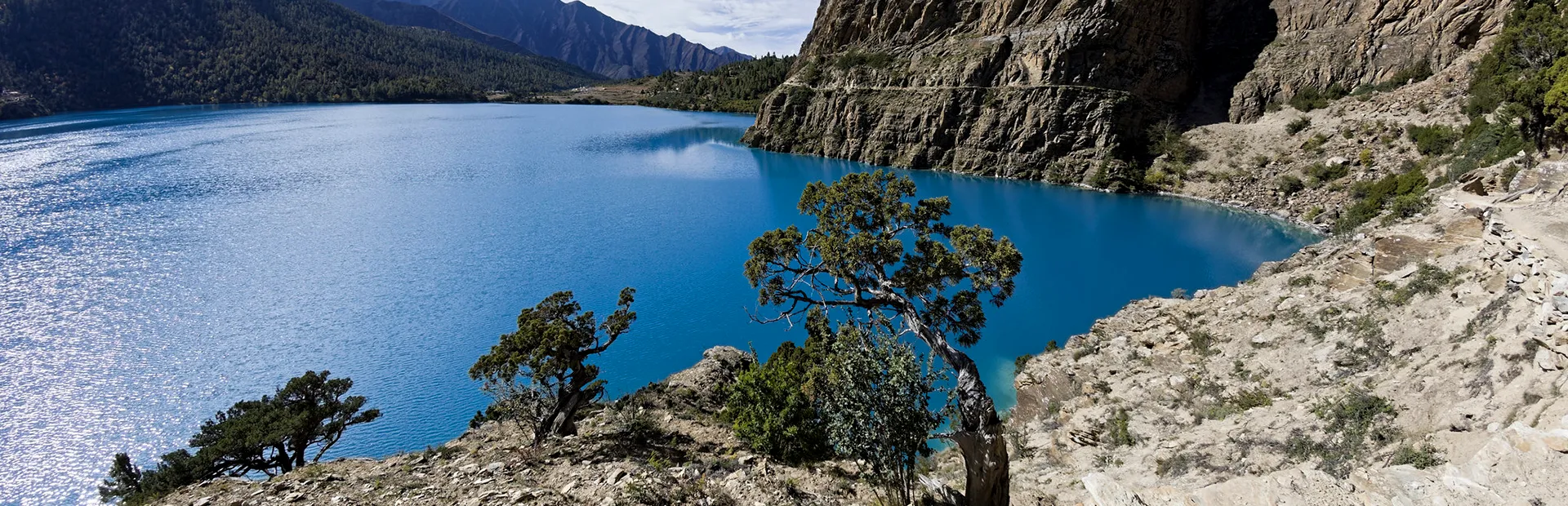
After spending days in the remote mountains of the Lower Dolpo region, we will trek to the Shey Phoksundo Lake at a later stage of the itinerary. This lake is just too gorgeous not to fall in love with; the deep blue water, the dry surroundings, and the serene landscape make it the main attraction of the journey. This lake is the deepest one in Nepal and also the second largest in terms of size. Hold yourself from swimming in the lake because it is prohibited, in order to preserve its pristine quality.
However, it’s not all rainbows and sunshine in this trek. You will have to trek a lot, climb up high passes, and pass difficult ascents throughout the route. This itinerary requires you to cross the Numa La Pass, reaching 5190 meters, the highest point of this trek, followed by the Baga La Pass (5070 m) the next day.
This region was officially opened to international tourists in the year 1990. Ever since, the Government of Nepal has regulated the number of yearly visitors to keep the region naturally stable and promote sustainable tourism. This effort has definitely helped the Dolpo region retain its natural beauty over the years. Here’s more that you need to learn about this stunning Lower Dolpo Trek.

Arriving in Kathmandu counts as your first day of the Lower Dolpo Trek. After your flight lands at the airport, you will be guided to the immigration section where your tourist visa will be granted. For this, you need to have your passport (valid for 6 more months), proof of stay, two passport-sized photos, proof of return tickets, and a bank receipt of visa fee payment. You need to submit these documents along with your filled-out visa application.
You can get an application form at the immigration desk and pay your visa fees at the nearby banking counter. They accept major credit card companies, but do not rely on them completely, as they might not work at times. So, just to be sure, carry enough cash to pay your visa fees. If everything goes right, you can use that cash to pay for your extra expenses later in the trek.
After getting your visa approved, you will find one of our representatives waiting. He will drop you off at your hotel for the night, and before you head to bed, we will hold a short meeting to introduce you to the team members.


Obtaining the permits for this Lower Dolpo Trek takes time, so we will make it most out of the day by going on a sightseeing trip around the valley of Kathmandu. First of all, we will apply for the permits to the Tourism Board Office in Kathmandu, and only then, get started with the sightseeing tour. Our experienced Sherpa Discovery Trek guides will get your permits without an issue. Our first destination of the day will be Bouddhnath Stupa, a bustling Gompa in the middle of the city, surrounded by interesting small businesses.
From there, we will visit the Swayambhunath Stupa next, followed by a visit to the Kathmandu Durbar Square, a major historical site. This complex houses the Hanuman Dhoka Royal Palace, the Kumari Bahal, Taleju Bhawani Temple, and a bunch of other temples that display the traditional Nepalese architecture. Moving on, we will visit the Patan Durbar Square and the Bhaktapur Durbar Square as well.
On the 3rd day of the Lower Dolpo Trek, we will get on a 50-minute flight to Nepalgunj. First, we will spend our morning in Kathmandu, having a leisurely breakfast, taking a look around, and getting on the plane shortly. After we reach Nepalgunj, you will have plenty of time to roam around the city and explore the interesting things happening. There are many daily flights connecting Kathmandu and Nepalgunj, giving you the flexibility of flying at your preferred time.
Unlike the daily flights to Nepalgunj, there are only weekly flights to Juphal because of the lower travel demands. You will only get a flight to Juphal on a Tuesday, every week. This flight lasts only 45 minutes, but a road ride to Juphal will set your back 10 to 12 hours or even more. This is the reason Sherpa Discovery Treks opt for flights instead of road rides like most other agencies. After arriving at the Juphal airport, we will get our bags and prepare to hit the road.
Starting from 2475 meters at Juphal, we will trek about 8 km, gain 335 meters of elevation, and reach the town of Dunai at 2140 meters. This trek will take about 3 to 4 hours. Our first day of trekking on the Lower Dolpo Trek itinerary starts with a gradual descent along tiny settlements and terrace farmlands. We will cross a handful of hanging bridges and pass the Roop Ghar to get to our destination of the day.

Today’s trek will gain us slightly over 400 meters of elevation, taking about 5 to 6 hours to complete, as we have to trek over 14 km of distance. The trek starts with a plain section, following the Thuli Bheri River’s path upstream. This section will shortly turn slightly ascending and take us through a forest, followed by terrace farmlands, and tiny villages. We will also cross a couple of suspension bridges to get to Tarakot village.
This village houses the Tarakot Dzong, a centuries-old fortress, which we will visit after checking in at our accommodation for the night. This gives a great chance to learn the history of this village and also interact with the locals a little.
Day 6 of the Lower Dolpo Trek starts at 2543 meters of elevation, and by the end of the day, we will have covered over 16 km to get to Laini village, sitting at 3160 meters above sea level. This trek will gain us about 620 meters of elevation and require about 6 to 7 hours of walking over dirt tracks. Leaving Tarakot, we will get on a trail following the Tarap Chu River upstream. This trail leads us to Sandul Gompa, but we have to cross the river twice over hanging bridges to get there.
This Gompa sits at the meeting point of the Tarap Chu River and the Barbung River, offering a great scene along with a religious visit. Continuing the trek, the trail gets rougher as we ascend higher and approach the village of Laini.
From Laini, we will have to trek about 10 km to get to Nawarpani, gaining an elevation of 385 meters. Today’s Lower Dolpo Trekking days will keep us on the trails for 5 to 6 hours. Leaving Laini, we will once again begin the trek walking alongside the Tarap Chu River upstream. We will shortly enter a slim gorge with huge valley walls on both sides, creating a canyon effect. After crossing this section, we will have to trek a series of ascending switchbacks.
As we climb up the valley, views of the surrounding area become apparent, and the sounds of nature come alive. The birds chirping, the river raging in the distant valley basin, and the winds make up a great trekking ambiance.
Today, we will be trekking a total distance of 14 km, gaining 545 meters of altitude, to reach our destination of the day, Tarap, reaching 4090 meters above sea level. This trek will take about 6 to 7 hours to complete since it is a difficult trekking day. Leaving Nawarpani, we will get on a rugged trail, exploring the Lower Dolpo region, a rough yet beautiful landscape. We will transition from lush forests to alpine vegetation and cross many bridges.
We will soon reach Kama Kharka, the meeting point of the Lang River and the Tarap Chu River. This is a great place to rest and enjoy the view, and so, we will. Continuing the trek, we will then get to the village of Sisaul, our lunch spot of the day. After lunch, we will pass by Sipchowk and get on the final section to Dho Tarap.
The village of Dho Tarap is really tiny, with only 40 to 50 houses, dominated by Magar people and Tibetans. The residents of the village highly practice the Buddhist teachings along with Bon culture. There are multiple gompas, many chortens, and mani walls within the village. Since we have a day to explore, we will visit all its gompas, starting with Ribo Bhumpa Gompa, dating back over a century.
Following that, we will visit the Bon monastery of Shipchuar and then head to Dhoro Gompa with a side tour to Mekhyim Gompa. Visiting these locations will give you many chances to interact with the locals and the monks. However, be sure not to do anything that disturbs the peace of the monastery.
Today is one of the best days of the Lower Dolpo Trek as we make our way to Numa La Base Camp, reaching 4440 meters above sea level. This trek will gain us about 350 meters of elevation and cover a total distance of 12 km. The trek starts with a gentle ascent through barren surroundings, keeping us on the northern side of the valley. This trail leads us to the village of Tokyu, where Jyampa Gompa and Kakar Gompa are located.
From there, we will head northwest and go over a bridge to Khanger. This is the final section of today’s trek. As we get closer to the base camp, the trail starts to steepen and turn more rugged. There are no lodges at the Numa La Base Camp, given the extreme climate and the remote location, so we will be spending the night in a tent.
Today’s elevation gain of the day remains trivial, but this is the longest trekking day of the Lower Dolpo Trek, requiring 8 to 9 hours of trekking. The total trekking distance of the day is 12 km, and we will have to climb the 5190-meter-high Numa La Pass, which is the main factor of today’s long trekking hours.
Leaving the base camp, we will steeply climb through rocky trails with ice patches to get to the top of the Numa La Pass. This is the highest point of our Lower Dolpo Trek. Needless to say, this climb is a difficult one as we have to ascend 750 meters. From the pass, views of the Kanjiroba peak, along with Shey Shikhar and the Dhaulagiri Himalayan Range, will be apparent.
After a while, we will start the descent to Penung Tang, another steep and difficult part of today’s trek. Trekking poles are highly recommended for this part since the steep descent will take a toll on your knees.
Day 12 of the Lower Dolpo Trek is yet another difficult trekking day as we have to pass the Baga La Pass, reaching 5070 meters above sea level. We will start the day with a filling and energetic breakfast, followed by a sharp ascent over a rugged trail to get to the top of the pass. This ascent is undoubtedly a challenge, perhaps the hardest part of the entire itinerary.
From the top of Baga La Pass, we will get a great view of the barren Upper Dolpo region along with the Kanjirowa Himalayan range. After a short rest and photo session at the summit, we will get 1000 meters to get to Dajok Teng.
Covering over 12 km and losing over 300 meters of elevation, today’s trek is the first descending day of the Lower Dolpo Trek. We will trek for 6 to 7 hours to get to Ringmo village, reaching 3600 meters above sea level. Leaving Dajok Tang, we will first get on a descending trail through alpine pasture lands and reach a lush forest of pine, leaving the alpine vegetation behind.
The trail gradually takes us out of the barren highlands and straight to the shores of Shey Phoksundo Lake, where the Ringmo village lies. This Tibetan village offers a great view, and the cultural practices of the community are very unique and rich. You will hopefully get to experience their cultural programs at some point.
Our morning starts at the traditional Bon village of Ringmo. You can see most of the lake from the village, yet it takes about 45 minutes to reach its shores. The elevation level is on the same plain, making the Phoksundo Lake one of the highest freshwater lakes of Nepal. Leaving Ringmo, we will go for a brief, easy walk through a sparse woodland section, enjoying the turquoise scene of the lake all along.
There’s a 900-year-old gopma named Tshowa near the lake. We will give it a visit after we are done with the views of the lake. After spending hours at the lake, we will get to a nearby lodge and check in.
Today, we will be covering over 18 km of distance, the longest trekking distance of the entire Lower Dolpo Trek itinerary. This trek will last 6 to 7 hours, with an elevation loss of almost 1100 meters. Leaving the beautiful lake, we will ascend a ridgeline with a wide backdrop of Phoksundo. Shortly afterwards, we will be descending towards the Phoksundo River and following its downstream, to get to Chunuwar village.
After that, we will get to Rechi village, descending through a lush forest alongside the Phoksundo River. We will then reach the final climb to the village of Shyanta.
This is the last trekking day of your Lower Dolpo Trek, and it’s also one of the longest. We will be trekking for 6 to 7 hours to cover a total distance of 18 km and get to Juphal, the ending point of the trek. We will only lose about 200 meters of elevation, meaning that the trail is very easy, with no sharp descents or ascents. The trek begins with a descent following the Suli Khola River, passing by terrace farmlands and thick woodlands.
We will then cross a bridge to get to Kageni, followed by a trek to Rupgad. Continuing the trek, we will descend further to reach Kala Gaura village, sitting at 2090 meters above sea level. From there, the final leg of the trek to Juphal begins.
From Juphal, it will take us about 45 minutes to get to Nepalgunj; it is a substantial drop in elevation, and you will definitely feel the difference in temperature. This time, we will not be sticking around at Nepalgunj, instead, we will take a direct flight to Kathmandu. After we reach Kathmandu, we will get you to your accommodation and call it a day. This is how the 17th day of the Lower Dolpo Trek ends.
This is the last day of the Lower Dolpo Trek itinerary. We will escort you to the airport at your earliest convenience. We hope that you had a great time with Sherpa Discovery Treks, and you are free to review us on any platform.


This Lower Dolpo Trek starts with your arrival in Kathmandu. The following day, we will take you around Kathmandu city to explore the different attractions it offers, after applying for our trek permits. On the 3rd day, we will get on a flight to Nepaljung, spend the night there, and get to Juphal the next day. This is the starting point of our trek; we will trek from Juphal to Dunai on the first trekking day of the itinerary.
The Lower Dolpo Trek is definitely a moderately difficult trekking destination given the sharp ascents, high elevation daily destinations, and the high passes. In addition to that, the trek is also a long one. It requires a high level of physicality to be able to complete this trek without any major issues. You literally have to cross two mountain passes that reach over 5000 meters above sea level. On a scale of 10, Sherpa Discovery Trek’s expert guide has given it an 8.
The best season to visit the Lower Dolpo region is spring. During the springtime, the forests appear greener than ever with flowers blooming and wild animals becoming more active in the Shey Phoksundo National Park. The spring season is also a great time for day trekking since it offers very mellow daytime temperatures with less rainfall and cloudy days.
Similarly, the autumn season is the next best option. Traits like very low rainfall chances, dry period, mild daytime temperature, and festive time all around Nepal, make it a great choice for trekking. Dry period means that you are less likely to encounter slippery trekking trails throughout the trek. Additionally, if you are just at the right time, you might get to experience festival celebrations in Kathmandu and along the Lower Dolpo Trek route.
5190 meters above sea level is the highest we will reach during this trek. This elevation is definitely a considerable height, but we will be there for a short period of time, just an hour or less. However, we will spend a couple of nights at an elevation over 4000 meters. Specifically, we will spend a night in Dho Tarap (4090 m) and another night in Numa La Base Camp (4440 m). Altitude sickness can reach us at this elevation, but we will be practicing the preventive measures to make sure that we steer away from altitude sickness as much as possible.
Make sure that you do not outpace the Lower Dolpo Trek guide, and always keep yourself well-hydrated to avoid any altitude-related complications. Our guide will also check your blood oxygen level to point out any irregularities at an early stage.
Tea houses and lodges are the primary accommodation settings during the trekking days of the Lower Dolpo Trek. These establishments provide basic services like food, a bed, and a shower. Extra services include a hot shower, WiFi, laundry, gadget charging, etc. Our standard accommodation arrangement requires two trekkers to share one room, with two beds. If you would like a private room arrangement, please let us know before you book the trek with us.
During our stay at the Numa La Base Camp, we will have to sleep in tents since there are no tea houses or lodges there. It is completely void of physical buildings. So, make sure that you pack a warm sleeping bag to combat the sub-zero temperatures during the nighttime.
Meal options during the trekking days include Dal Bhat, soups, momo, pasta, pancakes, noodles, etc. There are not a lot of options when it comes to food since the villages are very remote and transporting goods/food products is very impractical and difficult. You will have to adjust to what is readily available and the seasonal food that is easy to get. During the camping night, the trek guide will cook up something for you using a burner and a stove.
First of all, we will provide you with a private vehicle for your day sightseeing tour in Kathmandu. This will be followed by a flight to Nepalgunj and a flight from Nepalgunj to Juphal. At the end of the trek, we will have you on a flight back to Nepalgunj from Jhupal and subsequently a flight back to Kathmandu. All of these transportation costs will be covered by your Lower Dolpo Trek package, along with airport pick-up and drop-off.
This trek requires every trekker to have the Lower Dolpo Restricted Area Permit, along with the Shey Phoksundo National Park Permit. Both of these permit fees will be covered by the Lower Dolpo Trek package.
Cardio is the best thing you can do for any trekking destination preparation. This allows you to develop your overall physicality along with raising your endurance. You need to focus on working out your legs and building your stamina, as they are the major things you need. Also, you need to be a fit individual; having an average physique is ample, but being overweight might turn into a problem.
The cost of our Lower Dolpo Trek is USD ________ per person. This package will cover your daily meals during the trek days, daily wages of the crew members, daily accommodation expenses, permit fees, local taxes, and more. Also, you need to carry enough cash to handle your extra expenses throughout the trek since there are no ATMs or banks once we pass Juphal town.
Charging your gadgets will be an issue on this Lower Dolpo Trek since most of the villages we visit will be very secluded and remote, very far away from modern civilization. We recommend you bring along a power bank, which you can use whenever there is no electricity available. In addition to frequent power outages, the tea houses might charge you a couple of extra bucks as a service fee for charging your devices. Most of the highland villages depend on solar electricity for their daily activities, so charging your gadgets might cost you a little.
The internet services are in the same condition. You will not find a reliable internet connection once we start trekking. From Day 5, you are highly unlikely to get any internet at all. You might not even get mobile network connections. This Lower Dolpo Trek is truly a time away from your city life.
Personal expenses such as travel insurance fee, medical insurance fee, trekking equipment rent, extra meals, meals during your stay in the city area, additional and upgraded accommodation, emergency evacuation services, etc, are considered to be your extra expenses. These expenses will not be treated as part of our standard Lower Dolpo Trek package, under any circumstances.
Our standard accommodation in Kathmandu is 3-star hotels, offering a comfortable stay and a range of services that are sure to meet all your needs. However, you can one-up this arrangement by upgrading to a 4-star or 5-star hotel. You can choose from any of the high-end establishments within the city of Kathmandu, and we will arrange for you a stay there as long as they are available. This is not a part of the Lower Dolpo Trek package but an extra service we provide at a cost.
Yes, guides are mandatory for this Lower Dolpo Trek since the Laws of Nepal require every international visitor to be accompanied by a licensed guide. While porters are not mandatory, they play a major role in the success of your trek. They relieve you of the weight of your luggage.
This Lower Dolpo Trek itinerary requires a high physicality level and preparation. You need to prepare for this trek for about 12 to 14 weeks before the starting date.
Yes, realistically, trekkers suffer from altitude sickness during the Lower Dolpo Trek. But, also realistically, the chances of you getting altitude sickness are very low.
From the starting point of the trek, the Himalayan weather becomes very unpredictable, with a climate zone that follows a random pattern. You might be enjoying the rays one moment, and in an instant, they can be blocked by clouds. In general, the climate is similar to any other hilly and mountainous region.
No, we recommend you carry a handful of water purification tablets to last you throughout the trek.

Need help?
Talk to trip expert