English
 Dutch
Dutch Japanese
 Hindi
Hindi Italian
 Spanish
 French
 German
 Chinese
 Korean
 Arabic
 Hebrew
 Russian
 Portuguese
 Danish
 Czech
Czech Polish
 Swedish
Need help?
 +977 9767994912


Trip Duration
18 Days
Trip Difficulty
Moderate
Max. Altitude
5,780m / 18,963ft.
Activity
Trekking
Destination
Nepal
Group Size
1-16 Pax
Accommodation
3 star Hotel
Meals
Breakfast, Lunch, Dinner

Need help?
Talk to trip expert
The Mera Peak Climbing trek is one of the less traveled destinations of Nepal but one of the most rewarding as well. This trek offers you the chance to climb one of the majestic peaks of the Himalayas with views that will captivate all your senses. With a success rate of 90%, this peak climbing journey is sure to be one of the highlights of your life.
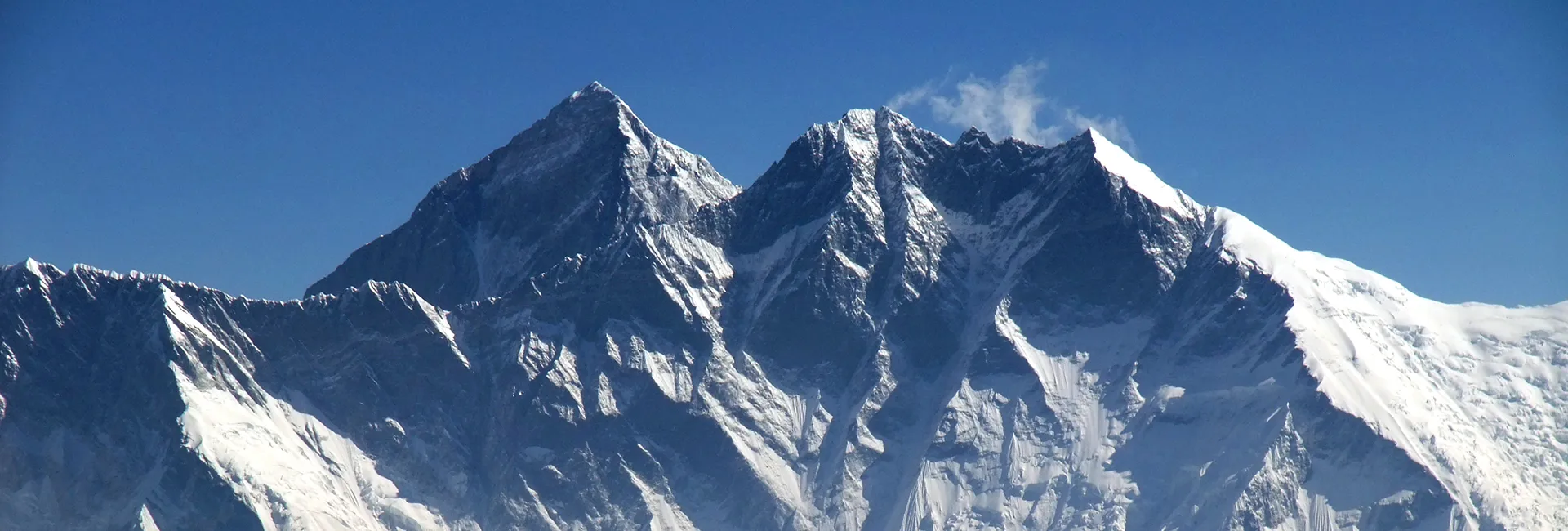
The peak itself lies in the famous Everest region of Nepal, in close proximity to Lukla. The surrounding peaks such as Kyashar, Thamserku, Numbur, KongdeRi,Chamlang, etc. are visible from the summit which makes up for a one-of-a-kind view. You can also see Everest, Makalu, and Cho Oyu on the way up.
Our Mera Peak Climbing trek itinerary takes you around the Everest region; we will walk on glaciers, forested trails, and snow-covered tracks, cross many streams and rivers, and ultimately climb the Mera Peak. This trek starts from Lukla, just like any other Everest region trek, from where we make our way to Paiya. The majority of the treks take you to Phakding but we will travel a road less chosen.
Before you actually decide to do the Mera Peak Climbing trek, please make sure that you are ready to prepare for the trek. This includes working out, hiking (if possible), and increasing your stamina. This is not a trek that you can do unprepared. The harsh cold temperature, the thin air of the Himalayas, and the extreme conditions overall require heavy preparations and prior trekking experience.
If you are unsure of this trek, here’s a detailed experience that might just help you decide.

The first day of your Mera Peak Climbing trek takes you to the lively city of Kathmandu. After you land at the Tribhuvan International Airport, you will first have to get to the immigration desk section to obtain the tourist visa. Meanwhile, one of our reps will be waiting for you at the terminal to welcome you and escort you to your stay for the night.
To get your tourist visa, you will need a couple of documents, proof of residence, proof of return tickets, a valid passport (valid for a minimum of 6 months), two passport-sized photos, and a bank receipt of the payment of visa fees. You can also apply for a tourist visa digitally by visiting the official site. It’s recommended to apply via an online form during the peak travel seasons as the immigration booth can get a bit cramped.
After you are officially done with your prerequisites, you can finally leave the terminal where our representative will find you. The driver will help you with your bags and transport you to your hotel.
Arriving in Kathmandu will definitely feel exciting as it is a city of temples and traditions. There are a plethora of temples and huge stupas such as Swayambhunath, Boudhanath, etc. Your time there will be anything but boring.


The 2nd day of the Mera Peak Climbing trek is spent preparing for the trek and perhaps a bit of strolling around the city if you are up for it. The trek guides will make sure that the equipment you are going to use is free of any defects, they will discuss the nuances of the trek, the itinerary, and things to keep in mind during the trek, and you will also be introduced to other participants of the trek.
You can also bring your own trekking equipment but most people tend to rent trekking gear from us or someplace else as it is quite the hassle to board the plane with your heavy gear. During your briefing session, please make sure that you are aware of the conditions of the trek and do not shy away from asking any questions you may have regarding the Mera Peak Climbing trek.
Day 3 of the Mera Peak Climbing trek is the first day of action. We will get up around 7 in the morning and get ready by 8 as we have an early morning flight to Lukla. “Why early morning? Can’t we schedule it for the afternoon?” you might be wondering. And the answer is “No”, we can not do it at any other time of the day as the afternoon winds are not friendly towards the mini aircraft.
Big planes do not go there as there is no big enough space for them to land, the small airstrip is just enough for small places. However, if you really do not want to get on an early morning flight, you can opt for a private helicopter ride which is more scenic and intimate but it will not be an expense that is covered by the Mera Peak Climbing trek package.
The flight to Lukla is rather short but it is one of the most scenic flights you will take. It will take us around 35 minutes to reach Lukla, a beautiful gateway village to the harsh Everest region. Following that, we will get on the track to Paiya, a secluded village that is seldom visited by trekkers.
Starting from Lukla, we will decend down head south crossing the HandiKhola, and reach another village named Surke, from where we will eventually reach Paiya after crossing the Chutok La Pass. The village is also referred to as Chutor after the nearby mountain pass.

It is the 4th day of the Mera Peak Climbing trek, we will wake up at an altitude of 2846 m or 9338 ft. At this height everything is normal, we will have our early morning breakfast before starting the trek to Pangum. Today’s trail spirals through hilly forests mainly consisting of Bamboo, Rhododendron, and Fir trees.
During the initial phase of today’s trek, we will descend a little before arriving at a small river. In that particular section can get a little slippery as the constant water flow enables algae growth. Crossing that section, our next destination will be Kari La Pass. The trail can get narrow in some sections but overall, today’s trek should not be much of a challenge.
Continuing trekking through the DudhKoshi valley, we will eventually reach Pangum village.
Day 5 of the Mera Peak Climbing trek is yet another easy trekking day. Following a hearty local breakfast, we will get on the track to Pangum La pass. The trail during this section is a bit steep but very manageable, to be honest. After crossing the pass, we will climb a bit further before reaching a plain section that takes us to the Peseng Kharka River. Continuing the trek, we will then reach Peeng Kharka Danda which will be our resting spot.
We will then descend a little to reach a small river named Ningsow before we actually reach the Ningsow village. This village sits at an altitude of 2863 m or 9394 ft; it should take around 5 hours to reach this village from Pangum. Here, we will have our lunch before heading towards Ramailo Danda. Will trek to Ramailo Danda (our night stay) which takes around 2-3 hours from Ningsow.
Day 6 of the Mera Peak Climbing trek is full of ups and downs. As always, we will have our breakfast before hitting the trail, an empty stomach will not get you very far. The trail begins with an ascend which turns to a descending track before rising up again. After this initial up-and-down section, we will reach RamailoDanda. This hill is a great viewpoint offering stunning scenes of the Mera Peak and the surrounding valley.
Continuing the trek, we will again ascend and descend to enter the Makalu BarunNational Park. From this point onwards till we reach our destination of the day, we will be on the famous PasangLhamu trail. Since we are inside a National Park, the chances of encountering wild Himalayan animals are high. Animals such as Wild boar, Pangolin, Red panda, Assamese monkey, etc. are the major species that inhabit the park.
Putting an end to an exciting day we will spend the night in ChhatraKhola. Today’s trek should last about 8 hours considering the ups and downs of the trail.
On the 7th day of the Mera Peak Climbing trek, we will gain significant altitude starting the day at 2800 meters and ending the day at 3691 meters above sea level. Going north following the Majang river basin, we will get on the standard Mera Peak trail. As we move up the valley, the trail connects to the Hinku River.
Following the Hinky River basin, we will soon reach the small settlement of TashingOngma where seasonal eateries are located. One of the best reasons to trek during the appropriate trekking seasons is to avoid the circumstances where you face a lack of services. Services are in full bloom during spring, autumn, and summer, any other time of the year is not deemed good for trekking.
After further trekking, we will reach the Sanu River bridge which indicates that we are close to our destination. Soon enough, we will reach Kothe where we will spend the night.
Trekking from Kothe to Thaknak will have us ascend over 650 meters over the period of 4 hours. This short but uphill day of the Mera Peak Climbing trek can be considered a difficult trekking day but it is still manageable. Our trek guides will make sure that you are not rushing and following a safe climbing rate so as to not get altitude sickness.
Today’s trail follows the Hinku River basin while the Mera Peak towers above us. The initial part of the day’s trek sees no sunlight as a result. After crossing this shadowed section, we will shortly reach Gondishung, yet another seasonal settlement that is mainly housed by shepherds. This small settlement is our lunch stop for the day.
From there, we will first pass the LungsumgbaGompa which is a two-century-old Buddhist monastery. This sacred building is one of the main stupas in the region and has a stoned-scripted map of Mera Peak. Eventually, we will reach Thanknak, 4358 meters, where we will spend the night.
Today is the day we reach the 5000-meter mark. Day 9 of the Mera Peak Climbing trek requires ascending almost 700 meters in just about 3 hours. Starting off the day, we will follow the Dig Glacier moraine to get to Dig Kharka. This small village offers a great view of the CharpatePeak.Going forward, we will get on the trail facing the front of Hinku Glacier.
Today’s trail, as you might have guessed, is a steep one as we cover 700 meters of ascend in just 3 hours. Khare is our base camp for the Mera Peak Climbing trek and you can enjoy the majestic view of the peak’s northern face from the village.
As we are now at 5045 meters above sea level, we should let our body acclimatize to the harsh conditions of the high Himalayan surroundings before we actually begin our Mera Peak climb. Our climbing leader will make sure that you are well-versed in the basic climbing techniques. Over the day, he will go through all the things you need to be careful of and go through how every gear is supposed to be used.
After the basic training session is over, you are free to explore the surrounding area. We will spend the night in Khare but before that make sure that you climb at least a hundred meters as climbing high and sleeping low is proven to be the most effective preventive measure against altitude sickness.
Day 11 of the Mera Peak Climbing trek is the start of the climax you have been waiting for. We will climb to the Mera high camp 5780 m following the Mera glacier. The initial portion of the climb is easy but as you get high, you need to be very exact on where you place your foot. You should always follow in the footsteps of the climbing leader.
In about 3.5 hours we will reach Mera La, 5415 m, our first resting point. The scenes you will see along the way are ones you won’t forget easily. After taking in the one-of-a-kind view of the Himalayas, we will begin our climb to the high camp. Soon enough we will reach the section of glacier cracks (crevasses). These deep cracks run down several hundred meters but with the help of our expert climb leader, you will avoid these dangers.
After crossing these crevasses, we will finally reach the high camp (in about 2.5 hours from Mera La) where scenes of Mt. Makalu, Lhotse, Nuptse, and Everest are apparent.
The ultimate day of the Mera Peak Climbing trek is here. From the high camp, it takes around 6 hours to reach the summit of the peak which is why we will start very early in the morning, preferably around 2 AM. The starting section of the Mera Peak Climbing trek is easygoing and soon gets tougher as we reach the steep ascend over snow-covered track. It’s very crucial to not rush and conserve our energy as much as possible.
Reaching the summit, a rush of adrenaline will overpower you as you feel a sense of conquer. We will spend some time at the summit, resting and taking tons of photos, before heading back down to high camp and ultimately to Khare. Getting back down to Khare from the summit of Mera Peak takes around 5 more hours.
This day is reserved in case we experience an unforeseen situation that limits our daily activity or forces us to stay put. If everything goes well, we won’t be needing this way, which happens 90% of the time
We will go through a great descent today as we will drop down to 3691 meters in Kothe from 5045 meters in Khare. First off, we will reach Thakank in about 2 hours of descent and ultimately Kothe in about 3 more hours. We will cover approximately 13.5 kilometers in the process. Kothe is the best place to celebrate your successful Mera Peak Climbing trek.
Today’s trek takes us along the Inkhu river basin crossing several small streams on the way. Soon enough, we will reach a junction from where we will turn right to reach ThuliKharka. On the way, we will pass by many Chortnes (small Buddhist stupas) and sharply descend before arriving at our destination.
Day 16 of the Mera Peak Climbing trek offers stunning views of Mt. Khangru, Kongde, Cho Oyu, Numbur, and more as we cross the Zatrwa La pass. This 4600-meter tall pass is the descending point of the trek. From there, the trail is all downhill till we reach Lukla in about 6 hours. We will spend the night in Lukla as there are only morning flights that head out.
The next day we will get on the flight to Kathmandu, remembering all we have experienced during the past 2 weeks. After we reach Kathmandu, we will take you to your hotel and you can spend the rest of the day visiting the different temples and historic buildings of Kathmandu valley.
This is the final day of the Mera Peak Climbing trek. We will drop you off at the airport, say our goodbyes, and hope to see you soon again for yet another Himalayan adventure.


The Mera Peak Climbing trip starts from Kathmandu where you will be briefed on the details of the journey and properly geared. Arriving at Kathmandu counts as the first day of the trek as we receive and escort you to your accommodation. On the 2nd day, we will prepare you for the trek, and on the 3rd, you will get on a flight to Lukla and trek to Paiya village. We will spend the night at Paiya, ending the 1st trekking day of the Mera Peak Climbing trek.
Climbing the Mera Peak is definitely a tough undertaking as you have to trek through snowy trails and climb a literal mountain while the temperature is well below 0°C and the oxygen level is 47% of sea level at the summit. Given the facts, the Mera Peak Climbing trek is graded as a strenuous trek but it is definitely doable as it has a success rate of 90%.
The difficulties that you will face during this trek are the harsh cold and dry conditions of the Himalayan, the significantly low oxygen level, and the risk of getting altitude sickness. However, we can successfully combat altitude sickness by following simple preventive measures. Please let the guide know if you are feeling unwell or if you have any questions regarding altitude sickness.
The best seasons for the Mera Peak Climbing trek are spring, autumn, and summer in no particular order as all of them are great choices with different cons. Spring brings out the birds and animals as nature resets itself. The season of autumn is the driest period of the three, offering minimal rain and snowfall. Lastly, the summer season is agreed upon to offer one of the best views but it will rain quite often in the lower regions.
If you are planning to do the Mera Peak Climbing trek during the off-season, you should be prepared to face minimal amenities and less active teahouses since the people in the mountains avoid the high altitude in winter and monsoon. They usually migrate to lower regions to avoid the cold and snowy periods.
No, we recommend beginners to not join this Mera Peak Climbing trip as it is graded as a strenuous trek. The grading does not only mean that the climbing is difficult, it also means that the environmental conditions are harsher in comparison. Sure, a beginner with stamina can handle the physical requirements of the trek but the environmental conditions take a mental toll.
Not to mention, beginners are usually not well versed in the little details of trekking such as gearing up properly, making sure you are following the preventive measures for sickness, and keeping yourself well hydrated. These things seem trivial but they will make a huge difference in the Himalayas.
As the name suggests, the Mera Peak Climbing trip is a literal mountain climbing journey which means you will be well above 5000 meters above sea level for a couple of days and above 4000 meters for a couple more. Altitude sickness at 4000 meters of altitude is not very impactful but once you reach 5000 meters it becomes the biggest sickness.
If altitude sickness is unchecked and not properly treated, it can be fatal which is why our guide will check your oxygen levels every night and every morning to make sure we can prevent the sickness as early as possible. If you are feeling the symptoms, please let the climb leader or trek leader know about it and you will be brought down to a safer altitude. Symptoms of altitude sickness include mild headache, nausea, fatigue, vomiting, loss of appetite, and more.
However, altitude sickness can be easily treated with simple preventive measures such as keeping oneself well hydrated, following a safe pace of ascent, and climbing high and sleeping low. If you suffer an extreme case of altitude sickness, which is unlikely given we will follow the preventive measures, we will contact the emergency services. You will be transported to the nearest medical facility via helicopter.
Accommodations in Kathmandu are upgradeable at a price but during your trekking days, you will have to adjust to what’s available. Highland accommodations are often the most basic form of stay with minimal extra services. Getting modern materials and services to these villages is difficult hence they just stick to what they have and provide you the best they can. We believe the remoteness of the stay adds to the experience of the Mera Peak Climbing trip. Services such as hot showers and internet connectivity are often charged separately in highland accommodations.
During your Mera Peak Climbing days in the Himalayas, we will provide you with 3 meals per day (breakfast, lunch, and dinner). You are free to choose anything from the menu but we recommend that you stay clear of meaty meals as most villages do not have proper refrigeration. Animals that are locally found are not primarily seen as a source of meat, they are used to transport goods, get wool, and other things.
So, the villagers often resort to importing meat from lower region villages which is transported on the back of cattle or human porters. This increases the chances of meat being foul after it spends hours in the open air. Going full vegetarian is the best way, the veggies are locally sourced and you can also try the local dishes.
Drinks should be limited to tea and water, if you happen to find energy drinks, it’s fine but do not go for the locally brewed alcohol. Alcoholic drinks are known to dehydrate your body which is an invitation to altitude sickness. Warm teas of different flavors or just warm water is the best choice.
All of the different transportation required from Day 1 to Day 18 of the Mera Peak Climbing trip will be provided by us, as a part of the trek package. Note that your international flights are not a part of the trek package. Upgraded flights are also not a part of the trek package. All we provide is road transport as per the itinerary and flight to and from Lukla.
For this Mera Peak Climbing trek, trekkers are required to have the Makalu Barun National Park permit, Sagarmatha National Park permit, and the KhumbuPasangLhamu Rural Municipality Permit. All of these permits are a part of the Mera Peak Climbing trek package. Our trek guide will help you obtain all of these passes; you do not have to pay extra for them.
The Mera Peak Climbing trek is regarded as a strenuous journey with lots of ascent and snow-covered tracks. Needless to say, one must be physically fit and in good shape to be able to traverse this lengthy and challenging Himalayan journey. The best way to prepare for this trek would be to go on short hikes and do cardio workouts to increase your endurance.
Stamina is very necessary for this Mera Peak Climbing trek as we have to cover a lot of ground. If you are constantly worrying about your ability to make it to the next destination, you will not enjoy the trek as much. There are a lot of things that make up for a great trekking experience, and having the required physicality is definitely one of them.
The Mera Peak Climbing trek is priced at USD _______ per head. Considering the services, conveniences, and facilities we provide to you from the get-go to the final day of the trek, our pricing is reasonable and valid. You can also get a detailed breakdown of the total billing. You should carry some hand cash with you since the highlands do not have ATMs or major banking branches for you to withdraw money from. You will also have to put a $500 dollar deposit while visiting the highlands which is regulated as a garbage management deposit. You will get this money back while returning from the Mera Peak Climbing trek.
Charging your electrical devices should not be an issue for the most part but you might face some power outages. Most of the villagers and establishments have solar panels to combat this, however, these panels are mainly used for lighting purposes. If you want to charge your devices using solar power, you might have to pay a small fee.
If you are someone who enjoys luxury, you can simply ask us to arrange an ultimate staycation while you are in Kathmandu. You should ask for upgrades during the booking phase so we can arrange the necessary services with ample time. Luxury stay is not an option during your trekking days as it is very difficult to get even the basic things and amenities in remote Himalayan villages.
As mentioned previously, you canopt for a private helicopter flight if you wish to fly to Lukla at your preferred time of the day. These private flights fly throughout the day and given the open space of the helicopter ,you will be able to see more of the scenes from high above.
Note: Add-ons are not a part of the Mera Peak Climbing trek package itself, but rather special arrangements that should be paid for extra.
From the high camp, it will take us anywhere from 4.5 to 5.5 hours on average to reach the summit of the Mera Peak. On the way down the travel time is cut by more than half, lasting just around 2 hours.
No, a beginner should stay away from this trek unless he builds enough trekking experience. This is a strenuous trek which tests the physical capabilities of the trekkers.
In terms of difficulty, it’s clear as day that Mera Peak is harder. The EBC trek is a lengthy trek that has similar environmental conditions to that of Mera Peak but the extra effort of having to climb a peak makes it a comparatively harder journey.
For the majority of the trek, you will not encounter tricky situations, it is pretty straightforward but once you begin climbing the peak, it will get technical.

Need help?
Talk to trip expert