English
 Dutch
Dutch Japanese
 Hindi
Hindi Italian
 Spanish
 French
 German
 Chinese
 Korean
 Arabic
 Hebrew
 Russian
 Portuguese
 Danish
 Czech
Czech Polish
 Swedish
Need help?
 +977 9767994912


Trip Duration
10 Days
Trip Difficulty
Difficult
Max. Altitude
6,461m / 21,198ft.
Activity
Climbing
Destination
Nepal
Group Size
1-16 Pax
Accommodation
3 star Hotel
Meals
Breakfast, Lunch, Dinner

Need help?
Talk to trip expert
Do you want to conquer the solid height of one of the most fascinating trekking peaks in the Himalayas? Do we hear yes, then come with Sherpa Discovery Treks for ten days on Mera Peak climbing with helicopter return expedition where the unique twist awaits you on return.
On our 10 days Mera Peak climbing with helicopter return adventure, you will ride back to Lukla by helicopter saving your precious time and energy on your return along with the exhilarating experience.
Our Mera peak climbing with helicopter return will take you to the exceptionally accessible Mera summit which is considered to be technically extremely easy given the conditions in the Himalayas.
Erected inside the peaceful atmosphere of the Makalu Barun National Park on the south of Mount Everest right next to the Everest National Park between the Hinku and Honku Valleys, the Mera Peak has three identical summits: North Mera (6476 m), South Mera (6065 m), and Mid Mera (6461 m).
The southern and the northern brothers of Mera is too complicated to reach so our Mera Peak climbing with helicopter return adventure will concentrate on the central or the Mid Mera Summit.
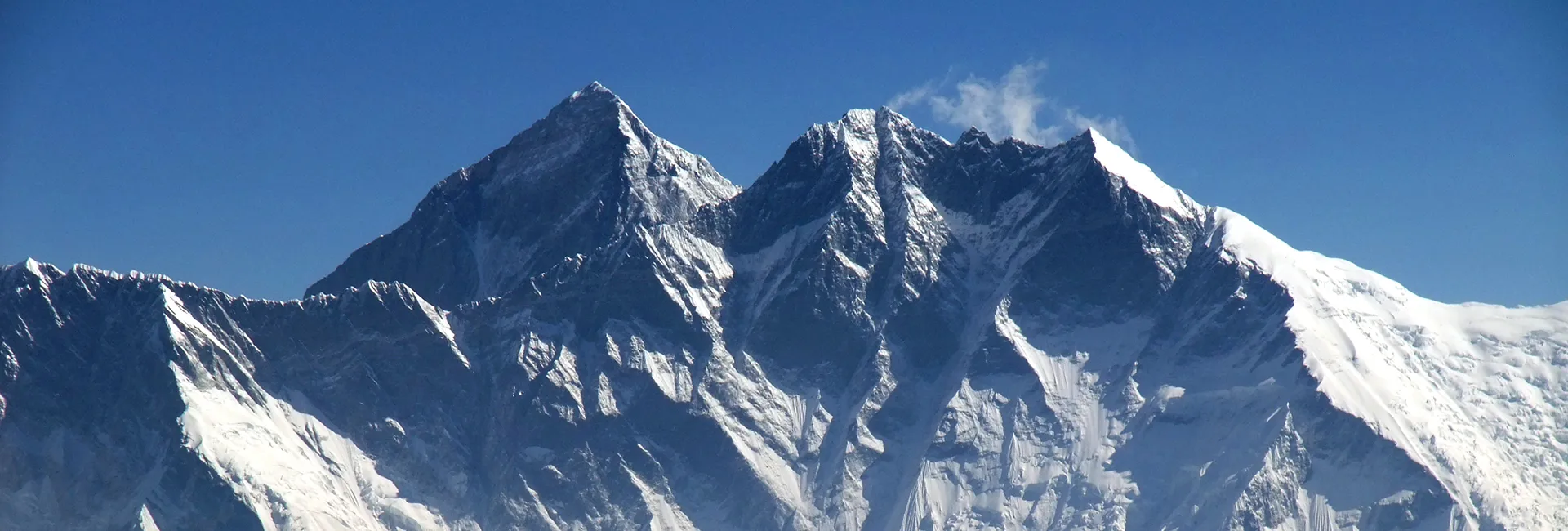
First triumphed on 1953, 20th May by Col J.O.M. Roberts and Sen Tenzing , the Mera Central Summit is also the outstanding beautiful vantage points to see Lhotse (8516 m), Kanchenjunga (8586 m), Makalu (8463 m), Cho Oyu (8201 m), Everest (8848 m), Nuptse (7855 m), Ama Dablam (6812 m), Lobuche (6145 m), and Chamlang (7319 m).
Additionally, there will also be the crossing of the breathtaking heights of two mountain passes of Zwatra la Pass (4600 m) and Mera La (5245 m). You will also have an interesting encounter and interaction with the Sherpa People known around the world for their authentic time-honored Buddhist tradition.
Our Mera Peak climbing itinerary will first fly you to Lukla from where you will begin walking through the silent trails of Chhuthang, Thuli Kharka, Kothe and Thangnak.
You will have then an acclimatization day at Khare where our Sherpa guide will provide you crucial training in climbing techniques to ensure a safe and enjoyable ascent.
Finally, when you will have successfully completed the Summit attack, you will then move down back to Khare and ride in helicopter to Lukla and depart to Kathmandu.
Thus the trekking journey to Mera Peak is very pleasant with reduced time and not technically demanding as well. In short, our Mera peak climbing with helicopter return journey can be taken by people who already have some experience at higher altitudes.
In fact, this expedition will be very good for people who want to reach higher with time such as over 7000 m or 8000 m. We also like to emphasize that Mera Peak does not require a very long amount of time for acclimatization and setting up permanent camps. Trekking according to our Mera Peak climbing with helicopter itinerary is quite enough for our body to acclimatize.

Our exciting Mera Peak climbing itinerary today will take on a remarkable short flight to Lukla known for its most interesting airstrip. At Lukla, we will meet the rest of the Mera Peak climbing expedition team, Mount Kongde Ri, and then move on with our first trek.
The pine and rhododendron jungle path alongside the peaceful Dush Koshi will direct us southeast. Shortly, we will be inside the Conservation Area of Makalu Barun.
After registration at its checkpoint, a trail with chorten, Mani Walls and stupas will lead us to Chhutang within 2 hours.
Important Note
Please understand that the TIA may re-shift the Lukla flight to Manthali Airstrip in Ramechhap during the spring and fall time in Nepal which are the two very peak hiking and mountaineering times. The same re shifting can occur at times of return from Lukla as well.
Sherpa Discovery Treks will arrange a private vehicle for your back-and-forth transfers between Kathmandu and Ramechhap.


We have a challenging path ahead today. First, we will cross the Kalo Himal Ridge which may take around 3 to 4 hours. This ridge is like a border between the valleys of Khumbu and Hinku.
A steady descent from this ridge will guide us to Kharitang Village (3900 m). From here, the constantly rising track will guide us over the 4600 m height of Zwatra la Pass.
Everest, Kogde Ri, Lhotse, Kusum Kanguru, Kanchenjunga, Makalu, Numbur and Cho Oyu are the snowy titans that can be seen clearly from the pass.
We will now progressively advance down to Thuli Kharka where we will have a peaceful overnight stop.
The path beyond Thuli Kharka will consistently advance us into the Hinku Valley. The Hinku River will take us up to Tashi Dingma and then downward to Tashi Ongma.
The path will now unwaveringly rise till we are Kothe aka Mosom Kharka. Mera Peak shines with its beauty in the distance.
From Kothe, we will follow the ridge above the Hinku Khola and meander through Hinku Drangka to the small settlement of Gondishung. A little further, we can take some moments to see the 2 century-old Lungsumgba Gompa (Monastery).
We will push on for one more hour of climbing after which we will be settling at Thangnak with Charpate, Peak 43, Mera, Kusum Kanguru, and Thamserku in view.
From Thangnak, we will be involved in thirty minutes gentle upward trek till we are at Sabai Tsho glacial lake (4463 m). Now, a rigorous uphill trek along the rocky walls of Dig, Hinku Nap, and Shar Glaciers will take us to Khare.
The unobstructed glorifying beauties of Kyashar, Mera, Kusum Kanguru, and Kangtega welcome us in Khare.
To give our body the extra time to adapt to the changing high environment, we will rest at Khare today. We can choose to briefly hike up to Mera Glacier or Khare Ri (5500 m).
The Mera Glacier route runs over the large boulders while the Khare Ri route follows the challenging rocky terrain. Either way, you will be able to straightly look at the north wall of Mera and 5245 m Mera La Pass.
Later, our guide will help us inspect our essential gear and give us some brief prep sessions on utilizing the harness, ropes, crampons, and ice axes.
From Khare, the uneven tough glacial trail will take us to the glacial ridges towards Mera La Pass. This pass acts as a tall border between the valleys of Hinku and Honku.
From this Pass, we will slowly go downhill for about 100 m and set up our tents at the base camp of Mera Peak. The Everest, Mera, Makalu, and Lhotse rise high in front of us as we prepare for one more climbing session at our camps.
From the Mera base Camp, we will now smoothly climb along the not-so-difficult and technically uncomplicated trail to the Mera High Camp. There can be some crevasses so we will be tied with ropes if needed.
Here, the tents will be set up and we will take a closer look at Nuptse, Makalu, Everest, Lhotse, Mera, Cho Oyu, Baruntse, and Chamlang. We will have a final attack on Mera tomorrow so we will make sure will sleep early tonight.
Finally the summit day is here! Our summit push will begin very early at around 3 AM. With our guide showing us the trail, we will traverse a difficult terrains and icy slopes with crampons and ropes whenever required.
The final 50 m stretch will be glaring at us where our guide may decide to use the already installed railings but not before he inspect the safety first.
Here we are at the summit of the grand Mera where Lhotse (8516 m), Kanchenjunga (8586 m), Makalu (8463 m), Cho Oyu (8201 m), Everest (8848 m), Ama Dablam (6812 m), Chamlang (7319 m), Nuptse (7855 m), and Lobuche (6145 m) will be staring at us.
After we celebrate at the Mera Summit, we will take a mild descent to Khare where we will wait for our helicopter to travel us back to Lukla.
Today very early in the morning, we will take off for 30 minutes air journey to Kathmandu. If we need to land at Ranechhap Airstrip, Sherpa Discovery Treks will look after your transport to Kathmandu via private vehicle.
You will be then taken back to your hotel where celebrate your incredible accomplishment of reaching the Mera summit.


We have altogether three flights involved during our Mera peak climbing with helicopter return expedition. Also, we need to walk the long trekking trail and stand atop the Mera Summit.
Therefore, we must have the driest and clearest weather, ideally with minimal or no rain. In Nepal, we can get these favorable conditions in spring (March, April, and May) and autumn (September, October and November).
The spring paints the landscape in vibrant green and crimson color with an abundance of trees and rhododendrons. The walking temperature during the day also remains calm with the lively creatures spotting on the trail.
The autumn brings in excellent transparent Himalayan views, lively festivals, and very tranquil heat essential for long day walks. Both spring and autumn present the ideal climatic conditions for the heli ride as well.
Starting from December, the temperature around Mera Summit begins to decline ultimately reaching minus 20 degrees Celsius. The progressing trail to the High Camp and summit can also be tricky with numerous crevasses in between.
Commencing from June, rain start to wet the landscape around Mera Peak with frequent occurrence of avalanche at the Passes and the base and the High Camp.
Mera Peak is rated as a 2C Peak which means the summit is of moderate challenge with no technical hurdles. Of course, climbing the summit requires effort but it is not overly complicated.
The climb is also pretty simple and accessible making it a perfect try out peak for the beginner. And, as for the hiking part, the trail is rated level 2 which is again moderate in nature.
Beginning from the low forests, the main challenge will appear as Zwatra La Pass where the rocky landscape prevails. After Kothe, the trail again return to be green.
However, as the trek progresses, the weather becomes alpine and harsher. The ascent will then proceed from the base and High Camps along the ice and snow zone.
Another hurdle stands here in the form of Mera La Pass, however, the approach will be on a gentle slope. The final 50 m ice ledge before the Mera Summit is tackled with the handrails.
Mera Peak approaches nearly 6500 m elevation so it doesn’t demand strong skills, gear, or long acclimatization time. Also, the tent camps will only be needed for your time at the base and advance camps of Mera Peak.
Our Mera Peak climbing itinerary supports all your camping experience and have also placed enough rest days with training sessions from our expert Sherpa climbing guide.
The trekking days also consist of a gradual pace allowing your body to adjust well before attacking the height of the Mera Summit. Thus, the Mera Peak climbing with heli return trip is open to those who have already done some high-altitude hikes in the mountains.
As for the summit, it is very beginner friendly and serves as the major milestone for those who later wishes to try new heights reaching above 7000 m. Additionally, to ease your expedition, a helicopter will carry you back to Lukla.
Altitude can sometimes may pose a challenge but it can be overcome with determination.
On our Mera Peak climbing with Helicopter return expedition, you won’t face a long return trek. However, the journey up to the summit will be on foot when you will walk the 75 km long up and down route which will ultimately conclude at 6461 m elevation of the Mera itself.
The hiking portion also demands ou t walk for 5 to 6 hours each day traversing the varying terrain with both climbs and descents. Most part of the expedition will occur above 3000 m height.
Taking these into account, we have placed rest day at Khare followed by only 2 hour upward climb to the advance camp of the Mera Summit before pushing for the peak.
We also have designed our Mera Pak climbing itinerary with a consistent pace. However, altitude sickness which you may understand as acute mountain sickness (AMS) can still appear in some climbers.
The condition may cause your body to show signs such as body aches, fatigue, nausea, and headaches. To promote your adaptation and prevent the manifestation of the condition, you can choose to take Diamox.
We also suggest that you walk very gently avoiding the hurried steps particularly in the initial phase of the journey. Please also change your diet, sleep pattern and drink water as much as you can even when you are not feeling the thirst.
There is no need to stress about AMS as our climbing guide will keep a very close eye on the health condition of each climbers. If any one of you show persistent AMS, he will act accordingly taking you lower or postponing your climb by few days.
Mera Peak comparatively a straightforward peak but it is also not a simple Himalayan peak. So we encourage you to get in shape before you set forth to triumph this summit.
Please aim to engage in physical sports and activities minimum three to four times a week few months before our 10 days Mera Peak Climbing with heli return begins.
Commence your routine by walking a few km (2 to 3 km) with light weight backpack on your shoulder. And do not forget to include more vigorous exercises as well such as swimming, cycling, and do sports such as badminton, basketball, football or volleyball.
Gym workouts will also benefit you such as on the treadmill or weight lifting. Running and stair climbing are yet other simple but very advantageous activities that will prepare your legs for the climb. If you are interested then you can also go for the rock climbing training.
For practical aspect, talk with someone who have already climbed peaks of high altitude. Their experience will prepare you for the out comings of the trip. Also collect the right information about the weather and landscape surrounding the Mera Summit.
The Mera peak climbing route that we have proposed here is quite long but effective, simple, and beginner-friendly because of its plenty of chances for acclimatization.
However, if you want a certain spice of thrill and challenges, then you can reach the Mera Summit from another route as well. This approach will travel you through Paiya, Pangkongma, Ramailo Danda, and Chhatra Khola, ultimately linking you to the trail coming from Kothe.
The advantage of this approach is that you will get to see Khatang, Tang Ragi Tu and some other less known Himalayas of the region other than Everest.
If you want to hype your adventure level, then consider adding one or more Himalayan peaks to your travel program such as Lobuche and Island.
However, if you don’t want the challenge of the peaks but still looking for the extra sense of thrill, then you can also integrate the Amphu Labtsa Pass (5845 m) or Mingbola Pass (5816 m) crossing in your itinerary.
Sherpa Discovery Treks will see to the management of your place of stay, eating and traveling arrangements during the trekking and climbing portion of Mera Peak climbing with helicopter return adventure.
In the overnight villages, we will organize for you the double room of the cozy little tea houses often run by the Sherpas. Sometime you may have the triple or four beds as well with limited basic furnishings. Sleeping bag of your own will be of great help to escape the colds of the night.
You may get hot waters, WiFi and device charging facilities as well on request at few extra bucks. Also keep in mind that most of the toilets on the tea houses will be in squat style which may have to shared among travelers.
For the camping arrangements, our team will set up the durable warm two person tents at the base and the High Camps of the Mera Summit. You will have individual tents for the eating, sleeping and latrine.
Concerning your food arrangements, three courses (breakfasts, dinners and lunches) with fresh fruits after your evening meal will be given to you at tea houses and in the camps.
For your transports, a private vehicle will be available for all our domestic airport transfers. Our team will also pre-organize you Kathmandu/Ramechhap and Lukla back and forth internal flights. For the Ramechhap transfer, a private 4 wheel will be utilized and a shared helicopter will be organized for your trip from Khare to Lukla.
Mera Peak although a trekking rated summit still is a Himalayan climb that reaches almost 6500 m. Therefore, a permit to ascend the peak from the NMA (Nepal Mountaineering Association) is mandatory.
The price of this permit varies with season with spring being the pricey one costing you US Dollars 250 per climber. The autumn is the second expensive season which need US Dollars 125 per climber and summer and winter are less expensive needing US Dollars 70 per climber.
Another permit that we will be procuring for our 10 days Mera peak climbing with heli return is the permit to get inside the Makalu Barun National park that costs US Dollars 30 per climber.
Both the climbing and the National park Permits are available in Kathmandu through the NMA and the tourism office. Sherpa Discover Treks will take care of the permit logistics.
We cannot stress how important and necessary the travel insurance is for our Mera peak climbing with helicopter return expedition. It is not only an advisable component but also absolutely necessary for our travel.
Please understand that NMA will deny the Mera Peak climbing permit if you don’t have the right travel insurance policy with you. Please note that your insurance should stay active for ten days time of the expedition.
It should have the coverage for the special hiking and climbing activity in the mountain of up to 6500 m altitude. Specify clearly to your insurer that your climb will be utilizing the gear such as crampons, ropes, jumar, harnesses and ice axes.
This way our insurer can suggest the right coverage for you. Also ensure that they will provide you the necessary helicopter or air ambulance service when needed to 6500 m elevation.
Also, check whether our insurance will cover for your medical and hospital bills when needed along with the few extended days in Nepal, expedition delays or cancellation, flight postponements or delays and your baggage losses or theft.
Mera peak is a 6461 m high peak, island peak stands at 6165 m, and Lobuche at 6119 m. Among the three Mera erects as higher but it is the simplest of the three while Island ranks second and Lobuche third. It means Lobcuhe Peak will be the hardest to climb. It is because of the route leading to Lobuche and Island that are technically more demanding than of Mera summit. The Lobuche and Island Summits are also quite treacherous to climb with more steeper inclinations. So Mera Peak for your first climbing adventure will be a better option for you.
Generally, within 4 to 5 hours, you will be standing atop the Mera Summit.
If we have very optimal clear weather, then we can stand here for 5 to 15 minutes.
Our expert Sherpa climbing guide and team will do their best to take you to the summit top but it cannot be guaranteed as you said. You may feel nervous, sick or may not be able to go on. Still, you will be able to touch the iconic landmark of its base or high camp. And Mera Peak will remain standing where it is for you to try in next season.
NTC will be a better choice after all it is a government owned network that has more coverage in the area than NCELL.
You will be able to use WiFi when you are till Khare, afterward, you may have to opt for the 4G data of NTC.

Need help?
Talk to trip expert