English
 Dutch
Dutch Japanese
 Hindi
Hindi Italian
 Spanish
 French
 German
 Chinese
 Korean
 Arabic
 Hebrew
 Russian
 Portuguese
 Danish
 Czech
Czech Polish
 Swedish
Need help?
 +977 9767994912


Trip Duration
4 Days
Trip Difficulty
Moderate
Max. Altitude
3,210m / 10,531ft.
Activity
Trekking
Destination
Nepal
Group Size
1-16 Pax
Accommodation
3 star Hotel
Meals
Breakfast, Lunch, Dinner

Need help?
Talk to trip expert
The standard Poon Hill trek lasts about 5 to 7 days while our Poon Hill Short Trek takes only 4 days to complete. This amazing journey to the highlands of Annapurna villages is full of beautiful scenes that are too good not to take a photo of. We recommend bringing tons of Gigabytes because you will need them to capture all the interesting things you will witness along the trekking trails and the gorgeous Himalayan scenes.
This trek takes you to a maximum elevation of 3210 meters above sea level, at the viewpoint of Poon Hill which is the climax of this Poon Hill Short Trek. This ultimate destination lies within the Myagdi district, one of the amazing regions within the Annapurna Conservation Area Project (ACAP). This protected region is home to hundreds of different types of birds and animals.
If you want to witness the animals and birds in full activity, you should do this trek during the spring season. You are not likely to find bears, wild dogs, jackals, foxes, and other carnivores at any point during this Poon Hill Short Trek, since it is a safe trekking destination. But you are likely to encounter deer, monkeys, rodents, wild cats, and more. This is a short 33 km trek, where you will also get to see peaks such as Huinchuli, Annapurna I, Dhaulagiri, Machhapuchhre, and more.
In addition to wildlife and natural scenery, you are also going to experience the traditional Gurung and Magar culture. We will be staying in remote, authentic villages dominated by Gurung and Magar communities. They are known for their easy-going nature and warm hospitality, along with rich traditional heritage and culture. You will have plenty of opportunities to experience their customs and practices and taste their traditional delicacies. Let’s learn more about this short and rewarding trek, starting with its highlights.

Today is your first day of the Poon Hill Short Trek and also the shortest trekking day of the journey. Our day will begin in Pokhara, where a private jeep will be waiting for us to take us to Hile. This ride is 52 km long and takes us about 2.5 hours to complete. The road condition along the Pushpalal highway and Pokhara Baglung highway is in great condition, but once we part ways with the freeway, we will be on a gravel road. These roads can be dusty and muddy depending on the weather conditions.
After completing the ride, we will grab our bags and hit the trails to start our trekking days. Sherpa Discovery Trek’s strong porters will carry your luggage, but make sure that you do not cross the 9 kg weight limit per person. Any extra weight will be accounted for and treated as extra weight, which calls for extra fees. The trek guide will lead the way, and all you have to do is follow the lead and enjoy the surrounding scenes.
Our destination of the day is the Magar village of Ulleri, which sits at 2050 meters above sea level. From our starting point in Pokhara, we will gain more than 1200 meters at the end of the day. The total trekking distance is 3.25 km, while the trekking hours are just 2 to 3 hours. The trek begins from Hile, making our way through small villages, terraced farmlands, and green surroundings.
We will soon reach the village of Tikhedhunga, where we will take a much-needed rest. It’s a serene village and a common resting place, so be prepared to meet a bunch of other trekkers. Continuing the trek, we trail turns steeper as we approach the 3000+ stone steps section. This is probably the hardest part of the entire Poon Hill Short Trek itinerary. We will be taking short breaks occasionally to make it through this section.


The 2nd day of the trek requires over 8 km of day trekking, which takes about 4 to 5 hours to complete. We will start the day at 2050 meters above sea level, and gain over 750 meters to arrive at the Magar village of Ghorepani, which sits at 2860 meters above sea level. Today’s Poon Hill Short Trek starts with a gradual ascent passing by terrace farmlands and forested sections full of rhododendron trees. These trees fully bloom during the spring season, specifically from March to April.
Continuing the ascent, we will shortly get to Banthanti village in just about 1.5 to 2 hours from Ulleri. This tiny village sits at 2250 meters above sea level and is our first resting spot of the day. There are a couple of tea houses, where you can have some warm tea or get some fresh beverages. After about 15 to 20 minutes of a break, we will resume the ascent and go through lush forests. This part of the section offers great views of the Annapurna valley and the peaks in the north.
After about an additional 1.5 hours of trekking, we will reach Nangethanti, reaching an elevation of 2460 meters above sea level. This is where our lunch will be served, and it is also the last village before we reach Ghorepani. From Nangthanti, the trail maintains a steady ascent all the way with vibrant Rhododendron forests. It will take us about 1.5 hours to reach our destination for the day.
We will check-in at our accommodation for the night and explore the village a little before ending the 2nd day of the Poon Hill Short Trek. You will get to see a great scene of the Dhaulagiri Himalayas and the Annapurna peaks from this village. You are highly likely to be a guest at the nightly performance set up by the local community to welcome visitors to their village. This program will include singing and dancing, and the theme will be traditional Magar culture.
Day 3 of the Poon Hill Short Trek is the longest trekking day on the entire itinerary. Today’s trekking distances are 2.9 km from Ghorepani to Poon Hiil round trip, and 10.7 km from Ghorepani to Tadapani. We will be covering a total of 13.6 km throughout the day, which will take us about 7.5 to 8.5 hours to complete.
First, we will get up to 3210 meters above sea level at the viewpoint of Poon Hill, then we will get back to 2860 meters at Ghorepani, and end the day at Tadapani, descending to 2630 meters. Today’s total elevation loss (from Poon Hill) is 580 meters. Needless to say, today’s trek is going to be long and tiring.
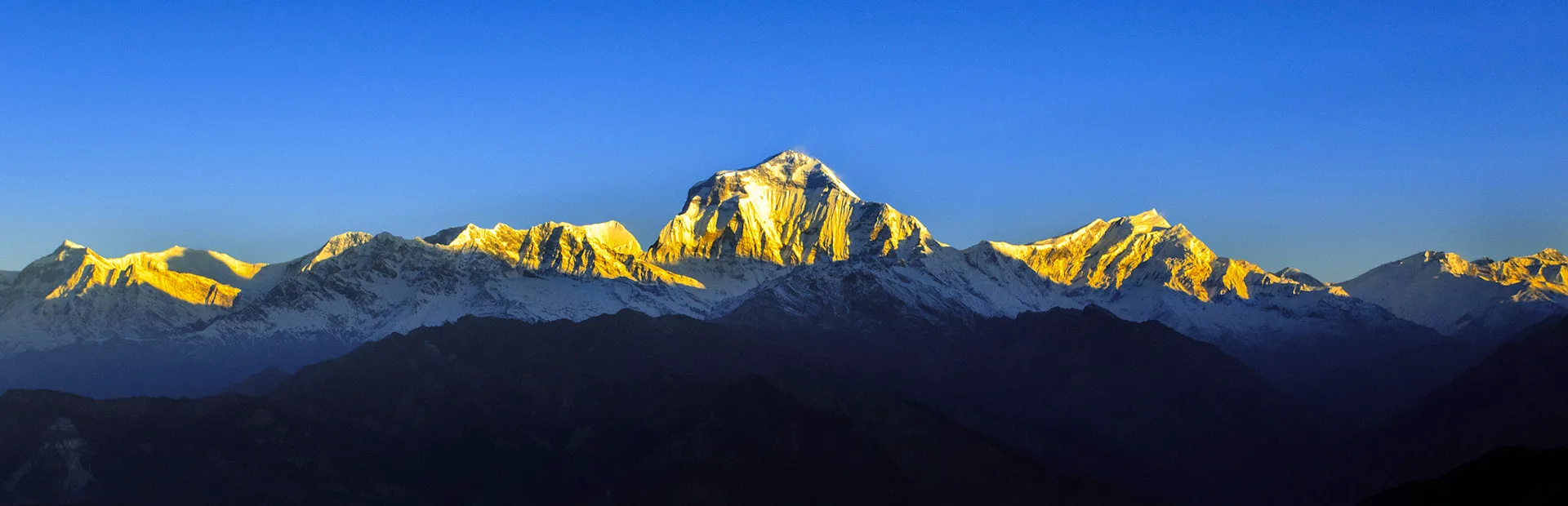
We will start the day at around 4 AM in the morning since we want to get to the viewpoint before the sunrise. The hike to Poon Hill is just about 45 mins to an hour long, gaining us 350 meters of elevation; this the highest point of our Poon Hill Short Trek. From this viewpoint, the sunrays look incredibly aesthetic, especially with the glowing surroundings as the sunrise illuminates the entire valley. The Dhaulagiri mountain range and the Annapurna mountain range are the dominant peaks on the scene.
After spending quiet some time at Poon Hill, we will get on the way back to Ghorepani. We will have a hearty and filling breakfast to fuel us for an exhausting trekking day. After our morning meal, we will grab our bags and get on the trail to Tadapani. We will first get to Deurali Pass, reaching 3090 meters; we will slowly descend a rhododendron forest for about 1.5 to 2 hours to get there.
Continuing the descent, we will trek 2 more hours to get to Banthanti, our lunch spot of the day. After an energizing lunch, the trail descends further to a small bridge, crossing the Modi Khola River. This suspension bridge is decorated with Buddhist prayer flags, much like any other bridge in the region. After crossing the bridge, we will ascend for about 30 minutes to get to our destination of the day.
Today is the last day of the Poon Hill Short Trek, and the total trekking distance of the day is slightly over 8.5 km with an elevation loss of almost 700 meters. Our starting elevation of the day is 2630 meters, while the day ends at 1940 meters as we reach the famous Ghandruk village. It’s a short trekking day today, 3 to 4 hours, as we would like to take it easy after a long and tiring previous trekking day. This aesthetic and charming village is one of the major villages of the Annapurna region, thanks to its size and easy accessibility.
We will start the descent with a trail through lush forests full of oak and rhododendron trees. The trail is more defined and well trodden in comparison to previous days. There is a stone steps section with backdrops of the Annapurna Himalayan range; it’s very doable. After about 1.5 to 2 hours of trekking, we will reach Bhaisi Kharka, the mid-point of the Poon Hill Short Trek.
Kharka refers to grazing lands, so you will encounter many cattle as you pass by. An additional 1.5 to 2 hours of trekking will take us to the traditional Gurrung village of Ghandruk. This village offers a great insight into the culture, customs, and traditional wears of the Gurung people. We will roam around the village for a little while before getting on the jeep that takes us to Pokhara.


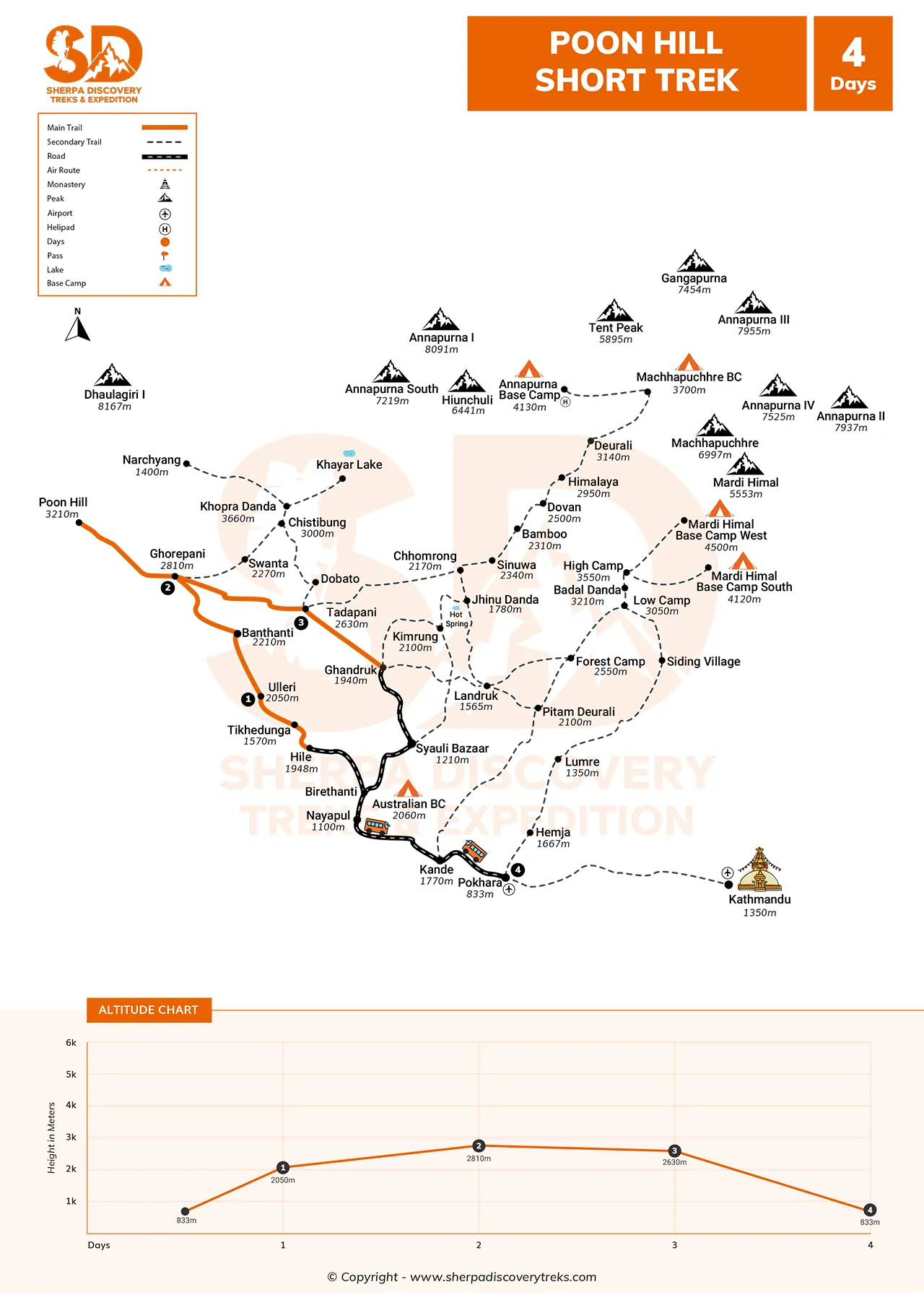

Our Poon Hill Short Trek starts with a drive to Hile from Pokhara. This drive is going to take around 2 and a half hours to complete, after which we will start the first trekking session of the journey. We will trek from Hile to Ulleri village, a traditional Magar village, reaching 2050 meters above sea level. This trek is going to cost us an additional 2.5 hours and gain us over 1200 meters of elevation from Pokhara. We will check in at our accommodation for the night and get to exploring the village a little.
Our lunch will be served at the same accommodation; it is an unwritten rule that you should have your meals at the place you are staying. This is because they do not have high pricing for rooms; their main margins are in selling meals. After dinner, we will call it a day and head off to get some rest.
Our Poon Hill Short Trek is among the easiest trekking destinations in the entire country. The Annapurna region is popular for its long treks that are challenging as well, but there are also easy destinations that are super beginner-friendly. Our particular itinerary goes a little over 33 km in total, which is very manageable. On top of that, you do not have to carry your heavy luggage; Sherpa Discovery Trek’s porters will handle it for you. On a scale of 10, we rate it a 4.5. If there were no 3000 stone steps on the way to Ulleri, it would have been a 3.5 on the difficulty scale.
The best seasons for this Poon Hill Short Trek are spring and autumn. During the springtime, you will get to experience the vibrant flowers of Rhododendron and other wild flowers throughout the trekking days. The animals living in the Annapurna Conservation Area are also active during this period, increasing your chances of encountering wildlife during the daily treks. In addition to all that, you will also get to experience suitable day trekking conditions with bright, clear skies.
Your other best season for this trek is the autumn season, since it shares many of the same traits as the spring season. During this season, you will get to experience mild daytime temperatures, clear skies with no clouds (for the most part), and an overall dry scene. Autumn is also the festive period in all of Nepal, offering you a great chance to experience the different festivals.
Yes, a beginner can surely join this Poon Hill Short Trek as it is absolutely meant for beginners. The short itinerary and the low altitude make it a great destination for first-time trekkers and beginners alike. The climactic day of the journey is long, but the other trekking days are short and easy. The maximum elevation we will reach on this trek is 3210 meters above sea level at the viewpoint of Poon Hill. At this elevation, altitude sickness does not even exist.
There is zero risk of altitude sickness on this Poon Hill Short Trek since we barely reach 3210 meters of maximum height. For most of the trek, we will be under 3000 meters of elevation, at such a low altitude, there is no risk of getting altitude sickness, as it usually starts from 3500 meters and above. Even at 3500 meters, the effects of this illness are barely felt. Out of the hundreds of trekkers we have sent on this trek, Sherpa Discovery Treks has yet to receive a case of altitude sickness.
You might have heard of tea houses even if you are a first-time trekker. These are the standard accommodations in any trekking destination within Nepal. Tea houses offer only the basic facilities with a couple of extra ones like laundry, WiFi, and more. You should not expect them to be serviceable, and definitely no late-night services since they have to be up early in the morning to prepare breakfast options.
These small businesses are locally owned and operated; they are not running for huge profits but for the sake of providing a resting place for visitors and making a living. Also, staying in tea houses directly contributes to the fragile economy of the highlands. We can also arrange accommodation in Pokhara before and after the trek if you want to stay there for a day or two, exploring the beautiful city.
Driving to the starting point of the Poon Hill Short Trek, Hile, and drive to Pokhara from Ghandruk village, are the only transportation expenses that will be covered by the trek package.
You will just neeed the Annapurna Conservation Area Permit to be able to trek this Poon Hill Short Trek, legally. This permit can be obtained at Pokhara or at a checkpoint during the trek. The trek package cost will cover this expense.
To prepare for this easy Poon Hill Short Trek, you should start physical training about 3 to 4 weeks before the start of the trek. Even though the trek is very easy, you still have to walk 3 to 4 hours on average during the trekking days, which requires some level of physical fitness. We do not expect you to be extremely fit and physically capable; we just want you to have an average physical fitness level, so you will not have issues doing this trek.
Packing your bags is also a part of preparing for this trek. The essentials for this trek are shades, trekking boots, trekking poles, light trekking clothes, weather-proof clothes, a reusable water bottle, a bunch of water purification tablets, and so on. You do not have to carry trekking gear such as boots and poles, you can just buy them here or rent them from somewhere nearby.
The cost of this Poon Hill Short Trek package is USD ______ per head. This cost will cover your daily accommodation expenses, transportation costs, permit fee, local taxes, daily meals, and more.
There shouldn’t be any issues with charging devices (except power outages), but you are unlikely to get a strong WiFi connection since the satellite coverage does not cover the hill region very well. However, it is not as bad as other highland trekking destinations in Nepal. Remember that both of these services can cost you a couple of bucks. Some establishments charge you ,while some do not mind it at all.
Things like flight expenses, additional accommodations, extra meals, personal travel, and medical insurance, tips for the crew members, hot shower, WiFi, etc., are considered your extra expenses.
The trek starts and ends in Pokhara. You can simply take a flight to Kathmandu and stay there to catch your flight back home or, you can stay in Pokhara and spend a relaxing day, pre or post Poon Hill Short Trek. Pokhara is a great city to spend time in and explore the different sites that offer a great scenic treat of the lakes and the Annapurna peaks.
Sites within the city include the World Peace Stupa, Pumdikot Shiva Statue, Bindabasini Temple, Barahi Temple, Begnas Lake, Pame, and more are very aesthetic and offer a lovely experience. The city is named the most beautiful city in the whole country, and it stands up to its moniker. There are countless interesting sites to visit, and it is also the extreme sports hub of Nepal.
Bungee jumping, paragliding, zip flying, hot air balloon ride, rafting, ATV riding, mountain biking, etc, if you are interested in any of the activities, you should stay in Pokhara. We will arrange accommodation for you as per your preference.
No, there are no ATMs or banks after we get to Hile village. You should carry cash from the ATMs in Pokhara, enough to last you throughout the trek, as you need to pay for your extra expenses.
No, you are not likely to get a good mobile network coverage throughout the trek, but you will have the option of a satellite phone if you want to contact someone in an emergency. Most of our daily destinations have some level of network connectivity, although it is not something to rely on.
Yes, they can join this Poon Hill Short Trek, but they have to be able to walk 3 to 4 hours on average. If they can not, they should not join this trek.
Yes, safe drinking water is available throughout the trek, but we still recommend trekkers carry enough water purification tablets. We do not want you to take any unnecessary chances that might ruin the overall experience of this journey.
Yes, emergency services are available at every point of the trek, but you are very unlikely to need them. This trek is one of the easiest for a reason: there is very little risk.

Need help?
Talk to trip expert