English
 Dutch
Dutch Japanese
 Hindi
Hindi Italian
 Spanish
 French
 German
 Chinese
 Korean
 Arabic
 Hebrew
 Russian
 Portuguese
 Danish
 Czech
Czech Polish
 Swedish
Need help?
 +977 9767994912


Trip Duration
12 Days
Trip Difficulty
Moderate
Max. Altitude
7,000m / 22,966ft.
Activity
Trekking
Destination
Nepal
Group Size
1-16 Pax
Accommodation
3 star Hotel
Meals
Breakfast, Lunch, Dinner

Need help?
Talk to trip expert
The Annapurna region is known among tourists for its several 7000 and 8000 m peaks, and it offers numerous hiking opportunities that are fit for all experience levels. Among such trails, we offer you a very little explored circuit of Sikles trek.
It is not only an easy short trek but also very interesting from a cultural perspective. The Sikles trek route offers a unique immersion in the local traditions of Brahmins, Gurungs, and Chhetris while being accessible to beginners and children.
Thus the Sikles trek is an excellent choice if you have limited time to spare but still want to experience authentically unique culture and breathtaking views.
Our Sikles trek itinerary will take you to the remote Sikles Village which was home to the conservationist and Annapurna Conservation Area Program (ACAP) champion Chandra Gurung.
It is among the ancient Gurung villages nestled in the southeastern Annapurna region at an altitude of 1980 meters in the Kaski district, above the Mardi Khola River.
This village has successfully maintained its age-old customs and traditions, providing travelers with an authentic cultural experience. The primary inhabitants of the village are the Gurung people, who are of Tibeto-Burman descent and practice Buddhism.
They are particularly known for their contributions to the Gurkha regiments of the British Army and are famous for their courage and discipline.
Additionally, they engage in mountain agriculture, growing crops such as potatoes, corn, mustard, and millet, and they tend to sheep, which they graze in the mountain pastures from April to September.
During our 12 days Sikles trek, you will traverse various villages, cross suspension bridges, walk beside waterfalls, and explore agricultural areas characterized by terraced fields.
You will eat and stay in community lodges alongside Nepalese families creating moments of connection and exchange. The Sikles trek also offers generous views of Annapurna IV (7,524 m), Manaslu (8,156 m), Annapurna I (8,091 m), Annapurna III (7,555 m), Lamjung Himal (6,983 m), Annapurna II (7,937 m), Machapuchare (6,993 m), and Annapurna South (7,219 m).
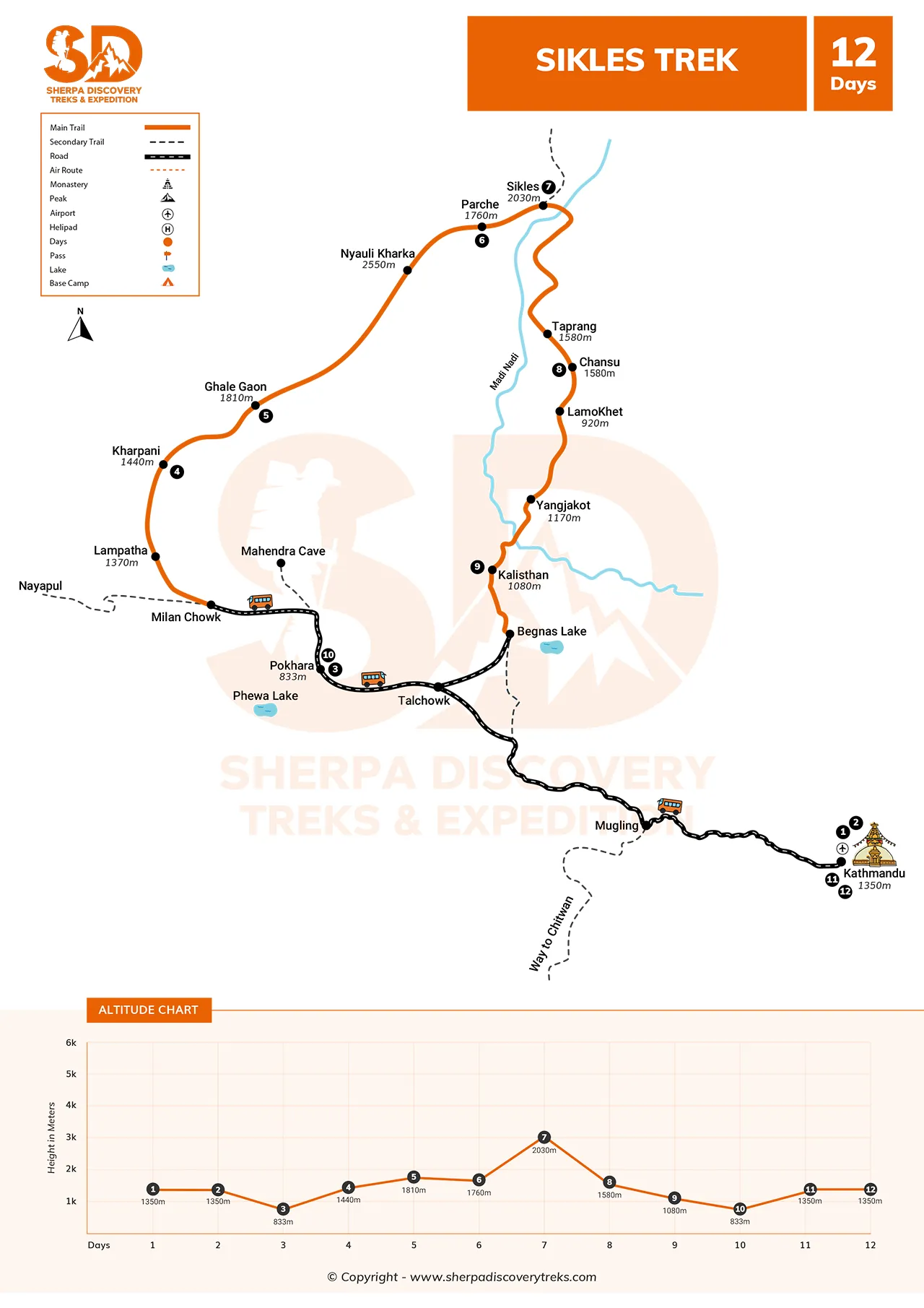
You will start our Sikles trek itinerary with a 7-hour drive to Pokhara from Kathmandu. Once you are in Pokhara, you will then trek through quaint villages like Kharpani, Ghalegaon, and Parche, ultimately reaching Sikles. You will spend the moment in the village then redirect your feet through Chansu and Kalikasthan back to Pokhara.
Particularly beautiful and pleasant in the autumn and spring, our Sikles trek is available for all those who want to appreciate nature, walking along the exclusive trail of Annapurna.

Greetings from the extraordinarily beautiful capital Kathmandu! After you leave TIA, one of our staff will help you get to your selected accommodation.
Please take a few moments to settle and recover. Then, you can take a short walk on the nearby streets so you can get to know the real vibe of the city.
Once everyone gathered in the hotel, our guide will offer a short introduction about our Sikles trek itinerary. Then, you can explore the variable cuisine available in the city.


Today, you will have a guided tour of Kathmandu city and its historical landmarks. You will discover the ancient sacred Hindu site of Pashupatinath, its cremation site (Ghat) by the Bagmati River, the all-seeing eyes of Boudhanath, and the hill of Swayambhunath.
You will also stroll through the ancient narrow brick path of the Kathmandu Durbar Square and see its majestic historical corners. After the excursion is complete, our guide will examine if you need any gear and help you in procuring one.
Please sleep early tonight as we will be undertaking a lengthy drive to Pokhara first thing tomorrow.
The day has come to begin our Sikles trek with a beautiful drive to Pokhara. Leaving Kathmandu via Kalanki, we will ascend the Thankot Pass and drive down to Trishuli Market.
Next, we will journey along comfortably along the tarmac road of the Prithvi Highway feasting our eyes on the Langtang Himal range. A while after, the expansive Mugling-Narayanghat Highway will lead us toward Bandipur- a small old Newari town with Annapurna massif up front.
We will keep on progressing and one by one, the massifs of Ganesh, Dhaulagiri, Fishtail, Manaslu, and the five other peaks of the Annapurna will begin to appear.
Lift your head to see the grand Manakamana Temple atop a lovely green hill. Pokhara will soon appear with its glistening lakes and shimmering white peaks.
Later you can explore the lakeside corner of the city and go for a short boat ride over Phewa.

From Pokhara, we will drive for around an hour to reach Milanchowk past the blue waters of Phewa Lake. We will now begin walking upward first along the road and then on the footpath passing the friendly villages of Lhachowk and Ghachowk.
Here, we will meet a small hung bridge after which the path will take us first to the Annapurna Conservation Area Office and then to Charghare. Soon, we will be walking beside the shore of the majestic Seti River where Kharpani lies.
This small yet delightful village has a thermal natural pond that says to heal any skin diseases.
The footpath from Kharpani will lead us east and after walking for a while, we will meet yet another suspended bridge over Seti River. The path after the bridge will rise upward through the terraced farms directing us to a hill.
We will then descend from the hill and traverse the enchanting Gurung village of Chyanglung. We will now proceed towards Sardi Khola and then prepare for a sharp ascent towards Kyabrang village.
We will then again hike downward till we are at Ghale gaon. The Ghale people are extremely friendly and hospitable who will treat with the tasty cuisine from their fresh produce.
In the meantime, we will watch the sun casting its golden light over the white chalk walls of Ngadi Chuli, Manaslu, Lamjung, Annapurna III and IV, Himal Chuli, and Fishtail.
We will have the peaceful mountain breakfast at Ghale Gaon after which we will continue on with our journey. We will first climb upward towards the hill of Byaule.
The path now starts to twist and turn, ascend, and descend through various other ridges of Harbu Danda, Bayule Danda, Chipli, and Jaljala Danda. The ascending and descending path will not stop and direct us toward
The journey may be tiring for our legs but it will be very enchanting for our eyes as we traverse the vast bamboo, oak and rhododendron jungles. Our ascending and descending path will not stop and direct us toward Nyaulikharka.
From here, we will walk past the Gurung hamlet of Chipli before making our way to Parche Village.
This morning we will hike up along the curvy trail for around three hours. We will then head right and walk past a few temples, fields and health facilities.
We will then walk up the hill high above Mardi Khola River valley before descending to the riverbed. After this, it will be a bit of steep climb to the fascinating village of Sikles, stunningly situated against the backdrop of the snow-capped Himalayas.
This village has still retained its traditional charm with narrow village lanes lined with stone and mud houses. The village has five traditional areas – Lama-thar, Sabha-thar, Harpu-thar, Dhaprang-thar and Gairi-thar, each with their own significance in the community.
We will have free time in the afternoon and we will explore this beautiful village and learn about Gurung culture and the history of the famous ACAP community conservation program that began here.
We will get a real insight into the lives and challenges of Nepal’s mountain people while watching at the gorgeous features of Lamjung, Annapurna II and IV.
The forthcoming journey will be now mainly downstream which will eventually lead us back to Pokhara. From Sikles, we will trek down through several eye pleasing villages of Talche, Tauneswanra, and Tantang.
The route is signposted and runs through the dense humid thickets of rhododendrons. There will be few cool streams great to soak our feet in.
We will then climb up to the ridge of Paiyon and hike down through the cool hamlets of Bagaletha and Setikholagaon before we arrive at Chansu.
The beautiful Mardi Khola will guide us steadily towards Sabaldanda. A bit further along, we will leave the area of Annapurna and walk upstream to Yangjakot.
From here, we will journey along the relatively easy path till we are at Kare. Here, we will have to cross the Mardi River over an attractive bridge after which our trail will once again follow the lush thickets.
Shortly, Kalikasthan will be arrived where we will rest our heads for the night.
We will enjoy our final hearty breakfast in the mountains with our hosts and of course the magnificent view of the surrounding landscape. Then, we will head for a short hike towards the radiant waters of Begnas Lake.
After capturing a few peaceful moments, we will now go along the jeep track to the main road that will lead us back to Pokhara. A local jeep or bus will drive us for around an hour through the marvelous route till we are at the glorious city of Pokhara.
The Sikles Valley trek itinerary comes to an end and we will have to continue our journey back to Kathmandu. Along the way, we will be able to see the picturesque landscape of rural corners of Nepal along with its tall Himalayas.
Once in Kathmandu, you can now enjoy the rest of the day visiting the places you may have missed early to explore.
Depending on your plane’s departure time, we will transfer you to TIA.



The 12 days Sikles trek is breathtakingly stunning all seasons of Nepal including winter, autumn, summer and spring. However, fall/autumn and spring are particularly regarded as the excellent time for this trek.
Spring is the pre-monsoon time starting from March and ending in May that adds a magnificent touch of color to the landscape of Annapurna with flowering rhododendrons.
The heat also gradually rises from 12 degree Celsius to 17 degree Celsius with light sporadic rain to ease the long hour hike. The animals and birds are particularity active and the forests are filled with unique flora endemic to the region.
The fall or autumn is the post-monsoon time beginning from mid-September and lasting till November which offers the most spectacular mountain views. The heat also wander between 10 to 14 degree Celsius with tranquil blue sky.
The winter beginning from mod December lasting till February will not hinder Sikles Trek as it is the balcony trek to Annapurna. The 2713 m of Ghale Gaon will not see much of snow and heat will also remain tolerably cold.
As for the monsoon rains, they will start from June and lasts till early September. The Annapurna area in Nepal is one of the wettest regions, so if you decide to take the Sikles trek during this time, you will have to confront wild rivers, muddy and slippery trails, and lush forests that are abundant with leeches and mosquitoes.
The Sikles trek route in the Annapurna is among the easiest low altitude and short mountain trekking trail that is perfectly walkable by anyone with the moderate physical condition, and health.
The route has no technical requirement except for few steady ascent and descent. The maximum elevation is at Ghale Gaon peaking just over 2500 m which means no worries about the altitude sickness.
The hiking is also not extensive and long needing only 4 to 6 hours of time each day with a lunch break in between. So the Sikles trek route is suitable for anyone wanting to immerse in the authentic vibe of Nepal without needing a ton of trekking or climbing skills.
However, unlike other routes in the Annapurna area, this trek mainly offers stays in local home stays, so you can’t expect the same luxury as you will get on the Annapurna Base Camp trek. So a decent level of fitness and mental toughness are the two elements needed for this journey.
The simplicity, easiness, brevity, and low elevations are the key elements of our 12 days Sikles trek. So, the trek is best suited for any age group, caliber, and capacity.
You can even undertake this trek with your parents, grandparents, and children and make it a memorable family holiday trip in the astounding Annapurna mountains of Nepal.
Because the trek reaches a maximum height of 2,700 meters, so it is also appropriate for people with health conditions that often limit their option of engaging in more challenging mountain treks, such as those with heart, lung, or kidney issues.
However, we still suggest you talk to your physician about the nature of the trip and get their approval and advice before the trek.
The Sikles trek also offers a cultural insight into the lives of the Gurung people, so this trip can be very appealing to those who have a keen interest in cultural experiences.
In addition, the Sikles trek route is also lined with lush jungles rich in unique endemic flora and fauna, as well as rare bird species so this trip will be a delight for bird watchers, nature enthusiasts, botanists, and wildlife lovers.
If you are crazy about photography, then there will be numerous opportunities for you to capture breathtaking images of people, nature, and scenic views. If you have a busy lifestyle, then the 12 days Sikles trek can be cut short to a week. You can also present this trek as a thoughtful gift to someone you value.
The chances of experiencing altitude sickness during our Sikles trek itinerary are significantly very less. Most of the time, you will be at a low altitude with the maximum elevation at Ghale Gaon at 2713 m while the Sikles Village itself rests at 1980 m.
So, these elevations are not high from sea level with rich oxygen concentration making the occurrence of acute mountain sickness or altitude sickness very rare.
That’s why, we have not included any rest days in our Sikles trek itinerary, apart from your time in Kathmandu so ou will get used to the lower altitude air of Nepal.
To further help in your acclimatization, we also have planned shorter walking days in between so that you have plenty of chances to take in the stunning views, interact with locals, and delve into the vibrant culture of the valley.
However, please remember that we can’t predict the occurrence of AMS which differs from one individual to another. If this trek is relatively new for you, if you have never walked to the altitude of more than 2000 m, then very mild manifestation may effect you.
Such as trouble sleeping, fatigue, vomiting, headache and body ache. In such instances, the bets solution will be to halt your walk and rest at the same elevation and intake plenty of fluid (water, tea, soups etc).
You can also opt for Ibuprofen or aspiring if you have only headache and for other symptoms, you can take Diamox which aid in the quick acclimatization.
Please walk steadily and slowly, do not compete, and maintain proper hydration throughout.
Although our 12 days Sikles trek is easy and simple without the necessity of even a hiking pole, it still demands a moderate physical condition from its travelers.
After all, you will still be tackling the uneven terrains of Annapurna for several days with a light backpack on your shoulder. So please don’t underestimate the demands of the Sikles trek and get on with your preparation and training before your departure date nears.
The fitness is the key factor for this trek which is made up of endurance, strength, flexibility, and speed. You can improve your fitness through regular exercise such as swimming, skating, walking, rowing, jogging, or cycling.
Those who prepare with these exercises regularly before our Sikles trek will find it easier to tackle the strain of the trip. You can also integrate stair ascending and descending to your exercise which will help build up your core leg muscles.
Whatever type of sports or exercise you choose in, please make sure to set specific training times throughout the week. Start lightly and slowly increase the intensity and don’t put too much stress on your body.
There is another alternate route to the Sikles trek that you can take in the reverse direction from our proposed Sikles trek itinerary. Instead of starting at Ghale Gaon, you can finish your trek there by beginning your journey from Pokhara to Chansu.
From Chansu, you will advance to Tanting and then to Sikles Village, after which you can return to Ghale Gaon and then to Pokhara. Additionally, you can also choose to add the Tara Top Hike to your Sikles trek itinerary.
Tara Top is a grassy, forested hill that rises to an altitude of 3056 meters and offers the 360-degree round view of the Annapurna massif that stretches across half of central Nepal, with the foothills of the Himalayas down to the Ganges and the Indian plains.
Another beautiful option to enhance your Sikles trek is to include a trek to Kapuche Glacial Lake, which is the world’s lowest glacial lake at an altitude of just 2546 meters.
For this trek, you will head to Sikles Village and then proceed to Huwu or Hugu before reaching the lake. Due to the availability of roads, you can also opt to take a jeep directly to Sikles so you can complete your journey within a day or two.
As your dependable partner in Nepal, we will look after your comfortable stay, dining options and your ground transfers. When you reach Kathmandu, our private transfer will be ready to drive you to your selected lodging.
In Kathmandu and Pokhara, our standard arranged accommodation for you will be in a three-star rated hotel where you will share your room with same gender traveler. You will also have your own bathroom with hot water and WiFi access.
Breakfast will be served each morning in your overnight hotel but you can cater yourself for lunches and dinners. As for the Kathmandu City tour, a private four wheel with our guide will be ready to take you around the city.
You will start your journey with a local bus or tourist bus drive to Pokhara from Kathmandu. From Pokhara, a local sharing jeep will take you towards Milanchowk.
During the trek, the local tea houses or home stays will be arranged for your peaceful warm nights in the villages. The tea houses or home stays will be pretty modest with a small room with two and sometimes three single beds that come with pillow, mattress and blanket.
The toilets may have to be shared among the travelers which generally come in squatting style. You ma get the hot water for your shower but at the extra charge payment.
You will also be able to power up your phones, camera and other electric gadgets at minima extra charge. The possibility of WiFi access in these tea houses are also present but we cannot promise you that so you can depend on the NTC or Namaste 4G data packages.
Regarding the dining options, in every tea house, you will have the fresh home-cooked meals. The omnipresent dish will be of course Dal Vat and Tarkari along with momos, dhido (millet paste), gundruk (fermented vegetables), noodles, thukpa, eggs, and sel roti.
As you end your Sikles trek, a local jeep will transfer you to Pokhara from where a tourist or local bus will journey you back to Kathmandu.
To engage in the circuit route of Sikles trek, we need to have the Annapurna Conservation Area Project (ACAP) permit and the Trekkers’ Information Management System (TIMS) Card.
These permits are available in the tourist centers in Kathmandu or Pokhara at 2000 NPR for TIMS and 3000 NPR for ACAP. We provide a full-service solution for managing all fees and the complete permit application process.
Although the Sikles trek is brief and low, still, its diverse terrain comprising of few steep climbs can pose few challenges of accidents and injuries. Also, there may be a chance that you suffer from serious AMS that may need an emergency medical transfer in helicopter.
For this reason, we advise you to have travel insurance for our 12 days Sikles trek. Plus, it is also a mandatory for procuring the TIMS Card. Assure that your policy supports your medical expenses, and transfers up to the altitude of 3000 m along with extensive protection against theft, delays, cancellation, and damage to your baggage.
Although located in the heart of Annapurna, the Sikles trek is less explored. Along with the Himalayas, the trek will also give you cultural knowledge about the unique Gurungs. You will have first-hand experience with the locals and their delicacies. And nature will be at its glory with diverse wildlife.
Yes, by flying to Pokhara and then driving straight to Sikles, you can complete this trek within a week.
If you want to see and feel the complete glory of the Sikles trek, then go for the month of October.
Yes, the roads are well-constructed now and there will be a few dirt roads to the village for your extra adventure
No, you can find ATMs only in Pokhara or Kathmandu.

Need help?
Talk to trip expert