English
 Dutch
Dutch Japanese
 Hindi
Hindi Italian
 Spanish
 French
 German
 Chinese
 Korean
 Arabic
 Hebrew
 Russian
 Portuguese
 Danish
 Czech
Czech Polish
 Swedish
Need help?
 +977 9767994912

Trip Duration
7 Days
Trip Difficulty
Easy
Max. Altitude
3,165m / 10,384ft.
Activity
Trekking
Destination
Nepal
Group Size
1-16 Pax
Accommodation
3 star Hotel
Meals
Breakfast, Lunch, Dinner

Need help?
Talk to trip expert
The Tamang Heritage Trek allows you to experience the Tamang people and Tamang heritage in a beautiful place in Nepal. You can explore the stunning Langtang region starting from its border with Tibet.
The trail for Tamang Heritage combines Himalayan views with agricultural scenes, forest beauty, and traditional Tamang villages. The path shows travelers the remaining Tibetan cultural impact on Tamang community architecture and customs in old villages.
While trekking you will see colorful religious buildings and prayer artifacts at the side of locals who demonstrate friendly treatment. Tourists find natural hot springs at Tatopani a pleasant place to unwind during their adventure. Travelers on this route get to admire three Himalayan peaks including Langtang Lirung, Ganesh Himal, and Jugal Himal.
The 7-day trail suits both seasoned and novice trekkers because it combines easy mountain walking with the discovery of nature and local traditions. What starts and ends here, allows adventure seekers of all levels to have the essence of the true Himalayan world.
Tamang Heritage Trek provides hikers with an exceptional way to explore the unique Tamang Heritage culture and stunning heartland combined with exciting activities. This route makes the ideal choice for those who prefer to avoid busy trails at both Everest Base Camp and Annapurna Circuit.
People prefer this trek primarily due to its authentic opportunity to learn about Tamang cultural customs. The Tibetan Buddhist beliefs have deeply influenced how the Tamang community maintains its traditional ways of life.
You will see standard house construction and observe religious dance performances while visiting colorful Buddhist monasteries. Homestay accommodation creates special moments as it lets you live Tamang traditions while eating their native foods.
The route offers magnificent opportunities to view the Langtang Lirung, Ganesh Himal, and Dorje Lakpa peaks of the Himalayas. The path works well for first-time trekkers and experts because it features basic climbing compared to higher-altitude trails.
Walking trekkers can find rest and recovery at Tatopani Hot Springs after their daily trekking sessions. The path passes through areas that offer viewership of natural features such as forests, terraced fields, and local wildlife.
Everyone seeking to hike Nepal’s mountain ranges should try the Tamang Heritage Trek because of its medium challenge and reveals both local traditions alongside breathtaking natural scenery.
Tamang Heritage Trek is positioned in Nepal’s Langtang region between Kathmandu and Tibet’s border. The trek passes through Langtang National Park which gains fame for its untouched forests filled with wildlife and its majestic mountain ranges.
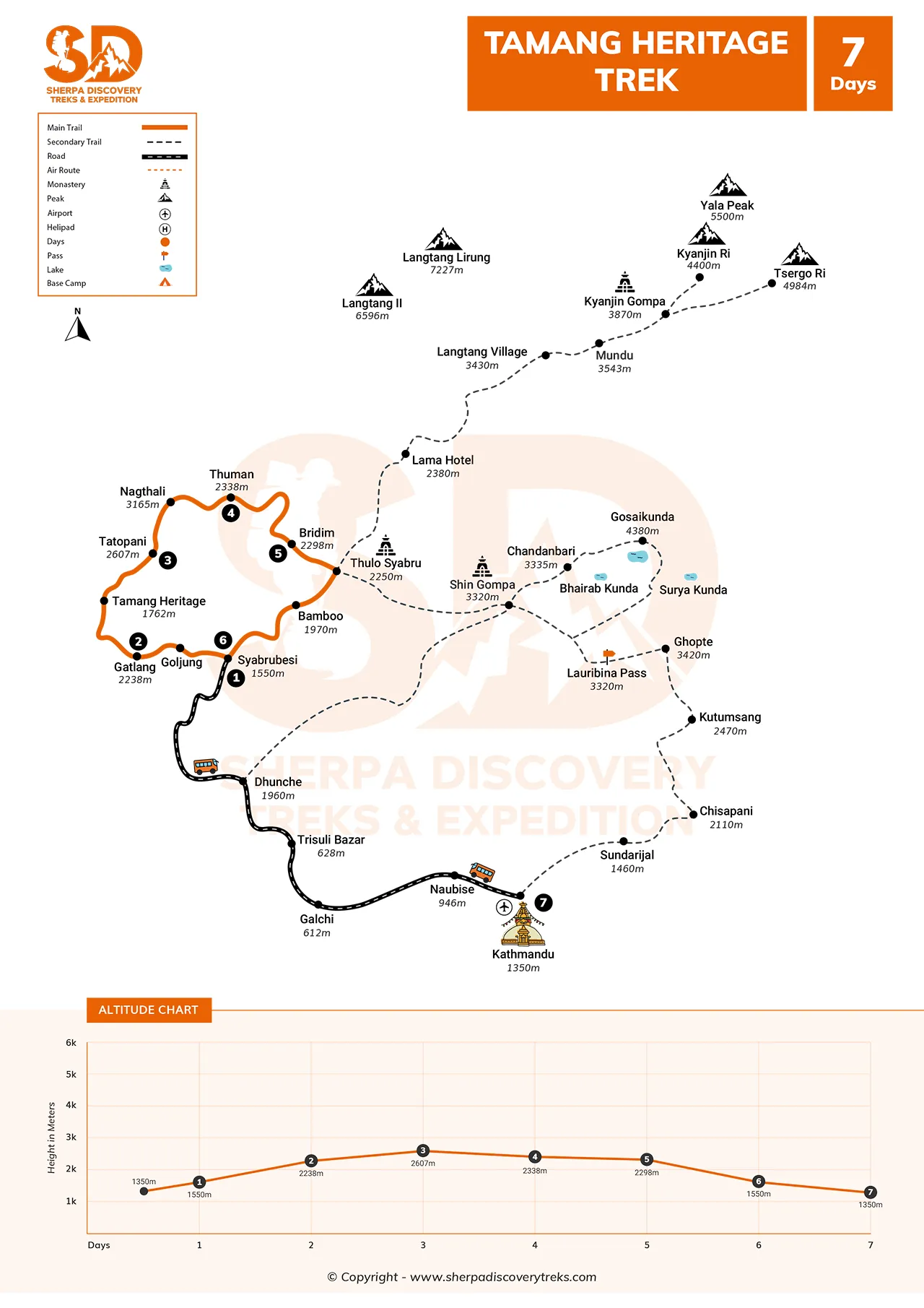
The adventure starts at Syabrubesi (1,503m) which functions as the point of entry to both Langtang Valley and Tamang Heritage Trail. The walk passes three traditional Tamang villages at Gatlang, Tatopani, Thuman, and Briddim en route from Syabrubesi back to the beginning.
Located near the Tibetan border brings strong Tibetan Buddhist traditions which you will see through ancient monasteries and prayer wheels. From the trail, you can admire many Himalayan peaks especially Langtang Lirung at 7,234m and Ganesh Himal at 7,422m.
The trek’s location near Kathmandu allows travelers to reach it easily after a 7 to 8 hour drive without domestic flights to explore Himalayan culture and stunning beauty in peaceful surroundings.

Setting off from Kathmandu you will take a beautiful 7 to 8-hour drive to Syabrubesi as your first step on the Tamang Heritage Trek. Travelers see stunning landscapes of farmed terraces and towns while trekking by the Trishuli River.
The road leads through Dhunche which serves as headquarters for Rasuwa district. Once you reach Syabrubesi at 1,503m you may explore the community and socialize with residents while getting ready for the trek.


You begin your trek by hiking upward while seeing paired views of the mountains Langtang Lirung and Ganesh Himal. The Tamang community culture stands unique in Goljung village as you hike through it. The trail from Syabrubesi ends at Gatlang at 2,238 meters where you see local stone houses and mind a routine village life.
We walk downhill from two sets of fields and forests to reach Thangbuchet which hosts the Chilime Hydropower Dam. You will climb a suspension bridge until you reach Tatopani (2,607m) through beautiful rhododendron forest paths. Visitors enjoy mountain views and unwind through natural hot springs that heal their bodies at this location.
The route rises past Tatopani to Nagthali located at 3,165 meters above sea level. The tough trail leads you up to a high point for clear views of both Langtang and Ganesh Himal including distant peaks in Tibet. Experience a place to rest at Nagthali before descending through thick forests to the cultural village of Thuman at 2,400 meters.
The Thuman to Briddim path leads you past astonishing areas with small stream crossings and thick forest sections. After passing through Lingling you will arrive at Briddim which stands at an altitude of 2,345 meters.
The village of Briddim offers travelers an opportunity to live with locals and study Tamang culture visiting the sacred Dukchu Gomba Monastery which blends elements of Tibetan Buddhism.
Once you wake up comfortably in Briddim you will hike down for 3 to 4 hours to reach Syabrubesi. The route is simple since it leads through farmed areas and local neighborhoods. You reach your destination at Syabrubesi (1,503m) where visitors can take pleasure in lodge amenities or shop in the market.
The trek ends with a beautiful drive of 7 to 8 hours back to Kathmandu. After descending the Trishuli River area you will follow the path back through mountainous terrain to Kathmandu. You will reach the destination where you can investigate the area or unwind from your Himalayan experience.



The favorable seasons for trekking the Tamang Heritage Trek are from March to May and between September and November. During spring and autumn months you will find good weather alongside perfect clarity and stunning mountain backdrops.
During spring months March to May is the best time to begin this trek when rhododendron forests reach their peak colors. Trekking in the daytime becomes comfortable due to the pleasant temperatures during these seasons.
The route offers perfect visibility that lets travelers admire the beauty of Langtang Lirung, Ganesh Himal, and Jugal Himal.
Autumn presents ideal conditions because rainstorms wash away dust and create natural fresh air above the clouds during this period. The trekking paths stand at their peak quality and daytime temperatures sit in the middle range.
At this time Nepalese people hold their biggest festivals like Dashain and Tihar which visitors can witness during their trek.
Though you can trek from December to February the temperatures reach freezing point, especially at mountain elevation. During this season only a few trekkers visit the area because they enjoy snow-covered paths in quieter settings.
Individuals should try to avoid trekking during the Monsoon season as rain turns paths slippery and leeches become active yet you will find reduced crowds on better-developed tracks among beautiful greenery.
Choose spring or autumn to walk the trail because weather conditions are optimal and local culture reaches its highest point.
Before starting the Tamang Heritage Trek hikers need to secure both a TIMS card and a Langtang National Park permit.
The Trekkers’ Information Management System card serves as a safety feature to track trekkers and protect their safety in distant trekking terrain. The system eases trekking administration tasks effectively.
All hikers need to acquire a Langtang National Park permit because the Tamang Heritage Trek route runs through Langtang National Park land. The needed permits help the community defend environmental protection and cultural sites of the area.
The joint permits keep trekker numbers in balance while teaching responsible tourism behavior. You can obtain permits both at the Nepal Tourism Board and from authorized expedition agencies located in Kathmandu.
All trekkers must hold and secure these permits in advance because walking there illegally incurs legal consequences. Take both permits with you during your trek since officials will randomly inspect permits throughout your route. The legal requirements involve two simple procedures that need valid identification and passport pictures.
This trail suits trekkers with general physical capabilities because it provides easy hiking challenges. The hike suits new trekkers who enjoy walking because it needs no advanced trekking skills.
Walkers will find the trail easy to follow yet struggle with steep hills if they are new to mountaineering at high elevations. Even at 3,300 meters and 10,827 feet altitude there is a chance for altitude sickness but it poses a smaller threat than on higher treks.
The trail crosses numerous villages as it climbs and descends different kinds of land features from forests to rivers and hill peaks. Despite rising in altitude the trek moves at a reasonable pace that allows hikers easy adaptation to changing elevations.
During seven days hikers can adapt to altitude changes while also resting from harder trekking days. The Tamang Heritage trek offers both an average amount of physical labor alongside enough time to adapt to high-altitude conditions.
The Tamang community in the Langtang area follows a vast cultural heritage shaped by Tibetan Buddhist traditions. Their people follow combined Tibetan and Nepali customs that make this land experience unique.
Hikers encounter Tamang culture on the Tamang heritage trek that leads them to visit monasteries and historic village settlements of this people group. Many Buddhist temples and prayer flags display how strongly Tamang people follow their spiritual faith along the trail.
The local people welcome guests warmly and visitors can join religious practices while talking with monks who practice age-old customs. Agricultural work matches animal raising with regular religious rituals and forms the basis of Tamang cultural activities.
Most Tamang villages maintain their original house style made of stone and show complex wood ornaments on their exteriors. Community celebrations with music and dance help people protect the Tamang culture in their entire village.
Trekkers can learn deeply about the cultures of the Tamang indigenous people and take back their displayed knowledge of local customs and practices through the Tamang Heritage Trek.
During the Tamang Heritage Trek participants will explore different natural environments alongside different plant and animal species that appear with increasing altitude.
Walkers find a variety of plants at lower altitudes including many rhododendron trees, oak trees, and pines in the subtropical forests. The forest erupts into flower blooms during spring and turns golden-red during fall.
People at higher trekkers can enjoy alpine grasslands under snowy mountain views. The area features several wild animals including Himalayan tahr, musk deer, red pandas, and many types of birds. Bird fans can spot Himalayan griffons pheasants and eagles alongside other bird species while exploring the area.
The area houses different plants which local people use for natural medicine. The area boasts aesthetic natural surroundings and offers breathtaking prospects across the Langtang Lirung and Ganesh Himal mountains. Visitors enjoy observing the natural balance of wildlife and plants at the Langtang National Park because this draws many travelers there.
The Tamang Heritage Trek gives trekkers spectacular views of the top mountains in the Langtang region. Trekkers will see Langtang Lirung at 7,227 meters sitting highest above the tour route.
During your trek, you will enjoy looking up at this impressive mountain since it stands tall over the surrounding land. You can see the snow-covered slopes of Ganesh Himal it stands at 7,422 meters. The trek passes near Dorje Lakpa which stands at 6,966 meters above sea level.
The trekking routes show changing scenery as their altitude changes thanks to the mountains’ peak views. The close-peaked mountains lined by mountains improve the stunning value of the trekking path as climbers observe alternating views of rock formations and mountain glaciers.
The beautiful mountains mean more to the Tamang people who perform religious rituals throughout their land. The sight of these impressive peaks during the trek brings great appreciation to everyone who passes them.
The experience of hikers becomes richer as they discover how impressive the mountains remain at every step of their journey.
The Tamang Heritage Trek includes numerous Buddhist monasteries and gompas because its path carries deep cultural and spiritual importance to the people. Religious communities use these buildings for Buddhist worship in their Tibetan practice.
Across the centuries-old monasteries Tibetan architecture stands out through its traditional style while wood carvings decorate their surfaces. Prayer flags wave proudly in the air.
The path crosses many monasteries including Gatlang where hikers can spend time in worshiping or observing local ceremonies. Most trekkers find inner peace in these monasteries while learning about the Buddhist faith and its meditation rituals.
These monasteries hold both spiritual values and serve to maintain Tamang culture along with their historical background. Monks who live in these sites welcome trekkers to speak with them while they focus on their Buddhist practices.
Exploring these monasteries during the Tamang Heritage trek lets you find peace as you learn about regional cultural traditions from the Tamang people.
The Tamang people honor many Buddhist festivals from their Tibetan beginnings with added local traditions.
For Tamang people, Lhosar marks their New Year celebration which usually occurs in February or March. During the Lhosar festival, the Tamang people start their new Tibetan lunar calendar period with devoted celebrations.
People join in eating delicious foods while dancing and praying while doing traditional ceremonies that pay respect to local gods and dead family members. Every person dresses in their classic clothes and creates a happy atmosphere through songs and laughter.
Buddha Jayanti honors the life events of Lord Buddha through celebrations of his birth enlightenment and passing. Monasteries and temples celebrate Buddha Jayanti through their religious practices.
People of the Tamang community unite during this period to study the core beliefs of Buddhism together. These festivals hold great importance to Tamang people by helping them stay connected to their culture while doing religious practices and keeping their old rituals alive.
Travelers gain real insight into Tamang culture when they join or observe these local events while trekking.
Beyond its visual and cultural discoveries, the Tamang Heritage Trek provides trekkers with delicious food experiences. The best part of the trek lets you sample Tamang cooking which shows their Tibetan Buddhist cultural roots.
Dal bhat serves as the main food in this locale and trekkers find it together with locals. Thukpa stands out as a favorite dish because its noodle soup tastes excellent with vegetables, meat, or both in order to warm up during cold mountain weather.
Trekkers love eating Momo which originated from Tibetan dumplings that pack various fillings. People enjoy eating cooked dumplings with a strong dipping sauce as their main snack or diet option.
Travelers can warm up with butter tea brewed with tea, salt and butter to fuel their mountain climb into the cold air. The people of the region often eat yak cheese which is famous for its smooth and decadent taste combined with various dishes or bread.
The easy-to-make dishes of the local cuisine enable travelers to gain trekking energy while getting a flavor of the traditional food of the area.
Most travelers on the Tamang Heritage Trek use teahouses which offer simple rooms with essential sleeping amenities. All teahouses here provide individual sleeping rooms with basic furniture but guests should expect modest facilities.
During busy trekking times, several villages need to share their rooms with guests. Every teahouse offers shared dining areas for trekkers to sample local meals. Trekkers can enjoy both wireless internet and hot shower facilities in some teahouses but some places do not offer these amenities.
Teahouses provide both an authentic stay and a chance to meet local Tamang people along the hike. Each overnight basic room offers safety and comfort for trekkers to get needed relaxation before their next day’s travel.
Since the trek stays below high elevations everyone can find lodging at any point along the trail. People who travel to popular spots Gatlang and Syabrubesi need to book their rooms ahead to get space during busy times.
The straightforward accommodation of teahouses enhances the appeal of walking through the Langtang region as guests experience Nepali friendliness during their adventure.
Despite being marked as a simple trekking route the Tamang Heritage Trek needs proper fitness training because challenges exist along the way. Trekkers need to walk, jog, or cycle often to strengthen their stamina and cardiovascular endurance.
People should train by walking uphill since our trail includes major climbing sections. The body needs strong leg muscles to endure mountain paths so exercise with lunges squats and calf raises works for this trek.
Adding core and upper-body exercise movements like planks and push-ups alongside backpack use will enhance your total body stability during the trip. To adapt to altitude changes you need to take small hikes on higher terrains because high elevations cause health problems to someone new to mountain conditions.
People preparing for treks need to train 30 to 45 minutes daily for at least several weeks before the trip. Managed stretching will protect your muscles from injury throughout the training period.
Physical preparation needs to include mental preparation since the trek demands commitment throughout its length. Exercise preparation will make trekking more enjoyable and less dangerous by helping trekkers tackle their long adventures without harm.
Trekkers climbing mountain heights face acute mountain sickness (AMS) which affects their bodies at high altitudes. The trek to Tamang Heritage reaches dangerous heights for travelers.
Going from low to high altitudes slowly lets your body adapt to the altitude changes. The suggested method involves rising to 300 to 500 meters daily with rest days integrated into your schedule.
Proper hydration and nutrition enable the body to adapt better to the higher altitudes. Seek rest and start descending if you notice headaches together with nausea and dizziness along with feelings of fatigue.
When symptoms become critical you need emergency descent and possibly medical treatment. Your doctor needs to oversee your use of Acetazolamide (Diamox) as a medicine to avoid Altitude Sickness.
Hiring a guide lets them track your health status while an emergency oxygen bottle adds important protection. When these symptoms continue after descent you must call a doctor immediately. To stay safe in your trekking trips you should pay attention to your body signals and never push your physical boundaries.
On your Tamang Heritage trek, safety should remain your main concern. Start your trip only when you have all important permits like Langtang National Park Permit and keep copies close at hand.
Follow only mapped trails and view maps or GPS devices to stay on track. Before your departure let someone at home or your guide know about the route and expected return time of your trek.
Take all your medical supplies on the hike including bandages tables painkillers and altitude medication for sickness. You need to bring enough water and choose from tablets or a filter system to stay properly hydrated.
Your trek will go better with a dependable flashlight and spare battery setup for trips in dim light conditions. You need to prepare and pack suitable clothing since mountain weather changes often.
You need to wear multiple clothes to modify your temperature response. Choose a licensed guide as beginner trekkers need protection from local experts who provide emergency support and teach about the area.
To stay safe only walk at your physical abilities and take regular rest periods. Good preparation and safety measures will create a risk-free and satisfying trekking adventure.
Tamang Heritage Trek involves strenuous conditions that need both physical fitness and psychological readiness. You should worry about altitude sickness because the trek crosses 3,000 meters where air becomes very thin.
Your work performance and emergency aid needs will diminish when you experience headaches, nausea, and fatigue as symptoms. You must face physical obstacles when your trail crosses snowy storms and high wind plus deep cold temperatures.
The challenging mountain slopes with steep grades and slippery paths plus frozen ground makes travelers more likely to suffer injuries. Travelers must bring medical supplies to their first aid kit because available healthcare options are rare throughout the trip.
Your mental and physical strength decreases each day you walk under heavy weight. Your ability to handle mental issues from isolation and tiredness needs strong determination plus staying positive.
Having professional trek guides, adhering to proper altitude adaptation methods and drinking enough water help climbers deal with these tough conditions on their Tamang Heritage Trek.
Every trekkers needs to follow safe practices to protect the environment and help local residents of the Tamang Heritage Trek. Trekkers need to bring their own water bottles or hydration bladders because the staff members work to stop plastic bottle waste at the camp.
Use water purification devices to cleanse natural water sources instead of buying store-bought bottled water. Disposing of all trash including eating remains and plastic products serves to keep the trails pristine.
Only using designated walking trails helps ward off damage to natural soil and active conservation of alpine life. Visiting tea house accommodations and buying local goods at stores benefits the local community.
Biodegradable personal items and less washing with soap help to reduce water pollution. Our responsibility to mountain animals means leaving them undisturbed while staying far away and not giving food. People who visit Tamang Heritage Trek can build eco-friendly lifestyle choices that keep the area true to nature for later visitors.
During the Tamang Heritage trek all trekkers need travel insurance that covers medical expenses and helicopter evacuation in case of emergencies plus trip cancellation.
Make sure the policy includes protection for trekkers who climb to high altitudes during the adventure. Trekkers need to bring a complete medical kit plus altitude sickness medicine plus contact details ready.
Without any travel insurance, any emergencies in the remote region will become highly severe. In cases of altitude sickness when a helicopter evacuation is required, not having travel insurance will severely reduce the chances of the helicopter actually coming.
Not only is the helicopter’s possibility reduced, but the cost without insurance can range anywhere from $3000 to $5000, which is usually not available and is unexpected during the trekking.
This hiking tour needs 7 days to complete with travel days included from Kathmandu to Soma Pok. People can arrange the trek length to match their selected dates.
Travelers who are new to treks can join this adventure but need to be in average shape for their pleasure.
Spring and autumn present light skies and mild temperatures although winter turns chilly and monsoon makes the trail wet.
Since there are no ATMs on the road you need to take sufficient cash from Kathmandu for your spending needs.
The trek offers traditional Nepalese Dal Bhat plus Tibetan-inspired cooked and baked items combined with nutritious soups and noodles.
Bring your own bottle and purification tablets because water bottles cost too much and new plastic bags are forbidden.
Very few tea houses offer Wi-Fi and mobile reception, but cost some extra and still remain poor across several spots. Local SIM cards like Ncell and NTC work best.
Bring multiple clothing layers with you since the weather changes dramatically with altitude. Pack your outfit with warm jackets, thermals, trekking pants, and waterproof clothes.
Exploring Tamang Heritage Trek alone remains possible but having a guide leads to richer cultural discoveries and protects trekkers in far reaches.
Many people expand their experience by combining Langtang Valley Trek or Gosaikunda Trek after the Sanbranjal tour.

Need help?
Talk to trip expert