English
 Dutch
Dutch Japanese
 Hindi
Hindi Italian
 Spanish
 French
 German
 Chinese
 Korean
 Arabic
 Hebrew
 Russian
 Portuguese
 Danish
 Czech
Czech Polish
 Swedish
Need help?
 +977 9767994912


Trip Duration
10 Days
Trip Difficulty
Difficult
Max. Altitude
4,919m / 16,138ft.
Activity
Trekking
Destination
Nepal
Group Size
1-16 Pax
Accommodation
3 star Hotel
Meals
Breakfast, Lunch, Dinner
US$ 700
We offer group discounts
Total Cost:
US$ 820

Need help?
Talk to trip expert
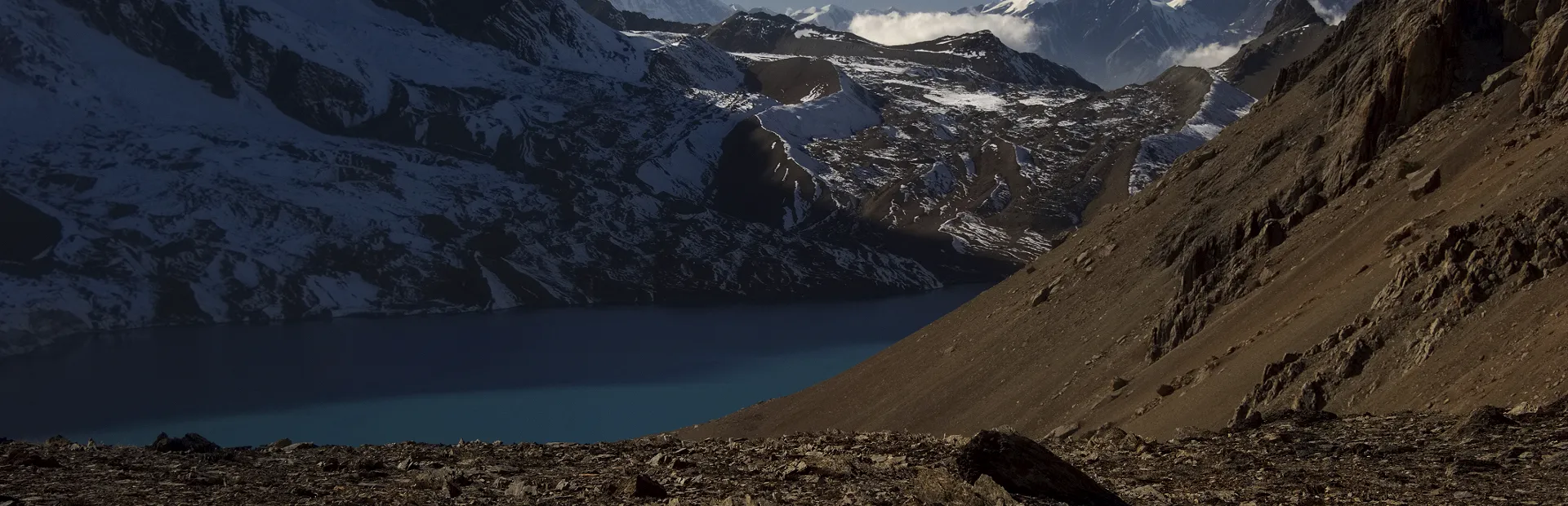
The Tilicho Lake Trek is one of the most scenic destinations that you can visit in Nepal. The serene location, the turquoise water of the lake, and the icy surroundings with views of multiple peaks make the Tilicho Lake a wonder of nature. We have taken countless people to this destination, and most of them complain about not having enough time to spend there. If you are up for it, we offer an extended version of this trek as well.
People often sell this trek as the highest lake in the world, when it’s not even the highest one in Nepal. The highest lake in Nepal is Lake Tsho, which is a gorgeous sight but not as charming as Tilicho, to be honest. This freshwater lake sits at 4919 meters above sea level and takes about 12 to 16 days to complete; 12 being the standard itinerary, while the extended version can stretch an additional 4 days.
Our Tilicho Lake Trek itinerary follows the standard Annapurna Circuit route but diverges to Khangsar to lead us to the Tilicho Lake Trek. The itinerary takes us through a bunch of different vegetation, starting from lush forest at a subtropical level to alpine vegetation with short shrubs and grasslands. You will also experience the barren highlands around the base camp and the lake.
The entire region is pretty much influenced by Tibetan Buddhism, especially the higher altitude villages. Generations ago, Tibetans who fled from the China-Tibet war would find their new home in the high altitudes of Nepal, similar to the barren landscape of Tibet. This was their perfect option since Nepal was on neutral terms with China at the time. At present, the communities have grown to become large villages that showcase the Tibetan Buddhist culture and architectural style.
Recently, a new itinerary for this trek has been introduced. This itinerary starts from Jomsom and takes you to Thini village, a much more secluded path compared to the standard. Last year, the Annapurna region was visited by over 240,000 foreigners, so maybe you want to try a secluded version of the trek. Just let us know about it, and we can make it happen.

The first day of our Tilicho Lake Trek consists of driving from Kathmandu to Dharapani village. This drive will last 8 to 9 hours, covering over 200 km. The extensive time it takes to cover 200 km can be linked to bad road conditions and traffic management. At first, we will be driving over the Tribhuvan Highway, which is in good condition. This is the highway that leads us out of the Kathmandu Valley.
After reaching Naubise, the end point of the Kathmandu Valley, we will get on the Prithvi Highway that connects Kathmandu and Pokhara. This is also the main highway that connects many trekking destinations to major cities. However, the condition of the road is very bad. There are many potholes, and some sections are completely washed out. This highway is the main reason for delayed driving.
After reaching Dumre, we will get off the highway and onto a well-paved asphalt road. This section of today’s drive is in good condition, but it does not last long as we will transition to a gravel road. To be honest, the gravel road is not that bad, perhaps better conditioned than the highway. We will reach this section before we get to Besisahar.
We will make a stop at Besisahar and change to a 4WD Jeep since the road is rough and requires a powerful and maneuverable vehicle. We will continue the drive over steep and rocky highland roads, which are bumpy all the way, swaying from left to right as the vehicle wobbles its way over the rocks. After reaching Dharapani, we will head to our accommodation for the night, have a satisfying dinner, and head to bed


The day starts at 1860 meters above sea level in Dharapani; our breakfast will be served at last night’s accommodation. After a filling morning meal, we will get ready to start the first trekking day of the Tilicho Lake Trek. The total trekking distance is 16 km, while the elevation gain of the day is 810 meters, taking us to Chame, reaching 2670 meters above sea level. We will be on the road for 5 to 6 hours, depending on the pace of the group.
The day trek starts with a slight ascent, passing through lush pine and fir forests until we reach the village of Bagarchhap. This village sits at an elevation of 2160 meters and is full of Tibetan-style houses and buildings. You can also see the Annapurna II peak from there. From there, we will get to Danaque village, reaching 2210 meters of altitude. This will be our first major resting stop of the day.
Following a 15 to 20-minute resting session, we will resume the trek and trek a steep section to get to the village of Timang. This climb takes us to 2750 meters above sea level and offers you a great view of the Annapurna Himalayan range, along with the Manaslu range. Moving on, we will descend a little to get to Thanchok, reaching an elevation of 2660 meters. From there, it is a gently ascending trail all the way to our destination of the day. Chame is the administrative center of the region, so the village is well built and offers a good range of accommodation services.
We will wake up to a beautiful view of the Annapurna II and Lamjung Himal peaks and have our breakfast before setting off to Pisang. Today’s Tilicho Lake Trek requires 4 to 5 hours of trekking with an elevation gain of over 600 meters. By the end of the day, we will reach 3300 meters above sea level and cover 14 km of distance, starting the day at 2670 meters.
Leaving the village of Chame, we will ascend a forested trail of pine with a view of the Lamjung Himal peak. After about an hour and a half of ascending gradually, we will get to Bhratang village, reaching an elevation of 2850 meters. This village has many apple orchards, those apples are supplied to other villages and cities, as well as the wineries in the region. The Paungda Danda cliff is also an impressive feature of the village.
From there, we will get to Dhukur Pokhari village, sitting at 3240 meters above sea level, where we will chow down on some tasty lunch. This is a great scenic spot, offering a wide view of the peaks in the distance. After lunch, we will begin our final ascent of the day with a gentle climb to Lower Pisang. This village reaches 3200 meters, and a further 30-minute ascent will take us to Upper Pisang at 3300 meters.
Day 4 of the Tilicho Lake Trek begins at the traditional village of Upper Pisang, where Tibetan-style houses dominate the scene. The chortens and gompas there are also based on Tibetan architecture. The whole village is very influenced by Tibetan Buddhist culture. Today’s trek is 14.5 km long, having us out on the trails for about 5 to 6 hours. The elevation gain of the day is just 240 meters, taking us to 3540 meters above sea level.
Leaving Upper Pisang, we will get on the trail to Ghyaru, enjoying the scenes of Gangapurna and most of the Annapurna Himalayan range. After about half an hour on the trail, the trail will turn steep, leading us to 3670 meters at Ghyaru. This traditional village has many stone houses and a monastery, but at present, the number of traditional stone houses has been declining as people want more earthquake-resistant houses.
We will then head to Ngawal village, reaching 3660 meters. This is the last village before we get to Manang, so we will stop there for a little while, resting our tired bodies. From there, we will descend to Manang.
From Manang, we will have to trek 9 km, mostly ascending, to get to our destination of the day. Day 5 of the Tilicho Lake Trek has an elevation gain of about 200 meters with a trekking time of 3 to 4 hours. We will start the day at 3540 meters and reach 3753 meters by the end of the trek.
Leaving Manang, we will trek over a dusty road that is often travelled by jeeps, bikes, and cars, making it a dusty trek session. But we will soon pass this section and get off the clouds of dust and cross the Marsyangdi River over a suspension bridge. The trail then leads us to a quaint forest of coniferous trees and turns slightly ascending with views of a few peaks up north.
We will shortly reach Khangsar Khola River and ascend further into the valley to get to Khangsar village. This village is full of traditional stone houses and, much like the other villages in the region, has been influenced by Tibetan Buddhism. This village is very different from the bustling streets of Manang, it is very quiet and calming. We will have a few day-hours left to explore the village, after checking in at our tea house for the night.
Today is one of the main days of the Tilicho Lake Trek as we will be trekking to Tilicho Base Camp, reaching 4150 meters above sea level, our first day over 4000 meters. The total trekking distance is 8 km, while the elevation gain of the day is 387 meters, requiring about 5 hours of trek.
We will start the day with a gentle ascent from 3753 meters, passing by chortens and gompas. The track is full of loose rocks and takes us all the way up to 4650 meters, where a flat hill summit lies. This section of the trek is steep and difficult, to say the least, but very doable as well. We will have plenty of rest in between. From there, we will descend over a series of switchbacks and get down to the Tilicho Base Camp, reaching 4150 meters of elevation.
The climax of our Tilicho Lake Trek is here, we will hike from the base camp, all the way to 4919 meters to reach Tilicho Lake. The distance from the base camp to the lake is 6 km, requiring 3 to 4 hours of ascent and 2 to 3 hours of descent, with an elevation gain of 769 meters.
Today’s trek starts with an ascent, early in the morning, since we do not want to battle the afternoon fast winds. We will be hiking up a ridge over loose rocks and scree. The ridgeline is narrow as we move along the mountainside, and a few sections are at risk of landslides. As we move up, the scenes of Khangsar Kang, Gangapurna, and Tarke Ghyang show up in the distance.
We will soon reach the lake, and the scene we will see is nothing short of magical. It is one of the highest freshwater lakes in the world, and the pristine condition of the lake makes it very pleasing and aesthetic to look at. We will take tons of pictures, have a great time enjoying the scenes, and get back to the base camp later.
Today is the first day of descent on the Tilicho Lake Trek itinerary. We will get down to 3519 meters from 4150 meters, losing about 630 meters of elevation. Our destination of the day is 14.5 km away, which takes about 5 to 6 hours to cover. Leaving the base camp, we will retrace our steps back to Khangsar. The trail is not a piece of cake, as we have to traverse over loose rocks, descending for the most part.
After the initial descent, we will ascend a little and descend once more to get to Khangsar village. This village sits at 3753 meters above sea level, full of traditional stone houses that add a charming element to the village. We will stop there for lunch before continuing the trek through a juniper forest and going downhill to Manang
This is the longest day of the Tilicho Lake Trek as we will cover over 30 km to reach Chame village from Manang. It will take us 7 to 8 hours to cover this distance, with an elevation loss of about 850 meters. First, we will trek from Manang to Pisang, covering over 15 km, losing over 300 meters of elevation over a period of 4 to 5 hours. We will pass the village of Braga and Humde, reach Ghyaru, stop at Ngawal for lunch, and get to Pisang.
From there, we will trek over 16 km, lose 550 meters of elevation over a period of 3 hours or so, to get to our destination of the day. We will pass by Dhukur Pokhari and cross the Marsyangdi River to reach Chame.
This is the last day of the Tilicho Lake Trek. We will get up and have a relaxing breakfast, knowing that the trekking days are over. Soon enough, we will leave our accommodation and get on the private jeep ride to Besisahar. It will take us about 3.5 hours to reach Besisahar, where we will change vehicles. We won’t need a 4WD vehicle to drive on the highway, so we will transition to a comfortable tourist bus instead. After about 6 hours of riding, we will finally reach Kathmandu


Our Tilicho Lake Trek starts with a drive to Dharapani, the starting point of our trek. It takes about 8 to 9 hours of driving to get there from Kathmandu, covering over 200 km in the process. From Kathmandu, we will first get to Besisahar, which takes about 6 hours. From there, we will have to take a jeep up to Dharapani since the road is rugged and unfit for buses. It should take us 2 to 3 hours to get to Dharapaani.
Upon reaching our destination, we will check in at our accommodation and freshen up, unfortunately, there isn’t enough time for us to explore the village since it will be late in the evening when we get there. We will have a satisfying dinner and head to bed.
The Tilicho Lake Trek has been categorized as a moderately difficult trek, given its rugged trails and high maximum elevation of 4919 meters at Tilicho Lake. We will be trekking for an average of 4 to 5 hours daily, which is not a huge obstacle for beginners, but the rugged trails and ascents make it unsuitable for beginners. In addition to that, high altitude comes with its own set of difficulties like icy patches on the trail, loose scree, loose rocky paths, and lower oxygen levels in the air.
Low oxygen forces your body to breathe more, which makes you more easily exhausted. Trekking 10 km in the lower region is the same as trekking 5 km at high altitude. Plus, the cold climate proves to be an issue for most trekkers. This trek deserves an 8 out of 10.
The best season for this Tilicho Lake Trek is autumn because it offers a dry period, which is perfect for a daytime trekking excursion. In addition to that, you might also experience some festivals as it is the festive time in Nepal. Clear skies, very minimal chances of rain, and dry trails are other great traits that make this season one of the best choices for trekking.
The next best option is spring because it is similar to autumn in many aspects and offers a lush trekking environment with lots of blooming flowers, along with the bright red national flower of Rhododendron. However, this season has slightly more chances of rain than autumn, so make sure that you have weatherproof clothes.
This Tilicho Lake Trek requires us to spend two whole nights at 4150 meters of elevation at the Tilicho Base Camp. Altitude sickness starts from 3500 meters, so spending nights at over 4000 meters presents us with the risk of altitude sickness, but we will be practicing all the preventive measures of this illness, so we will be able to avoid it strongly. In addition to that, Sherpa Discovery Trek’s guides will check your oxygen levels every night and every morning to look for early signs of altitude sickness.
On a personal level, you must make sure that you drink lots of water, keeping yourself hydrated at all times. You should also practice climbing high and sleeping low, which has proven to be the most effective way of preventing altitude sickness. Avoiding dehydrating things like coffee, alcohol, and so on is also on the list.
Accommodation during the trekking days will be at local tea houses, an inseparable part of trekking in the Himalayas of Nepal. These tea houses are the iconic accommodation providing all the basic services with a few additional ones, including WiFi, laundry, hot showers, and more. These tea houses are not some high-standard hotels, so you should not expect a high level of service. These are your only options for staying in the remote highlands.
Sure, there are homestays too, but they usually do not offer the wide range of services that tea houses offer, and homestays are not available at every village we visit. Your accommodation expenses will be covered by the Sherpa Discovery Trek’s Tilicho Lake Trek package, but expenses such as laundry, hot showers, and so on are not a part of the package.
Your breakfast options are pancakes, sandwiches, toast, Tibetan bread, Nepalese flat bread, eggs, etc. Your lunch and dinner options are Dal Bhat, Roti, Stir-fried veggies, Spaghetti, noodles, pasta, and some traditional dishes. Meanwhile, hot tea or coffee, hot chocolate, canned juices, seasonal fruit juice, etc., are your drink options.
All the transportation required by our Tilicho Lake Trek itinerary will be arranged and covered by the trek package. This includes a drive to Dharapani at the start of the trek and a drive from Chame to Kathmandu or Pokhara at the end of the journey.
You just need the Annapurna Conservation Area Permit to be able to roam around this protected region. The permit fee will be covered by your trek package cost, while Sherpa Discovery Trek’s knowledgeable guides will help you obtain it.
The recommended training period for this trek is 10 to 12 weeks before your arrival in Nepal. If you want to be able to breeze through the itinerary, you must prepare well and not slack off during this important preparation phase. You just need to do cardio exercises and build your endurance; nothing else is needed.
Our Tilicho Lake Trek package is priced at USD __________ per person, which is a fair cost since we will be covering your daily accommodation expenses, three meals per day, permit costs, transportation costs, wages for the porters, guides, and drivers, their insurance, and more.
Throughout the trek, you will have the facility to charge your devices at most of the stops we make, but power outages are frequent at remote villages, which might keep you from charging your electronics. One more thing, some of the villages rely on solar power, so they might charge you a couple of bucks to charge your devices.
Any kind of flight expenses, additional accommodations, extra meals, tips for the crew members, personal medical insurance fees, travel insurance fees, hot shower fee, gadget charging fee, and anything that is not mentioned as inclusive in the Tilicho Lake Trek package are your extra expenses.
Our Tilicho Lake Trek package does not usually cover your accommodation expense in Kathmandu, or even arrange it. Since the trek begins and ends in Kathmandu, you may want to spend some nights there just to explore the ancient city and its historical sites. If you want us to, we can arrange accommodations in Kathmandu before and after the trek. This trek can also end and begin from Pokhara, it’s actually closer to Pokhara than Kathmandu.
Your accommodation costs in Kathmandu will be added to the overall cost of the trek package, so make sure that you let us know at the booking phase if you want this arrangement done.
Depending on your preference, we can arrange a day tour around the city of Pokhara or Kathmandu, or both, if you are up for it. The two cities are very different from each other. While Kathmandu is the historic capital of Nepal and offers a great insight into the ancient temples and historic buildings, Pokhara is a more laid-back experience with beautiful scenes of a bunch of lakes with the Annapurna Himalayas standing tall and high in the distance.
From a legal point of view, it is possible for you to spend a night in a tent at the shores of Tilicho Lake. However, from a practical viewpoint, this is not recommended, since the elevation is high, inviting altitude sickness, and there are no tea houses or any establishments there to offer you food or a bathroom. The cold sub-zero temperature during the nighttime will be an issue as well.
Microspikes are useful while climbing loose rocky trails, but are not mandatory equipment. Meanwhile, crampons are not really needed for this Tilicho Lake Trek.
Yes, the Tilicho Base Camp is well-facilitated with 24-hour electricity and good WiFi coverage, but not as reliable a connection as in the cities.
You can freely shoot the natural scenes but you have to ask permission if you want to flim the locals and the insides of the gompas.

US$ 700
We offer group discounts
Total Cost:
US$ 820
Need help?
Talk to trip expert