English
 Dutch
Dutch Japanese
 Hindi
Hindi Italian
 Spanish
 French
 German
 Chinese
 Korean
 Arabic
 Hebrew
 Russian
 Portuguese
 Danish
 Czech
Czech Polish
 Swedish
Need help?
 +977 9767994912


Trip Duration
13 Days
Trip Difficulty
Moderate
Max. Altitude
4,000m / 13,123ft.
Activity
Trekking
Destination
Nepal
Group Size
1-16 Pax
Accommodation
3 star Hotel
Meals
Breakfast, Lunch, Dinner

Need help?
Talk to trip expert
Have you believed in the existence of Shangri La? Have you ever been in search of Inner Peace? If yes, then you must undertake the Upper Mustang trek that will venture you into the secret world of the ancient Buddhist kingdom of Mustang where the true culture of Tibet has been preserved, one in which miracles quietly exist in everyday life.
Once part of the Tibetan Empire, the Mustang region is located between the Annapurna mountain range and Mount Dhaulagiri and extends to the desert of the Tibetan Plateau. It is culturally, linguistically, and geographically tied to Tibet.
The mysticism of the place has even attracted renowned archaeologist and Television presenter Josh Gates to make the episode of Expedition Unknown based on the mystery of Mustang.
The Upper Mustang trek remained closed to foreigners for many years, officially opening to foreign travelers only in 1992. Hence, you can find the most pronounced form of Tibetan Buddhism, culture, customs, and tradition along the route.
The roadside Mani walls, chortens, ancient Gompas, channeled ancient Caves built by great mystics and people whose lives flow the same way as several centuries ago- all are part of the Upper Mustang trek.
The original inhabitants of Mustang are known as the Lhopas who are also known as Votes. The region has now flourished with the diverse community of Gurungs, Thakali, and Lhopas co-existing with each other in mutual respect and perfect harmony.
Salt trade used to be their ethnic trade which has now been replaced by animal breeding. The surge in tourism has turned them into lodge owners. However, the area is influenced by Tibetan climate marking harsh winters and high speed winds which make these people close their accommodation and seek refuge in the lower regions.
In terms of our 13-day Upper Mustang trek, you will trek into the mystical Kingdom of Lo, uncovering hidden caves, ancient monasteries, and charming settlements along the way. However, what truly sets our Upper Mustang trek distinct from others is the unique path we take on our return journey.
Our return trekking route in the Upper Mustang trek runs along the less frequented eastern trail thus making almost the entire loop around Upper Mustang. The beauty of the eastern route cannot be described in words, you have to walk it and see it with your own eyes. Then we will make a detour of Muktinath Temple – the most important religious site of Hindus and Buddhists before returning to Pokhara.
Involving a certain level of physical activities, this trek is accessible to every person who is in satisfactory physical shape.
Join us today for a 13-day spectacular hike through the incredible landscape of Upper Mustang.
Our journey to the mystical Kingdom of Upper Mustang begins with a flight from Pokhara to Jomsom. The epicenter of Mustang marks the beginning of our trek to Kagbeni, Chele, and Shayangbochen allowing us to explore the amazing Chungsi Cave en route.
Then following Ghami and Charang, we will arrive at Lo Manthag which offers us the opportunity to explore the ancient channels of caves in Chhoser Village. Then, following the eastern route, we advance forward through Yara, and Chhuksang to approach Muktinath.
After a morning puja at the temple, we will walk back to Jomsom finally flying to Pokhara.

After having a nourishing breakfast in the wonderful city of Pokhara, we will board a small plane that will take us to the administrative capital of Mustang region- the Jomson Airport within 30 minutes. Do not miss out on a chance to witness the incredible panorama of Annapurna, Fishtail, and Dhaulagiri from your seat.
At the Jomsom Airport, our local crew after a warm reception will relieve us from our luggage. We will now march along the Kali Gandaki riverbed to reach Kagbeni situated at the confluence of Kali Gandaki and Jhong Khola.
We will eat our lunch here marveling at the typical Tibetan architecture, numerous chortens, and Mani walls. Resuming our hike, the trail now follows the left bank of the Kali Gandaki in the upper reaches, repeatedly crossing the riverbed.
We will pass through Tangbe village and then the route continues along the torrent to arrive at Chhusang (2980m). We will then cross the Mustang Khola (Kali Gandaki River) and walk on the track that will take us to Chele where we can discover the unusual vertical manis.


After a restful night and a wonderful breakfast in the morning, we will advance with our hike today. We will overcome a steep climb, and then the trail relatively flattens. we will come across a bridge that leads to Ghyakar.
Instead of crossing the bridge, we will turn east and climb the two rocky spurs of Taklam La Pass (3,624m) and Dajori La Pass (3,740 m) before descending to Samar Village.
The top of these Passes is the incredible viewpoint to watch the magnificent Tilicho, Yakawakang, and Damodar Danda. Then, we will take the path that will take us to Chungsi Cave where Guru Rinpoche is believed to have meditated in the 8th century.
We will visit this cave where we can see many naturally shaped god statues that look like paintings. The cave also contains many sacred relics, statues, and myths. After visiting the cave, we now advance to Shayangbochen enjoying the impressive view of Nilgiri.
After leaving Shayangbochen, we will go up through a gorge before the valley finally widens. We will then climb Shayangbochen la Pass elevated at 3850 m before descending to Ghiling Village.
From the village, we will ascend one more steep Pass of Nya La (4020 m). After descending from the pass, the route will then take us to Ghami village where we will check into its lodge and rest our feet for the night.
Exiting from Ghami, we will walk for about 30 minutes to reach the longest Mani walls in the Mustang region. The Mani wall is historically very important due to its association with Padmasambhava- the father of Tibetan Buddhism.
After crossing the Mani Walls, we will now climb steeply the Mui La Pass elevated at 4170 m. it will take us a few hours to descend from the Pass, then we will arrive at Ghar Gumba said to be founded by Guru Padmasambhava in the 8th century. The path from here then takes us to Lo-Gekhar. It is an ancient monastery surrounded by a sea of chortens and prayer flags.
Then crossing the Charang Khola, we will finally arrive at Tsarang which is the second largest settlement in Upper Mustang. It was once the capital, and the former royal palace and the monastery from the 16th century still look impressive.
Departing from Tsarang, we will walk on a relatively flat trail observing the impressive spectacle of Tilicho, Nilgiri, Bhrikuti, and Annapurna 1. The trail gradually widens and goes up. En route, right in the middle of the road rises the lone Sungda Chorten, an unusual focal point in a barren landscape.
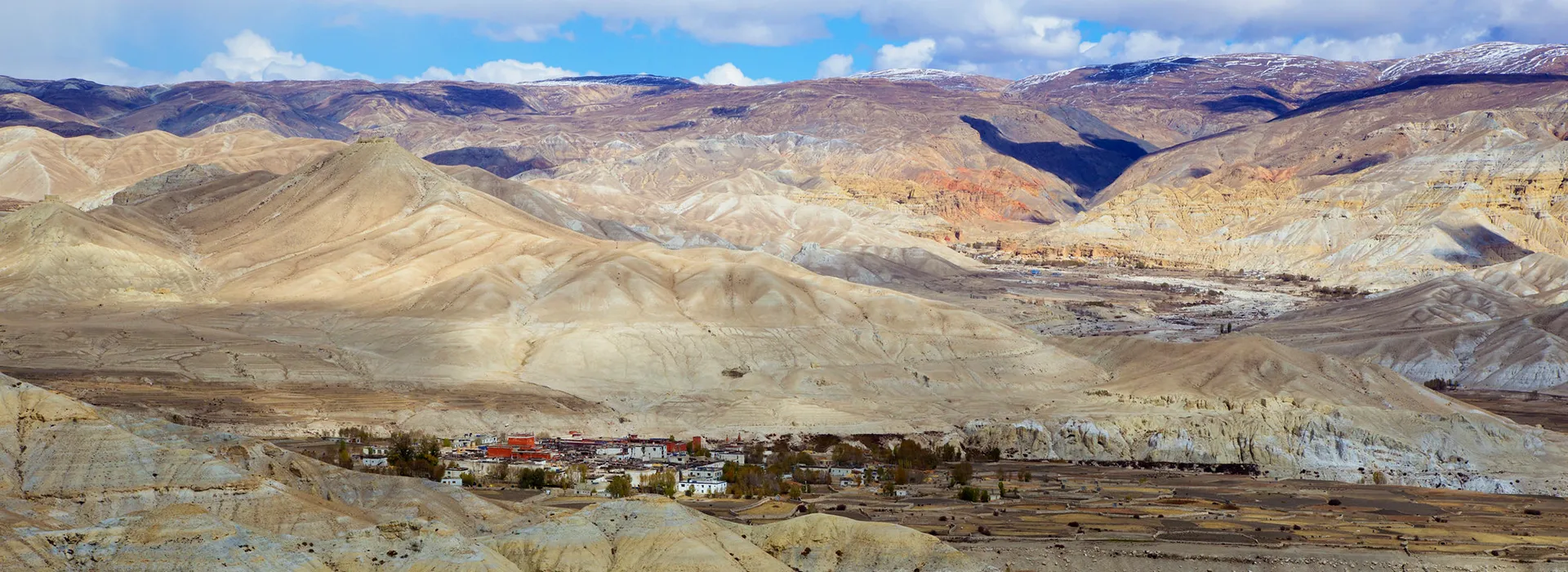
45 minutes before we reach Lo Manthang, we will come across the Lo La Pass elevated at 3,950m. This splendid Viewpoint offers an amazing view of a long-awaited city surrounded by walls, with white houses, a red monastery, a sea of colorful cliffs, and shiny peaks with white caps.
We will climb down the Pass and cross a stream to finally arrive at Lo Manthang among barley and buckwheat crops, a vast valley that is part of the Tibetan Plateau.
After breakfast, we will ride ponies to the town of Chhoser (16 km), where, apart from monasteries, there are famous caves. The most popular cave, Jhongu, makes an extraordinary impression: wooden ladders lead through small holes in the floors, and narrow tunnels connect many rooms. The cave system covers 5 levels. Some caves in Chhoser are 3,000 years old.
After exploring the caves, we will return to our lodge in Lo Manthang for a restful night.
We will dedicate this day to discovering the Mustang Valley and its surroundings. We will discover the walled town and its neat streets. We will also visit three gompas in the city: Champa Lhakanga, where it was sometimes possible to request an audience with the king of Mustang, Jigme Dorje Wangchuk.
We will also explore the monasteries of Tupchen and Choede as well as the museum. Then in the afternoon, we will explore the North-West region of Lo Manthang, forgotten by tourism. We will climb on a new ridge route to visit the fort of Ame Pal, the first king of Mustang, and the Black Monkey Gompa.
This will be the first day of return trekking along the eastern route of Kali Gandaki, one of the most picturesque in the world. This route is little known as they are less traveled. The reason is simple: the fairly difficult path crosses a very arid massif with scattered villages on the side. This path will save us a round trip and allow us to be in the remote valleys of the kingdom of Lo.
Revering our step, we will once again climb the Lo La Pass and walk past the Sungda Chorten. Then, we will advance to cross the suspension bridge and follow the trail that leads us to Dhi Village located on two rivers.
The views will be more and more extraordinary: multi-colored (yellow, cream, red, white), steep and eroded canyon walls. The most eye-catching is the huge wall that resembles giant cathedral organ pipes. The last part of the trail will take us to Surkhang village from where we will climb the stone steps to reach Yara.
Leaving Yara, we will follow the route that largely runs through the plateau. The route will then follow the Dhechyang Khola which we will eventually cross over a 171 m high suspension bridge. After crossing the bridge, we will arrive at the Dhey village where we will stop for lunch.
The trail now leads along a long ascent to the highest point of the day, 3,900 m above sea level, then a series of descents, paths, and sections on the plateau, and finally we will get a beautiful view of the village from the cliff.
Tangbe is an extraordinary place, a beautiful village with a row of ancient chortens in the very center, and apple orchards surrounded by stone walls.
Today is the longest, and most demanding section of our Upper Mustang trek that will take 9-10 hours of walk from us. However, the day will offer us the most breathtaking views, unusual rock formations resembling towers and organs, unusual colors, snow-capped Annapurna peaks, and lonely Dhaulagiri.
Our path begins with crossing the first bridge, then after 30 minutes, we will reach the next second bridge, behind which the climb begins for about 900 – 1000 m. It is a steep section of about 2.5 hours of climbing to the Paha Pass (4218 m above sea level).
From here, it is only 16.8 km to Chhuksang when we will overcome the Siyarko Tangk Danda, and pass the Chhomnang village to reach Chhusang.
Today we will exit the Upper Mustang trek trail and enter the lower Mustang region. We will pack our lunch and begin our hike to the Hindu Sanctuary of Muktinath. We will stay all day north of the Annapurna Massif.
Marching forward, the trail steeply climbs to the Gyula Pass (4077m). From the pass, magnificent views of the Annapurnas, Tukuche, and Dhaulagiri open up. The descent from the Pass is steep, then a balcony path leads us to Jhong Village from where we will advance to Muktinath
Early in the morning, we will visit the Muktinath Temple, participate in the Puja ritual, and take a quick bath in the 108-tap water at the periphery of the shrine. Then, we will leave Muktinath and proceed towards Jomsom.
The trail will take us past the Village of Lubra, the only village of the pre-Buddhist Bon religion in the area. Walking through the arid zone, we will walk past Jharkot and come across a slope full of loose stone. Descending from the slope, we will shortly arrive in Kagbeni where we will eat our lunch.
Then following the Kali Gandaki river bed, we will tackle a few vertical climbs towards Ekle Bhatti. Then the path flattens taking us to Jomsom- a real oasis of civilization.
We will take an early morning flight to Pokhara literally flying over Dhaulagiri, Fishtail, and Annapurna. From the Pokhara Airport, we will then transport you to your hotel in Pokhara. After relaxing and resting in the hotel, you can then set out to explore the beautiful city, its lake, monasteries, caves, museums, and many more.


Since Upper Mustang is influenced by the Tibetan weather, the best time to undertake the Upper Mustang trek is between May, June, July, August, September to early October. The region is blessed with a pleasant temperature of 15 to 20 degrees Celsius, and the landscape enlivens with a riot of colors.
During May, you can become one of the few to participate in the unique Tiji Festival while in August or September, you will be able to witness the horse racing festival of Yartung. And the occasional rain shower in June, July, and August makes the barren land bloom with wildflowers.
However, December, January, and February are quite harsh on the region with sub-zero temperatures and high-speed winds. Since the few lodges along the route will be closed this time, it is not wise to spend cold nights inside tents.
Covering a distance of approximately 125 kilometers, the Upper Mustang trek is situated at a distance of 462 km away from Kathmandu, 220 km away from Pokhara, and only 59 km away from Jomsom which is also the commencing point of our trek.
On our 13-day epic journey, the most significant elevation gain will be when we tackle the Paha Pass resting at 4218 m elevation while the unique Chhoser Village and its 3000-year-old caves will be our second highest elevation gain resting quietly at 3857 m.
The highest overnight stop during our trek will be at Lo Manthang village, nestled at an elevation of 3840 meters.
During our 13-day Upper Mustang trek, we will engage in 12 days of hiking, with an average walking time of 5 to 7 hours per day, covering a distance of 15 to 20 km.
The shortest walking duration will occur on day 5 when the hike from Charang to Lo Manthang will only take 3 to 4 hours. The longest walking day will be on day 12, with a 9 to 10-hour trek as we traverse the Paha Pass to reach Chhuksang from Tangbe village.
The Upper Mustang trek offers a moderately challenging route that transports us to a high-altitude desert with sublime landscapes illuminated with mineral colors against a backdrop of 7000 and 8000-m high mountains of Annapurna and Dhaulagiri.
The program includes 12 days of high-altitude trekking in a remote mountain region. In between the trek, we will reach the higher elevation ranging from 3600 m to 4200 m with several Passes. Some stages can be long (20 km), with significant positive and negative elevation changes.
However, most of the time, the trail is wide and not very technical trails, but certain passages can sometimes be damaged and require a little caution. Additionally, we have strategized a rest day at Lo Manthang. Therefore, this trek is suitable for those who enjoy walking for at least 5 hours a day through the serene Tibetan atmosphere.
The Upper Mustang trek is a lodge trekking in Nepal eliminating the need to stay in tents during trekking. Additionally being a relatively low-altitude hiking journey in comparison to other popular treks in Nepal, this journey presents only a mediocre challenge making it ideal for new trekkers and beginners.
The trek is also accessible to any individual of all ages and fitness. Whether you are a family with seniors or children, you can all participate in the Upper Mustang Trek and create unforgettable memories together.
However, you have to be mentally and physically prepared for the long hour walks along the barren land, and dry weather amid the vast Tibetan landscape of rocks, and minerals.
If you are someone who stays active, hits the gym regularly, and makes exercise a part of your daily routine, there is no need for any extra physical preparation for Upper Mustang Trek.
For non-athletes, however, physical preparation in the months preceding departure is essential. Prioritize endurance efforts (hiking, cycling, running, swimming, weight lifting, squats, push-ups, pull-ups, etc.). A short hiking trip to the nearest mountain will also not hurt.
And try to stay positive, and build up your inner strength with Yoga and meditation as we will be surpassing some terrains that may be outside your comfort zone.
There are numerous options available to explore the enchanting Upper Mustang region. After the construction of the motorable road, the trip can also be undertaken via comfortable jeep or bus eliminating the need for long hours of trekking.
You can start your journey with a drive to Pokhara or you can take a half-hour flight. Then the next day, you can drive to Jomsom, again there is the option of a domestic flight to Jomsom. Then, you can enjoy a scenic drive to Ghami, Lo Manthang, and Syangbochen, before returning to Jomsom. This will allow you to experience the beauty of Upper Mustang without the physical needs of a lengthy trek.
Or, if you like to experience some hiking as well, then you can trek through Kagbeni, Chele, Syangboche, Dhakmar, and Lo Manthang before returning to Jomsom by jeep.
Altitude sickness is of little concern in the Upper Mustang trek because the trip allows plenty of acclimatization in between the trekking journey. In addition, we will stay at a relatively low elevation with a maximum altitude gain of no more than 4300 m. Plus, we have thoughtfully designed the itinerary with a smooth uphill hike and a gradual increase in elevation.
The short days of walking uphill thus allow us to acclimatize to the altitude while discovering this Buddhist kingdom hidden behind the Himalayas. We will have time to enjoy the numerous Gompas, chortens (Stupas), and Mani Walls, but also to climb for superb walks above the stages, to better acclimatize.
However, we cannot guarantee that altitude sickness will be completely absent. It is possible that some members of our group may experience symptoms such as headaches, nausea, dizziness, and general discomfort once we reach an elevation of 3500 m.
Taking Diamox in such cases can reduce these symptoms and make your journey more enjoyable. Additionally, we recommend you stay hydrated by drinking plenty of fluids to help your body adapt to the warm and dry environment of Mustang.
You can enjoy the convenience of our all-inclusive domestic flight from Pokhara to Jomsom and back. During the Upper Mustang trek, we will provide you with private transportation for airport transfers in both Pokhara and Jomsom.
In Pokhara, you will sleep in a comfortable 3-star hotel (local standards) located near the city center. You are in an air-conditioned twin or double room, with a private bathroom and hot water. Breakfast every morning will also be offered.
During the trek, you will sleep in lodges where you will find twin rooms (2 single beds per room), with mattresses and pillows. The toilets are shared, and hot showers are chargeable.
Three meals (Breakfast, dinner, and lunch) with tea or coffee will be available during the trek. Dal, Vat, pani puri, Gundruk, Syabhale, Chowmin, momos, and keema noodles are some of the dishes you should try in the lodge.
NTC or NCELL national mobile networks will be at your service for flawless communication throughout the Upper Mustang trek. The lodges en route offer you WIFI service and electricity for charging your electric gadgets such as laptops, power banks, mobile, cameras, etc. However, there will be an extra charge for these services, which are not part of our tour package.
Please note, that due to high elevation and remoteness, the WIFI connections may be intermittent at Chele, Shyangbochen, and Ghame.
ACAP (Annapurna Conservation Area Permit), TIMS (Trekkers Information Management System), and a Restricted Area Permit are essential for the Upper Mustang trek. Our team will handle the permit acquisition for you and the cost of these permits is already included in our tour package.
Yes, if you do have not enough time to explore Muktinath temple, you can skip its visit and trek from Chhusang to Jomsom via Kagbeni.
More or less yes, with respect to people, culture, tradition, atmosphere, and geography.
Apparently so as there have been many researches regarding the caves, and artifacts found in the cave.
The Everest Base Camp trek is all about the breathtaking spectacle of the snow-covered giant Himalayas of Nepal with the hiking opportunity through the lush green forests of rhododendron. However, the Upper Mustang trek will take you to the dry barren lands of the region. Mostly this trek is for those who like to know the original culture, pristine nature, and archaeological heritage of the mystical caves.
Because the Upper Mustang is protected by the high massif of Dhaulagiri not allowing heavy downpours of rain. So the region is almost dry 12 months a year.

Need help?
Talk to trip expert