English
 Dutch
Dutch Japanese
 Hindi
Hindi Italian
 Spanish
 French
 German
 Chinese
 Korean
 Arabic
 Hebrew
 Russian
 Portuguese
 Danish
 Czech
Czech Polish
 Swedish
Need help?
 +977 9767994912


Trip Duration
18 Days
Trip Difficulty
Challenging
Max. Altitude
5,534m / 18,156ft.
Activity
Trekking
Destination
Nepal
Group Size
1-16 People Pax
Accommodation
3 star Hotel
Meals
Breakfast, Lunch and Dinner
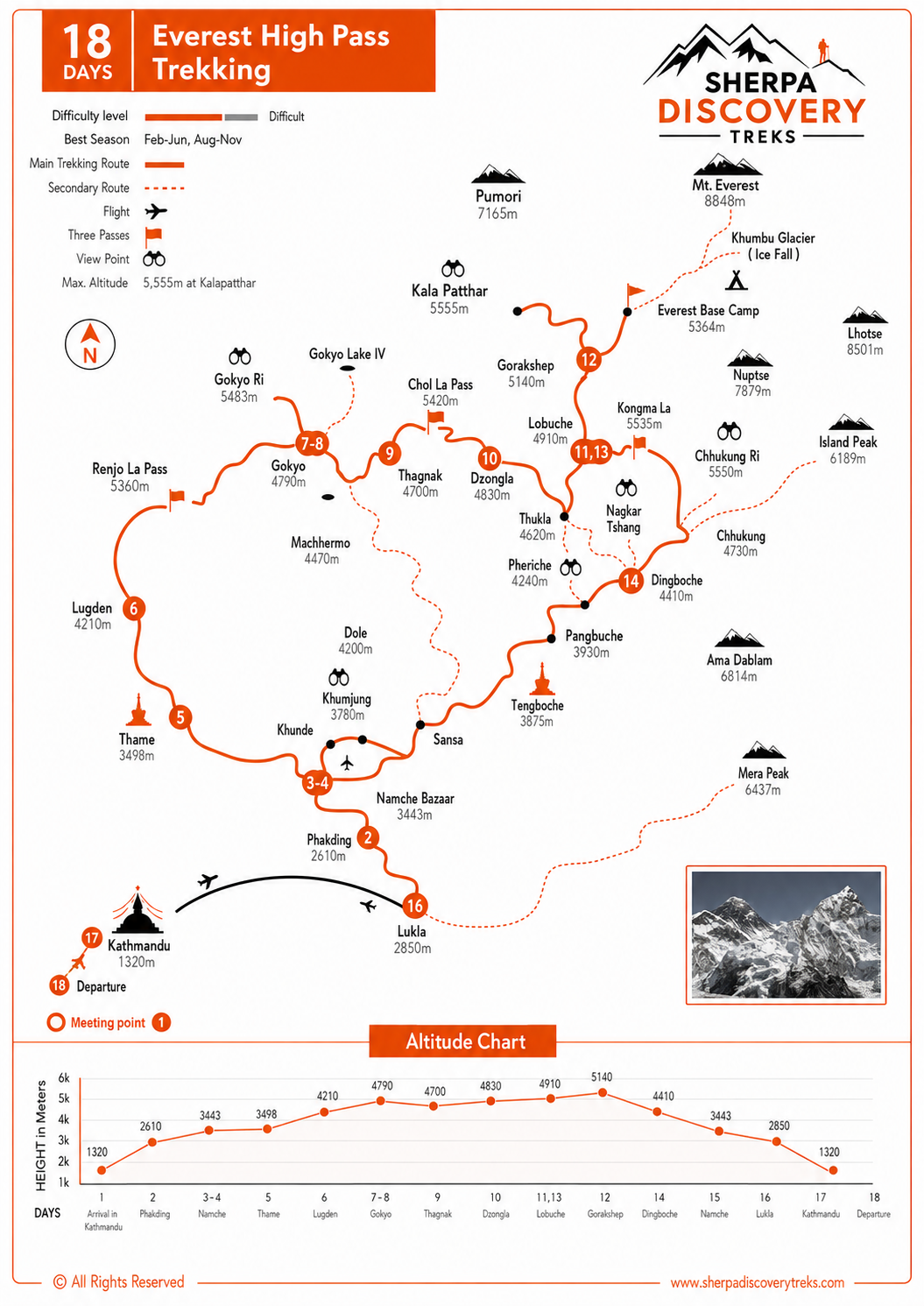
Kathmandu → Lukla → Phakding → Namche Bazaar → Khumjung/Thame side loop → Renjo La Pass → Gokyo Lakes → Gokyo Ri → Cho La Pass → Dzongla → Lobuche → Everest Base Camp → Gorak Shep → Kala Patthar → Kongma La Pass → Chhukhung → Tengboche → Namche Bazaar → Lukla → Kathmandu

Need help?
Talk to trip expert
The Everest Three Passes Trek 18 Days is the highest and most comprehensive high-altitude trek you can do in Khumbu — a circuiting, challenging and beautifully demanding loop combining all of the major highlights of the Everest region into one journey. This route does not simply go up one valley and return down the same way; it twists its way through three different valleys, connected with three gaping glacier-carved passes above 5,300 metres: Kongma La, Cho La and Renjo La.
Along the way you’ll stand at Everest Base Camp, watch dawn break over the world’s highest peak from Kala Patthar, wander the turquoise Gokyo Lakes, and climb Gokyo Ri for what many veteran trekkers consider the single best mountain panorama in Nepal. Sherpa Discovery Treks & Expedition has built this itinerary over years of guiding in the Khumbu, with acclimatisation days placed exactly where trekkers need them and a pace that respects the altitude rather than fighting it.
This is not a trek for some first-timer seeking an easy, beginner Himalayan style. Still, strike it, and you are in for a mega-reward if you have good fitness, some high-altitude trekking and a true thirst for adventure.
Strenuous / Challenging. This is a demanding trek recommended only for trekkers with prior high-altitude experience or excellent cardiovascular fitness. Three consecutive passes above 5,300m, several long trekking days, and cold, exposed terrain make this considerably harder than the standard Everest Base Camp trek.
Maximum altitude: Everest Three Passes Trek 18 Days is Kongma La Pass, 5,535 metres (18,159 ft)
Approximately 160 km (100 miles) round trip from Lukla.
Walking Hours
Typically 4 to 8 hours per day, with the three pass-crossing days on the longer end.
Spring (March–May): stable weather, rhododendrons in bloom, excellent mountain visibility
Autumn (late September–November): the clearest skies of the year and the most popular season
Winter and summer/monsoon departures are possible for experienced trekkers but carry added risk from snow-blocked passes or reduced visibility, respectively.
Comfortable teahouses/lodges throughout, twin-sharing rooms with shared bathrooms at higher altitudes and attached bathrooms available in Lukla, Phakding, and Namche. Two nights in a 3-star hotel in Kathmandu are included.
Full board (breakfast, lunch, and dinner) throughout the trek, featuring a mix of Nepali, continental, and Tibetan-style dishes. Breakfast only is included in Kathmandu.
Private vehicle transfers in Kathmandu, and round-trip domestic flights between Kathmandu (or Manthali, depending on season) and Lukla.
* Sagarmatha National Park Entry Permit
* Khumbu Pasang Lhamu Rural Municipality Permit
A detailed packing checklist is provided at booking. Core items include a four-season sleeping bag, insulated down jacket, waterproof shell layers, sturdy broken-in trekking boots, trekking poles, headlamp, sunglasses rated for high-altitude UV, and a daypack. Sleeping bags and down jackets can be rented in Kathmandu if needed.
You should be able to comfortably hike 6-8 hours a day, on consecutive days, carrying a light daypack, over rough and occasionally icy terrain at altitude. We recommend several months of cardio and leg-strength training (running, stair climbing, hiking with a loaded pack) before departure. Prior experience at altitudes above 4,000m is a significant advantage on this particular route.
Acute Mountain Sickness (AMS) is a real risk on any trek above 3,000m and is a serious consideration on a route that crosses three passes above 5,300m. Our itinerary is built with dedicated acclimatisation days at Namche Bazaar and Gokyo, and a “climb high, sleep low” pattern wherever the terrain allows. Your guide monitors everyone daily using a pulse oximeter and is trained to recognise early symptoms — headache, nausea, dizziness, and loss of appetite — and to act on them, including descent if necessary. Diamox (acetazolamide) is commonly used preventively; please discuss this with your doctor before travel.
Our guides carry a comprehensive first-aid kit and a satellite communication device for areas with no mobile signal. We maintain daily contact with our Kathmandu office throughout the trek. In the event of a medical emergency, helicopter evacuation can be arranged rapidly, which is why comprehensive rescue insurance is a strict requirement for joining this trek.
We are committed to low-impact, community-respecting travel. This means employing local Sherpa staff at fair wages, carrying out all non-biodegradable waste, avoiding single-use plastic bottles wherever teahouse water refill stations exist, and briefing trekkers on respectful behaviour around monasteries, mani walls, and local customs.
A signed booking form and a 20% deposit confirm your reservation. The balance is due upon arrival in Kathmandu, payable by bank transfer, credit card, or cash. We recommend booking at least 60 days in advance, particularly for the busy spring and autumn seasons.
Deposits are non-refundable but transferable to another departure date within 12 months. Cancellations made 30 days or more before departure are eligible for a partial refund of the trek balance (excluding the deposit and any non-recoverable third-party costs). Cancellations within 30 days of departure are non-refundable. We strongly encourage all trekkers to purchase travel insurance that includes trip-cancellation cover.
Comprehensive travel insurance is mandatory for this trek. Your policy must cover emergency helicopter evacuation and medical treatment at altitudes up to at least 6,000 metres. Please send us your policy details, including the 24-hour emergency contact number, before departure.
Book Your Everest Three Passes Adventure with Sherpa Discovery Treks & Expedition
Few treks in the world combine this much variety, challenge, and raw Himalayan beauty into a single journey. If you’re ready to stand on three of the Khumbu’s highest passes, watch sunrise break over Everest from Kala Patthar, and trek with guides who call these mountains home, get in touch with Sherpa Discovery Treks & Expedition today. Let’s start planning your Everest Three Passes Trek.

Upon your arrival at Tribhuvan International Airport in Kathmandu, our representative will warmly welcome you and escort you to your hotel. After checking in, you can take time to unpack, rest, and recover from your long flight.
In the late afternoon or evening, you will meet your trekking guide for a comprehensive pre-trip briefing. We will review the route, go over safety protocols, inspect your trekking equipment, and answer any questions you may have before we begin our journey into the Himalayas.


We start early in the morning with a flight from Kathmandu (or Manthali during peak seasons) to Lukla, offering sweeping views of terraced hillsides and distant Himalayan ridges. Landing at the famous Tenzing-Hillary Airport in Lukla, we gather our gear, meet our local porters, and take our first steps on the trail.
The walk today is a gentle introduction to the Khumbu region. We descend gradually along the Dudh Koshi River valley, passing through small Sherpa hamlets, pine-scented forests, and carved mani stones. Crossing several suspension bridges adorned with colourful prayer flags, we arrive at the quiet river village of Phakding for our first overnight stay.
Leaving Phakding after breakfast, we follow the winding trail through thick pine and rhododendron woods. We pass through small local settlements such as Benkar and Monjo, where we officially check into Sagarmatha National Park. The trail crisscrosses the roaring Dudh Koshi River multiple times on high suspension bridges, culminating in the famous Hillary Suspension Bridge hanging far above the canyon.
From the riverbed, we begin a long, steady uphill climb through forested trails. As we gain elevation, the trees open up to offer our very first view of Mount Everest peaking over the ridge. We continue ascending until we reach Namche Bazaar, the vibrant horseshoe-shaped mountain town that serves as the commercial and cultural capital of the Sherpa people.
Proper acclimatisation is vital before climbing above 5,000 meters, so we dedicate the day to resting and letting our bodies adjust to the thinner air. In the morning, we take a short acclimatisation hike up to the iconic Everest View Hotel (3,880m). Sitting on the open terrace, we enjoy clear panoramas of Mount Everest, Lhotse, Nuptse, and the striking spire of Ama Dablam.
On our way back down, we can stroll through the nearby Sherpa villages of Khumjung and Khunde to visit local schools and monasteries. The afternoon is yours to explore Namche’s narrow cobblestone streets, browse local bakeries and gear shops, or visit the Sherpa Culture Museum before resting for the evening.
nstead of heading along the popular highway toward Tengboche, we branch west into the quieter Bhote Koshi Valley toward Thame. This peaceful trail follows an ancient salt-trading route that once connected Nepal with Tibet. Walking away from the main tourist crowds, we trek through shaded pine forests, cross high bridges, and pass through small agricultural hamlets.
As we near Thame, the valley opens up into broad grasslands framed by rugged, snowy peaks. Thame is a historic Sherpa village famous for being the home of legendary Everest mountaineers, including Tenzing Norgay Sherpa and Kami Rita Sherpa. We check into our teahouse and spend a peaceful evening soaking in the traditional high-mountain atmosphere.
Leaving Thame behind, we head further north up the Bhote Koshi Valley. As we climb steadily higher, the trees gradually give way to alpine shrubs, yak pastures, and wind-swept glades. The sense of isolation increases, giving us an authentic experience of the wilder, untouched sides of the Khumbu region.
Along the trail, we pass small stone-walled settlements like Marulung and cross quiet glacial streams. The walk is steady, allowing us to build our endurance naturally. By afternoon, we reach Lungden, a small alpine settlement that sits near the base of Renjo La Pass, where we rest in preparation for our first high mountain crossing.
We start before dawn to cross our first major hurdle: Renjo La Pass. The trail leads up a steep, winding path over stony ground and stone staircases. As we ascend higher into the cold morning air, the landscape becomes increasingly dramatic, with glaciers and frost-covered peaks surrounding us.
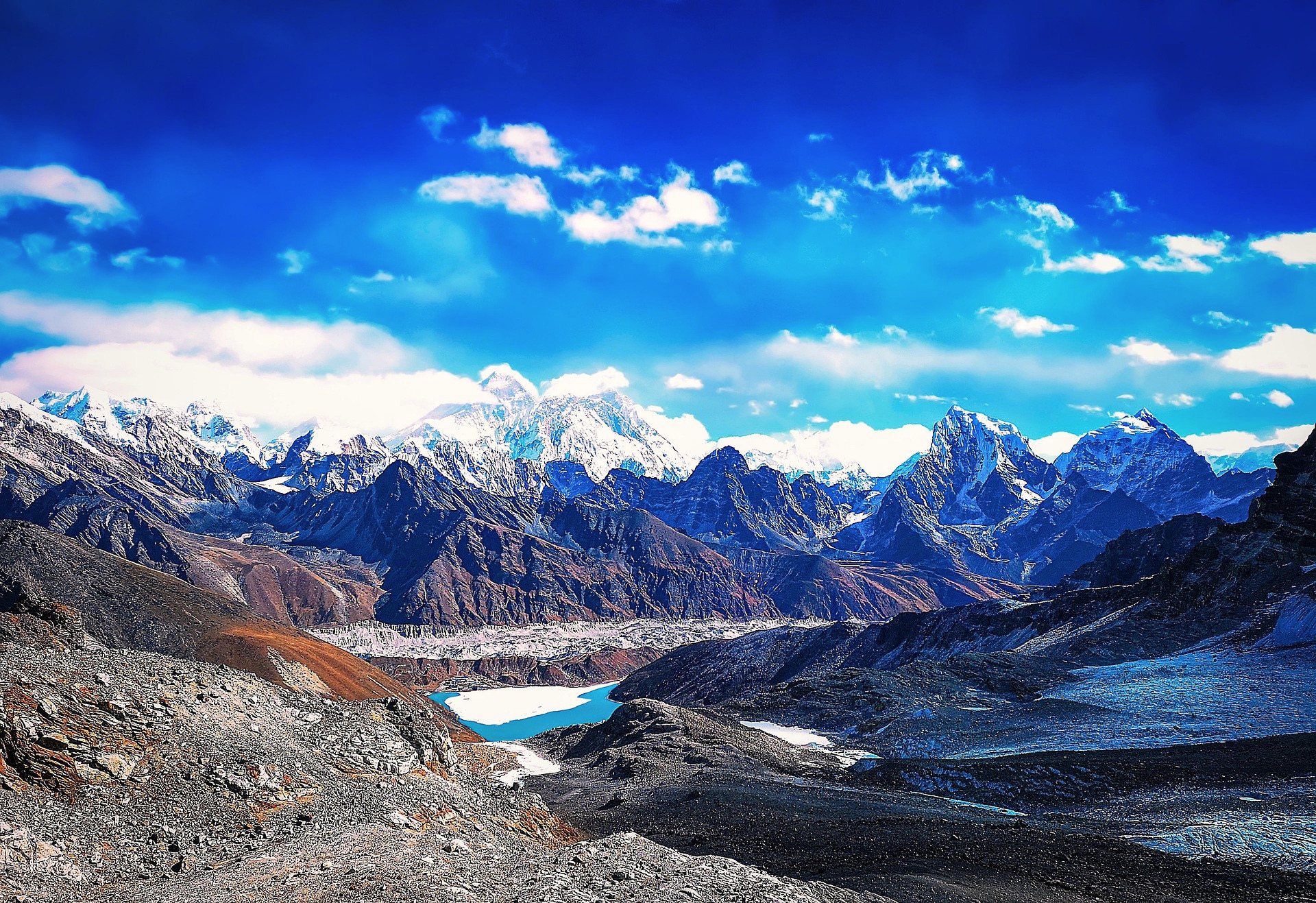
Reaching the summit of Renjo La Pass (5,360m) is a deeply moving experience. Strung with colourful prayer flags, the top reveals a world-famous view of the turquoise Gokyo Lakes down in the valley, backed by an unbelievable mountain wall featuring Mount Everest, Lhotse, Cho Oyu, and Makalu. After taking photos and enjoying the scene, we make a steep descent down stone steps to the edge of the third lake and rest at Gokyo Village.
Early in the morning, we hike up Gokyo Ri (5,357m), the steep grassy peak standing directly above the lake. As the morning sun rises over the horizon, golden light hits the snow-covered slopes of Everest, Lhotse, Makalu, and Cho Oyu. Below us, the Ngozumpa Glacier stretches out like a massive frozen giant alongside the sparkling lakes.
After capturing these unforgettable panoramas, we hike back down to our teahouse for a hearty breakfast. The rest of the day is completely free for rest. You can stroll along the edges of the turquoise lakes, catch up on reading, or simply relax in the warm dining room while admiring the high-altitude surroundings.
Today’s trek is relatively short in distance, but requires focus and careful footwork. We leave Gokyo Village and begin crossing the Ngozumpa Glacier—the largest glacier in the Nepalese Himalayas. The route across the glacier shifts continuously over ice mounds, gravel ridges, small glacial ponds, and loose rock.
Navigating through this ice wilderness, we witness and hear the slow movement of the active glacier. Once across the moraine, we reach the small, sheltered outpost of Thagnak nestled right at the base of Cho La Pass, giving us plenty of time to rest up for another big pass day tomorrow.
We set off early in the morning, climbing up a steep ravine and navigating boulder fields toward Cho La Pass. The climb gets progressively steeper as we approach the pass, requiring careful footing over loose rocks and scree slopes. Near the summit, we walk across a flat snow field that leads to the top of the pass.
Reaching Cho La Pass (5,420m) places us directly in front of the impressive rock face of Cholatse Peak. Prayer flags flutter wildly in the high wind as we take in the mountain views. The descent on the eastern side involves stepping carefully down steep rock trails and scree slopes, which gradually slope down into the peaceful, isolated pastures of Dzongla.
Today we tackle our third and highest pass: Kongma La (5,535m). Starting early from Chukkung, the trail climbs relentlessly up steep alpine slopes, rocky scree, and large boulder fields. The pass is isolated and wild, testing our endurance as we make our final push to the top.
Reaching the summit of Kongma La Pass completes our circuit across all three high passes! The top offers dramatic views of Pokalde, Nuptse, and the frozen landscape of the Imja Valley. After celebrating this milestone, we take a long descent down past frozen tarns into the wide, stone-walled valley of Dingboche.
Having conquered all three passes, we begin our descent through the main valley. The walk takes us down through Pangboche, crossing the river before climbing through shaded rhododendron woods up to Tengboche Monastery. We stop to admire the monastery and its mountain backdrop once again.
Continuing down from Tengboche, the trail drops steeply to the river at Phunki Thenga before making a final climb along the high trail back into Namche Bazaar. Arriving back in Namche feels like returning to civilisation, where hot showers, warm bakeries, and comfortable teahouses await us.
On our last day on the foot trail, we descend steep stone steps out of Namche Bazaar, crossing the high suspension bridges over the Dudh Koshi River once more. We pass back through Monjo and Phakding, retracing the path we took over two weeks ago.
The air grows thicker and warmer as we walk down the valley. A final uphill push from the river brings us back into Lukla. In the evening, we gather with our guides and porters to share a final celebration dinner, reminiscing on the epic journey across the three passes.
We wake up early to catch a scenic morning flight out of Lukla. Depending on the season and weather conditions, we will either fly directly to Tribhuvan International Airport in Kathmandu (approx. 35 minutes) or take a short flight to Ramechhap Airport in Manthali (approx. 20 minutes) followed by a comfortable 4- to 5-hour drive back through the rolling hills and countryside to Kathmandu.
Upon arriving in Kathmandu, you will be transferred to your hotel. After the long days on the high-altitude trails, you can enjoy a hot shower, relax, and spend the afternoon at your leisure—whether visiting local markets in Thamel for souvenir shopping or relaxing at a cafe. In the evening, we gather for a special Cultural Farewell Dinner at a traditional Nepalese restaurant, featuring local cuisine and live folk music and dance performances to celebrate the successful completion of your Himalayan adventure.
Today marks the end of your unforgettable journey in Nepal. Depending on your flight schedule, you may have some free time in the morning for last-minute exploration, visiting nearby heritage sites, or enjoying a final cup of Himalayan coffee in Kathmandu.
Approximately 3 hours before your scheduled international flight, our representative will meet you at your hotel and arrange a private transfer to Tribhuvan International Airport. As you board your flight home, you take with you lifetime memories of the towering peaks, the mighty Everest Base Camp, high mountain passes, and the warm hospitality of the Sherpa people.

1. Peak Season Flight Routing (Manthali/Ramechhap Airport) During peak trekking seasons (Spring: March–May and Autumn: September–November), civil aviation regulations route most flights between Lukla and Manthali Airport in Ramechhap instead of Kathmandu (Tribhuvan International Airport) to manage air traffic congestion.
2. Weather Dependency & Importance of Buffer Days Flights into and out of Tenzing-Hillary Airport (Lukla) operate strictly under Visual Flight Rules (VFR), meaning aircraft can only fly when visibility is clear. High-altitude mountain weather in the Khumbu region changes rapidly—dense cloud cover, fog, high winds, or rain can lead to sudden flight delays or multi-day groundings.


Yes. It covers more distance, more elevation gain and loss, and crosses three passes above 5,300m, compared to the single, gentler high point of the classic EBC trek.
Prior multi-day trekking experience, ideally including at least one trip above 4,000m, is strongly recommended before attempting this trek.
We suggest planning for 20-21 days overall to comfortably absorb possible Lukla flight delays without risking your international flight home.
The three acclimatisation days and the pass-crossing days should not be compressed, as doing so significantly raises the risk of altitude sickness. Minor adjustments elsewhere are possible.
Yes, we run this as a private trek with a dedicated guide and porter regardless of group size, so solo trekkers receive the same level of support as a full group
October and late April to early May typically offer the most reliable weather and the clearest mountain views for pass crossings.

Need help?
Talk to trip expert