English
 Dutch
Dutch Japanese
 Hindi
Hindi Italian
 Spanish
 French
 German
 Chinese
 Korean
 Arabic
 Hebrew
 Russian
 Portuguese
 Danish
 Czech
Czech Polish
 Swedish
Need help?
 +977 9767994912


Trip Duration
18 Days
Trip Difficulty
Difficult
Max. Altitude
4,998m / 16,398ft.
Activity
Trekking
Destination
Nepal
Group Size
1-16 Pax
Accommodation
3 star Hotel
Meals
Breakfast, Lunch, Dinner
US$ 1350
We offer group discounts
Total Cost:
US$ 1500

Need help?
Talk to trip expert
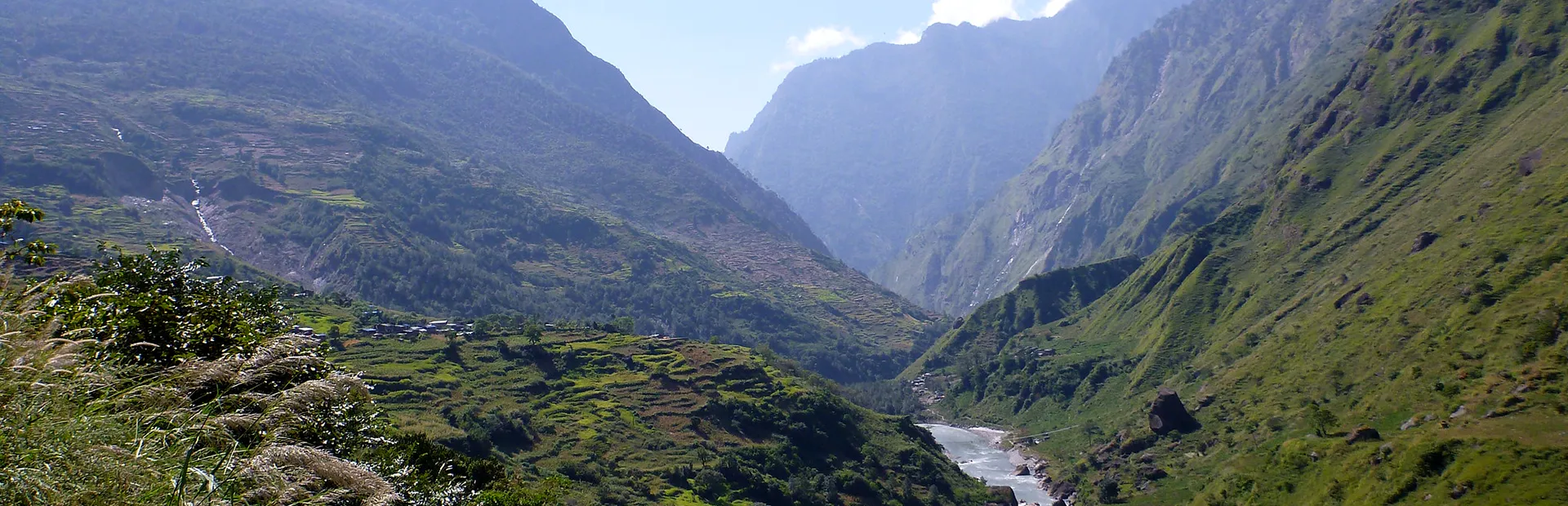
The Manaslu region and the Tsum valley region are two of the least-visited trekking destinations in Nepal. This Manaslu and Tsum Valley Trek is a perfect alternative to the crowded Annapurna and Everest trekking regions. This Himalayan journey begins from Machha Khola (a bit further than Besisahar), which is a very accessible village set on the shores of the Budi Gandaki River.
Since this trek is a combination of two different trekking destinations, the main selling point here is getting to visit two gorgeous highland regions in a single trek. First off, we will the Tsum Valley and trek up to the Upper Tsum Valley region for an amazing highland trekking experience. You will get to visit the Mu Gompa, Ranchen Gompa, Milarepa Cave, and more. Additionally, you will also experience the traditions and practices of the Tsumba people.
After we are done exploring the Tsum Valley, we will get back down to Deng and get on the standard Manaslu Circuit Trek. This part of the trek takes us to visit the Birendra Lake, Pungen Gompa, etc., and also requires us to climb the Rui La Pass and the Larkya La Pass, both of which are challenging climbs. You will get to see many peaks from those passes, including Cheo Himal, Manaslu, Annapurna II, Himlung Himal, and more.
This trek usually lasts for 18 to 24 days, depending on the itinerary you have chosen. Regardless of the length of the itinerary, you will have a great time exploring the villages, experiencing the Tibetan Buddhist culture of the highlands, and visiting the ancient gompas along the route. There are many viewpoints along this trek that offer you great views of the peaks, rivers, and the valleys.
There are a lot of attractions on this remote Himalayan trekking journey and a lot to experience, but before that, you have to understand the requirements of this trek and the nuanced aspects to make sure that you are up for the challenge. Here’s a detailed breakdown of our Manaslu and Tsum Valley Trek package.

The first day of the Manaslu Circuit Tsum Valley Trek takes us all the way to Machha Khola. We will start the drive from Kathmandu, cover over 160 km of distance, and lose 530 meters of elevation to get to Machha Khola village. Depending on the traffic flow, it will take us about 7 to 8 hours to complete today’s drive.
Leaving Kathmandu, we will drive over the Tribhuvan Highway to get to Naubise and get on the Prithvi Highway from there. Passing Malekhu, we will get to Dhading Besi, which is our turning point. We will leave the highway and drive north with a great view of the Trishuli River to get to Aarughat. This part of the drive is done over gravel roads. After Aarughat, we will get to Soti Khola village and hit the final leg of the drive to Machha Khola.


Today is the first trekking day of the Manaslu Circuit Tsum Valley Trek, but unlike other trekking destinations, this first day will not be a short and easy one. We will be trekking over 22 km, gaining over 500 meters of elevation, and be on the trails for 6 to 7 hours. Our final elevation of the day will be 1410 meters above sea level at Jagat. It is not your traditional short and easy first day, but it is very enjoyable and exciting.
The trek starts with a plain section, following the curves of the Budhi Gandaki River upstream. We will cross a handful of suspension bridges and pass by small villages. We will pass Khorlabesi and Tatopani to get to Dobhan. The trail is very gently ascending with a few sharp ascents that are very doable. From there, we will reach Yaru Khola shortly after and continue the trek to reach Jagat in about 45 minutes.
Day 3 of the Manaslu Circuit Tsum Valley Trek is yet another long trekking day as we will have to cover 17.5 km of distance over a period of 6 to 7 hours to get to Lokpa. This trek will take us 830 meters higher, reaching 2240 meters above sea level at Lokpa. Leaving the Gurung village of Jagat, we will first get to the village of Salleri. This part of the trail gently ascends up through terraced farmlands and lush forests.
From Salleri, we will cross the Budhi Gandaki River over a suspension bridge. This path leads us to the Gurung village of Philim, a great place to rest and munch on a meal before continuing the trek. We will have our lunch served there as we enjoy the traditional architecture of the houses. Resuming the trek, we will then get to a fork, one leads to Tsum valley while the other is the standard Manaslu Trek route. We will trek the former route and get to Lokpa after about two hours.
Trekking from 2240 meters at Lokpa, and reaching an elevation of 2386 meters at Chumling, ends the 4th day of the Manaslu Circuit Tsum Valley Trek. The elevation gain of the day is 146 meters, which is very trivial. The total trail distance is just 6.4 km, but it will take us 4 to 5 hours to cover this distance. Leaving Lokpa, we will first descend through a lush forest to reach the Lungwa River Valley. This section of the trek can be narrow at times.
We will then cross the Lungwa River over a suspension bridge and reach an ascending trail that offers occasional scenes of the surrounding hills and peaks. Climbing up the valley, we will soon reach a bridge that crosses the Syar Khola. This marks that we are now close to Chumling village. This village has the Panago Gompa, Mani Dhungyur Gompa, and the Gurwa Gompa, which we will visit in our free time.
Today’s itinerary takes us to Chhokangparo village, reaching 3031 meters of elevation and gaining us 645 meters of elevation. This day hike stretches over 10 km and requires us to be on the trails for 4 to 5 hours, including the rest breaks in between. The trek starts with a descent that leads us to the Syar Khola, where we will cross the river over a hanging bridge. After that, the trail starts ascending through a thick forest of rhododendron and pine.
We will soon make it to Rainjam village, where we will rest a little. Then the trail takes us to the village of Gho, followed by a crossing over the Syar Khola once again. This is how we will enter the Upper Tsum Valley. At this point, the thick forests will be left behind, and we will be amid open grasslands. This trail soon takes us to the final climb that leads us to Chhokangparo village; it is not an easy ascent, but it is manageable.
Day 6 of the Manaslu Circuit Tsum Valley Trek takes us all the way up to an elevation of 3361 meters at Nile. This trek has an elevation gain of 330 meters, covers about 10 km of distance, and requires a trekking period of 5 to 6 hours. Leaving Chhokangparo, we will gradually climb northwest, over an ascending trail to go deeper into the Upper Tsum Valley. This section of the trail passes by many religious buildings and sites.
Today’s trek begins with a visit to the Milarepa Cave. This sacred site is carved into a cliff and is currently a site for meditation. From there, we will first get to Lamagaun, followed by the village of Phurbe, where traditional stone houses are dominant, and then get to Pangdun. This village has a couple of ancient Buddhist monasteries. From Pangdun, we will trek to Chhule, where we will get the first glimpse of the barren alpine vegetation. We will soon get on the final ascent to Nile, which is gentle and easy.
This is your first acclimatization day of the Manaslu Circuit Tsum Valley Trek. Today, we will take you on an acclimatization hike to Mu Gompa, reaching 3700 meters above sea level. This hike will gain us about 340 meters of elevation, taking 3 to 4 hours to complete, and covering 7 km in total. Moving on from Nile, we will soon transition to an arid landscape as we make our way to higher elevations.
The trek goes along the Syar Khola, offering a great wide view of the valley, and takes us through pasture lands, eventually. As we get closer to Mu Gompa, we have to trek a steep ascent and reach the highest and biggest gompa in the entire Tsum Valley. This monastery dates back to 1895 AD, housing traditional Thangka paintings, scripts, and textbooks related to Buddhism, and religiously significant statues.
Spending the night in Nile, we will wake up to a beautiful scene of the valley, and have our breakfast soon enough. Today’s trek takes us back to Chumling, covering over 20 km of distance. The elevation loss of the day is 975 meters, taking us back to 2386 meters and requiring about 7 to 8 hours of trekking. This is the longest trekking hours of the Manaslu Circuit Tsum Valley Trek itinerary.
Leaving Nile, we will trace back our steps and slowly get out of the Upper Tsum Valley. This descent passes by Chhule, Milarepa Cave, and takes us to Chhokangparo first. You will enjoy the views of Ganesh Himal and Himalchuli peak from this village. After this, we will descend further to reach Domje village, the biggest village in the entire valley. As we get closer to Chumling, we will cross over the Syar Khola to get to Chumling.
Continuing the descent, today’s trek is as long as yesterday’s, with 7 to 8 hours of up time, covering over 18 km of distance. The day starts at 2386 meters above sea level and brings us all the way down to 1860 meters at Deng village, an elevation loss of over 500 meters. Leaving Chumling, we will descend a trail following the Syar Khola River and get to the village of Lokpa. This part of the trek gives you a chance to witness the culture of the locals, along with the natural scenery.
Leaving Lokpa, we will cross a hanging bridge over the Busi Gandaki River and continue the descent, entering a narrow gorge. The trail then ascends and descends many times over as we gently gain altitude. Exiting this part, we will reach a bamboo forest, followed by crossing many suspension bridges to arrive at the Gurung village of Deng. This village marks that we have exited the Upper Tsum Valley and entered the standard Manaslu Circuit route.
Starting from 1860 meters, today we will gain 800 meters of elevation to get to Namrung village, reaching 2660 meters above sea level. This day trek will cost us 6 to 7 hours of trek, covering over 19 km of distance. We will start the ascent with a walk over the Budi Gandaki River. The ascent then leads us to Rana village, where local culture shines through. Moving on, we will move west, pass by a dense forest with waterfalls, and cross the Budi Gandaki River a couple of times to get to Bihi village.
From Bihi, the trail ascends sharply via lush forests and mani walls decorated with Buddhist prayer flags. This path soon leads to the village of Ghap, where you will find Mani walls with very detailed inscriptions and figures. Leaving Ghap, we will get on the final leg of today’s trek and ascent to Namrung village, the gateway to the higher Manaslu region.
Today’s trek spans over 16.5 km, has an elevation gain of 870 meters, taking us to 3500 meters, and requires 4 to 5 hours of trekking. This trek starts with a gentle ascent through a forested trail of oak and fir, and passes by tiny settlements with traditional stone houses. After about an hour or so, we will reach the village of Sho. This village is a great place to rest and offers a great view of the Manaslu region peaks, along with other distant peaks.
Moving on, we will shortly reach Lho village, where a large gompa stands tall with a backdrop of the Himalayas. This will be our lunch stop since it is the last village before we reach Shyala. Leaving Lho, we will get on the final ascent of today’s trek and get to Shyala, where views of Ngadi Chuli, Manaslu, and Himal Chuli await us.
From Shyala, we will trek about 17 km today to get to Samagaon, with an elevation gain of only 30 meters; the least of our entire Manaslu Circuit Tsum Valley Trek. This trek will last anywhere from 3 to 4 hours. We will start the trek by passing through an alpine grassland and a forest. With occasional views of the Himalayas accompanying us, passing by many tiny villages, chortens, and mani walls, we will make it to Samagaon without any problem.
After checking in at our accommodation, we will go on a side trip to Birendra Lake. This short hike takes about 1 to 2 hours and is only 3 km long. The Birendra Lake is situated at the base of the Manaslu Glacier, and its turquoise water paired with the icy peaks in the distance make up for a great scenic treat.
Alternatively, we can also visit the Pungen Gompa. This hike is considerably longer than the first option. We will have to hike about 14.5 km and gain an elevation of 775 meters within 5 to 6 hours to complete this side trip. The Pungen Gompa sits at an elevation of 4070 meters above sea level and offers a beautiful scene of the entire Manaslu Himalayan range. Obviously, this trek would prove to be difficult for most trekkers since your day trek has already taken a toll on you. So, this one is recommended for heavily experienced trekkers only.
Day 13 of the Manaslu Circuit Tsum Valley Trek spans over 16 km, takes about 4 to 5 hours to complete, and has an elevation gain of about 345 meters. We will start the day at 3530 meters in Samagaon and end the day at Samdo village, reaching 3875 meters above sea level. This day trek starts with a gradual climb along alpine pasture lands, accompanied by the scenes of the peaks in the north.
Moving on, we will trek along the Budi Gandaki River and take a wooden bridge to cross it. This path leads us to Kermo Kharka, an alpine meadow, where you will find many cattle and shepherds. Continuing the trek, we will pass by many chortens and mani walls as the trail turns rough. The surrounding beings are dominated by sparse vegetation as we get closer to our destination of the day.
Today is a challenging trek day of the Manaslu Circuit Tsum Valley Trek. The itinerary of the day takes us to the Rui La Pass, reaching 4998 meters, gaining us 1123 meters of elevation. The total distance we have to cover is 14 km round trip with an expected trekking time of 6 to 7 hours round trip. Leaving Samdo, we will head north, trekking along the Athara Saya Khola (1800 River).
Following a 3-hour trek, the path turns west, following the curves of the river. This is where a small wooden bridge is located, marking the sharp ascent that takes us to the top of Rui La Pass. This ascent is challenging and requires hours of climbing. After reaching the summit, we will get to enjoy the scenes of the Himalayas along with the far-off Tibetan plateau. After about 30 to 40 minutes at the top, we will descend back to Samdo, as it will be getting dark.

Compared to yesterday, today is an easy trekking day as we just have to be on the trail for about 3 to 4 hours, cover a total distance of 6 km, and gain a total elevation of 585 meters. By the end of the day, we will be sitting at 4460 meters of elevation at Dharamsala, also known as Larke Phedi village. Starting the trek, we will first get on a gradual descent towards the Budi Gandaki River and cross it over a hanging bridge. Crossing the bridge takes us to the old Larke Phedi Bazaar’s remains.
After crossing that section, we will get on an ascending trail with views of Syacha Glacier, Manaslu, and Naike peak accompanying us. The trail soon turns rough as we get closer to our destination of the day.
Today is yet another challenging trek day of the Manaslu Circuit Tsum Valley Trek, having us gain almost 650 meters of elevation, reaching 5106 meters above sea level at Larkya La Pass. The total distance to the top is 7 km, which takes about 4 to 5 hours of trekking. Leaving Dharamsala, we will ascend gently over rocky trails, and soon the path turns steep with icy patches all over. The challenging part is the final climb to the top, which is very physically demanding.
From the top of the pass, we will get to enjoy the views of Annapurna II, Himlung Himal, Manaslu, and Cheo Himal peaks along with a panoramic scene of the valley. We will then descend steeply to Bhimtang, where there are amazing scenes of the Dudh Khola Valley. The total trekking distance from Dharamsala to Bhimtang is 24 km, which takes about 8 to 10 hours in total.
Following a challenging trek day, today is yet another difficult day as we will be covering over 25 km over a period of 7 to 8 hours with an elevation loss of 1810 meters. Leaving Bhimtang, we will descend along the Dudh Khola River and cross it over a wooden bridge to get to the village of Gho. This should take us about 2 hours. From there, we will continue the descent and get to Tilije, reaching 2300 meters. After this, we will get to the final section to Dharapani, crossing a number of hanging bridges.
This is the last day of the Manaslu Circuit Tsum Valley Trek. We will wake up at 1910 meters above sea level in Dharapani, grab a quick breakfast, and get on the ride to Kathmandu. This ride will last about 9 hours, and we will be following the Trishuli River for the most part.


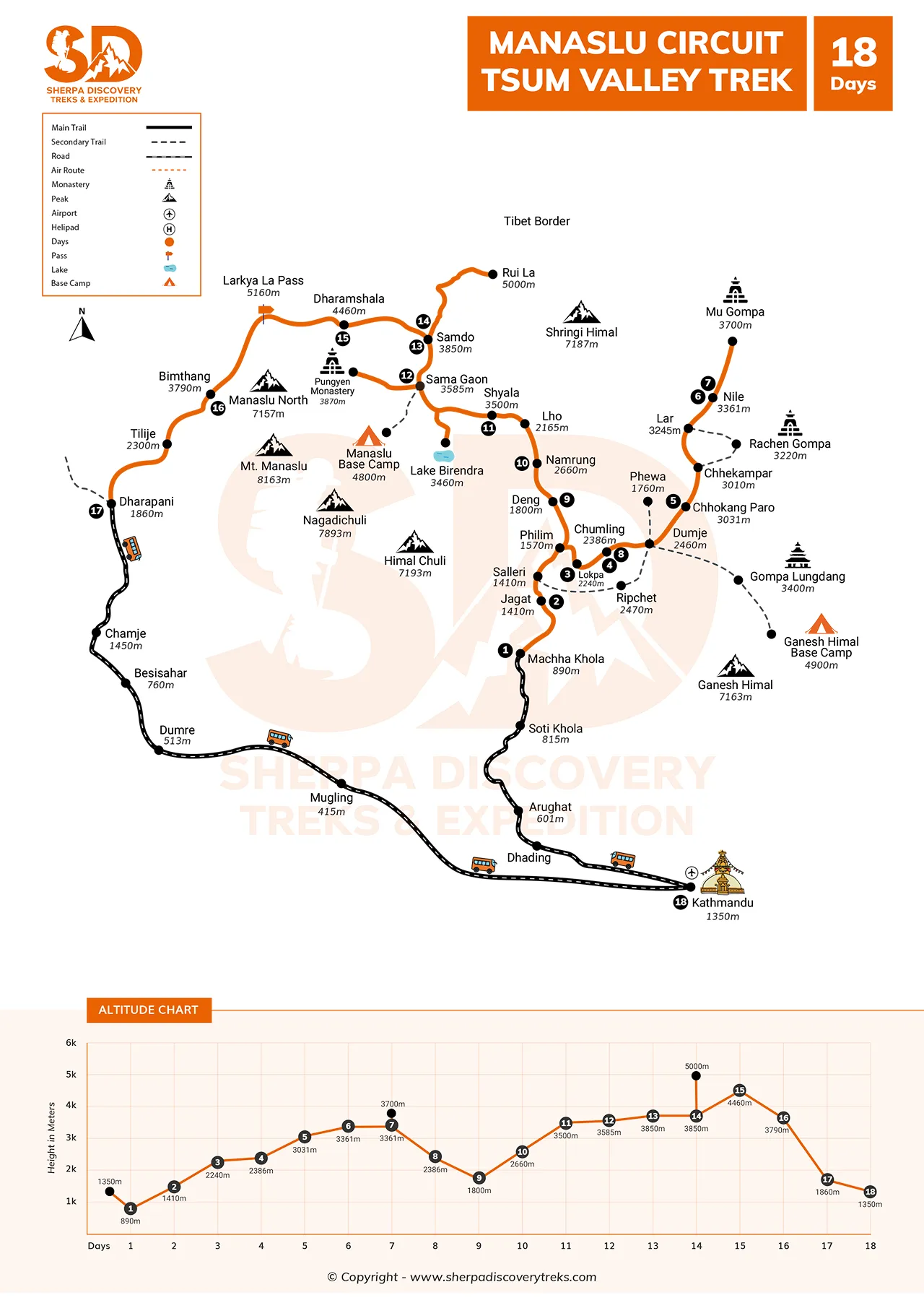

The Manaslu and Tsum Valley Trek starts with a drive to the Machha Khola. This road ride will take about 7 to 8 hours to complete, starting from Kathmandu. We will drive over the Tribhuvan Highway and the Prithvi Highway to get to Dumre, and head north to get to Besisahar. This will be the point where we get off the bus and get on a jeep, since the rough, bumpy road ahead is not suitable for buses. After we get to Machha Khola, we will check in at our accommodation and call it a night.
Our Manaslu Circuit Tsum Valley Trek itinerary takes you on a rugged and rough set of trails with multiple demanding ascents that take hours to complete. This trek definitely requires you to have considerable fitness, preferably above average, and be able to handle 5 to 6 hours of trekking on average every day. We will be climbing up two different passes, namely the Rui La Pass, reaching 4998 meters, and the Larkya La Pass, reaching 5106 meters above sea level. So, on a scale of 10, this trek is definitely an 8.5.
The best season for visiting the Manaslu region and the Tsum Valley is the spring season. The barren highland of the Tsum Valley does not receive much rainfall at all. So, it is actually dry throughout the year, with a few cloudy days. During the springtime, you can enjoy the lush hills and the dry and clear barren highlands of the Tsum Valley. The Manaslu region also blooms its flowers during the spring, making the scenes even more charming.
The autumn season is also a great choice for trekkers who want dry weather throughout the trek. Wet trails mean slippery sections, which is not great for ascent and descents, so the dry period of autumn is a great choice. In addition to that, you are likely to witness a couple of festive celebrations during this season.
This trek takes you to considerable altitudes, but you will be spending only one night at an elevation over 4000 meters. This will be your 15th day of the Manaslu Circuit Tsum Valley Trek, when you spend the night at Dharamsala, reaching 4460 meters. Mainly, altitude sickness occurs when you hike to considerable elevation without proper acclimatization techniques and spend the night. But we will be practicing all the preventive measures to make sure you steer clear of the illness.
Your trekking days will come to an end at local tea houses and lodges. These are the ultimate accommodations in the highlands of Nepal, as they provide the basic services, along with great food, laundry services, and WiFi. Homestays are also good options, but you won’t find them at every village, and they only offer a limited number of services, which is expected since you will be staying at a local’s house, not a business. Regardless, your accommodation expense will be covered by the Manaslu and Tsum Valley Trek package cost.
Your food options will be based on what is seasonally available; most of the villages do not import food items, except for meats from neighboring villages. However, you will find pancakes, spaghetti, noodles, sandwiches, pasta, and more at the lower region villages. These food items will vanish as you go deeper into the valley. However, your drink options are not that varied. Hot tea, seasonal fruit juice, canned juice, hot chocolate, coffee, etc, are your options.
First, we will drive to the starting point of our Manaslu and Tsum Valley Trek, Machha Khola. Lastly, we will drive from Dharapani to Kathmandu or Pokhara. These are the only two transportation costs that our trek package will cover.
To do this trek, you are required to obtain the Restricted Area Permit (RAP), Manaslu Conservation Area Project (MCAP) permit, and Tsum Valley Special Permit. Sherpa Discovery Trek’s knowledgeable trek guide will help you obtain these permits if you do not know how to proceed. The expenses related to these permits will be covered by the trek package.
This trek is definitely a physically demanding journey to the Himalayas, you really have to be physically fit and mentally ready to complete it. We recommend 4 to 5 hours of physical training per week, 12 to 14 weeks before your arrival in Nepal. This will get you sufficiently ready for the physical requirements of the itinerary.
Sherpa Discovery Trek’s Manaslu Circuit Tsum Valley Trek package will cost you USD _______ per person. This package will cover your daily accommodation costs, permit fees, local taxes in remote villages, daily wages of the porters, drivers, and guides, daily meals (breakfast, lunch, and dinner), and more.
You are highly unlikely to get to charge your devices at your preferred time during the trekking days. The upper Manaslu region and the Upper Tsum Valley region are not well-developed; they are the most remote part of this trek. This means basic facilities like electricity are not available 24/7, but rather with frequent blackouts.
Things like hot showers, WiFi, laundry, any kind of beverages, extra meals, extra accommodation, tips for the crew members, emergency evacuation services, meals during your stay in cities, etc, are your extra expenses.
Our standard Manaslu Circuit Tsum Valley Trek package does not arrange your stay in Kathmandu, but if you prefer, we can arrange a couple of days of stay in Kathmandu. Our standard stay will be at 3-star hotels, while high-end options include 4-star and 5-star hotels. None of this arrangement is a part of the standard package, so you will be charged separately for this accommodation.
No, acclimatization days can not be avoided at any cost. You must let your body adapt to the changes in order to avoid altitude sickness.
The temperature can go below zero in the highlands, so make sure that you have a sub-zero sleeping bag.
The chances of altitude sickness during this trek are very low, since we will not be spending many nights at considerable altitudes.
Yes, our standard accommodation settings are twin-based, meaning you have to share one room with one of your fellow trekkers in the group. There will be two beds in each room.
Yes, you can get private room during the trekking days but you have to request this arrangement before you book this trek.

US$ 1350
We offer group discounts
Total Cost:
US$
Need help?
Talk to trip expert