English
 Dutch
Dutch Japanese
 Hindi
Hindi Italian
 Spanish
 French
 German
 Chinese
 Korean
 Arabic
 Hebrew
 Russian
 Portuguese
 Danish
 Czech
Czech Polish
 Swedish
Need help?
 +977 9767994912


Trip Duration
7 Days
Trip Difficulty
Difficult
Max. Altitude
7,134m / 23,406ft.
Activity
Trekking
Destination
Nepal
Group Size
1-16 Pax
Accommodation
3 star Hotel
Meals
Breakfast, Lunch, Dinner

Need help?
Talk to trip expert
Are you an avid trekker and looking for the most picturesque corners of the world? If so, then we invite you to our Rolwaling Valley trek- a paradise trek for those who want to feel the magic of the high Himalayas while being in close contact with nature and the unique local culture.
Just imagine, the majestic lesser-known peaks, glaciers, crystal clear blue lake, charming locales, waterfalls and forest. This all defines our Rolwaling Valley trek 7 days journey that offers the unique beauty and peace breaking you away from the everyday stress.
The incredible Rolwaling Valley lies on the north-eastern map of Nepal beneath 7134 m high Gaurishankar Himal between Langtang and Everest in the preserved land of the Gaurishankar Conservation Area. The Valley is walled by more than fifty other peaks that penetrates the sky with their 6000 m altitudes.
Mostly, when walking the Rolwaling Valley trek route, you will get to look directly at the massive chalk-like walls of Jugal Himal (6535 m), Makalu (8485 m), Chugimago (6258 m), Lhotse (8516 m), Cho Oyu (8188 m), Chekijo Peak (6257 m), Gaurishankar, Langtang Himal, and Mount Everest (8848 m).
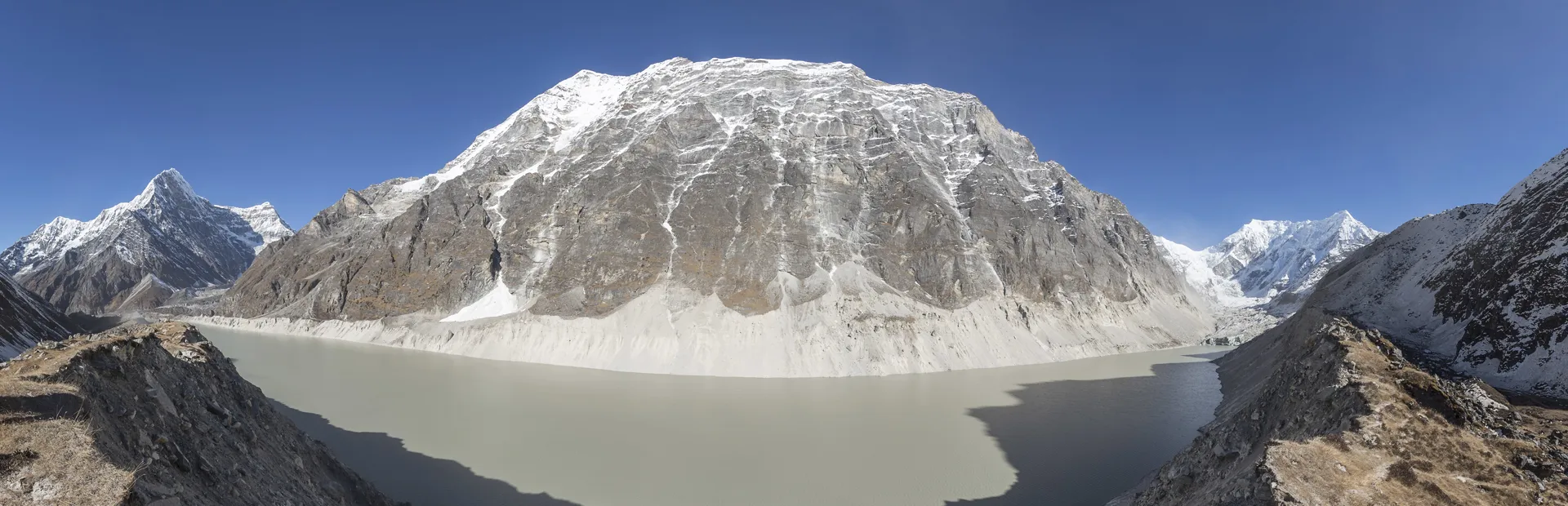
The Valley also contains the two major mirror-like glacial lakes of Tso Rolpa and Dudh Kunda that draw the nature lovers with their beauty and brilliance.
On the other hand, through the Rolwaling Valley trek, you will also get to know the cultural richness of this valley. The local inhabitants of Sherpa and Tamang live here following the traditional heritage of their Tibetan Buddhism.
You will also have the remarkable chance to see the wealth of flora and fauna of the region including the langurs, red panda, Himalayan Goat, rhododendrons and Himalayan firs.
You will start your Rolwaling Valley trek itinerary with a road trip from Kathmandu to Chetchet. You will then walk to Simigaon and follow the scenic villages of Dongang, Beding and Na.
These are the unique villages of Rolwaling that are full of life that goes unhurriedly and amaze you with their authentic houses and the hospitality of the locals.
Once at Na, you will then climb up to the Dudh Kunda Lake or Tso Rolpa Lake perched high among the glacial walls of the Rolwaling at 4500 m elevation. It is also the maximum elevation that we will reach in our Rolwaling Valley trek itinerary.
Our Rolwaling Valley trek will then come to an end as you redirect your journey through the same road back to Kathmandu.
All in all, our Rolwaling Valley trek is an adventure that will lead you to less popular corners of Nepal where you can escape the hustle and bustle of the common tourist trails.
Its charm is particularly attractive during autumn and spring that fits and attracts not only experienced trekkers but also those who are just starting their trekking adventure.
Welcome to Rolwaling Valley trek- a journey which will compel you to leave the part of your soul in this remote area of Nepal.

Our Rolwaling Valley trek starts from today with a long 8-hour drive from the capital to Chetchet Village. A bus or a jeep will take us along the Araniko Highway where we will be able to see the towns of Bhaktapur, Banepa, Dhulikhel, and Dolalghat rolling by our windows.
Once we arrive at Khadichaur, we will take a quick lunch break and continue along the gradually ascending road. It will cross the junction point of Bhote Koshi and Sun Koshi Rivers before we descend to Charikot, the district capital of Dolakha.
Now, the bumpy dirt road will take us alongside the Tama Koshi River with Gaurishankar rising before us. We will then journey through some amazing Chhetri and Tamang settlements of Bharle, Suridobhan, Jamune, Singati, Tatopani, and Manthali.
We will then cross the Gonggar Khola before reaching Chetchet. Now, we will start walking across the suspended bridge followed by a climb up a steep path that opens up to beautiful terraced fields.
We will start to see the colorful Mani Walls and chortens, the symbol of Sherpa Buddhist culture. Once we are at the other side of the Tama Koshi River, a steep climb will take us to Simigaon with a beautiful small Gompa and Gaurishankar massif at the front.


A very nice walk awaits us today that will take us through the dense jungle along the path built with a mix of stone and concrete. We will keep climbing for a while till we are at the beautiful Surmuche Village (2470 m).
Gaurishankar walls look stunning from here. Continuing our journey, we will resume climbing occasionally catching sight of Gauri Shankar.
Soon, we will be near the Kyalje Village where the grand Chekijo Peak (6257 m) dominates the sky. From here, a short thirty-minute walk will take us to a hill adorned with rhododendrons, pines, and charred tree stumps.
After passing a small waterfall and crossing two streams, we will make our way down to Dongang which has very few tea houses but offers a pleasant stay for the night.
Today is going to be the hardest upward climb of our Rolwaling Valley trek itinerary as we will be gaining about 1000 m altitude. Turning north, we will keep walking along the relatively flat trail for around two hours.
Now, we will have to cross the bridge hung over the Rolwaling Khola. The trail will lead us to a more clear area where we can exceptionally see the Chekijo Peak once more.
For one more hour, we will keep ascending till we meet yet another bridge this time over the Themlung Khola fed by the glacier of Gaurishankar.
A three-more-hour push through the settlements of Jobalu, Nyiamare, Ramding, and Chhimu Golche will lead us to Lama Monastery School. Here, our permits will be reviewed, after which we will climb for 40 more minutes to Beding- a small Sherpa Village with few houses and a monastery.
We will continue to follow the Rolwaling Khola and walk up for around three hours to reach the unique Na Village- one of the oldest ones in the Rolwaling Valley.
Along the route, we will pass by a rock painting of Guru Rimpoche, the father of Buddhism. High above, we can also see the small monastery on the hills.
We will now walk across the small mountain stream and reach a Mani Wall Gate indicating we are in the Na Gaon. This Village is hidden at the base of Kang Nachugo, Bamongo, and Chekijo Peaks. We also have wonderful views of Chugimago and Chubutse Peaks from here.
We will rest a moment here before proceeding with our acclimating walk towards the Tso Rolpa Lake. Continuing on, we will begin with a steady walk through the valley on the river bed.
Next, we will go on with a steep climb and reach the top where we can find the ridge situated between the two gigantic moraines of Rolwaling Glacier.
From here, we can approach the pious Dudhkunda Lake or Omi Tsho where we can sit by its blue waters for a while. Now, following the ridge of the Rolwaling Glacier south, we will walk down and cross the glacier wall.
We will ascend again the wall at Tsho Rolpa, and here we are at the bank of the vast lake. We will take our time to soak in the grandeur of the lake and its surrounding landscape, then we will redirect our feet back to Na.
We will leave the alpine terrain of Na and start our hike down to Dongang Village. Following the river back down, we will slowly walk back down through the forest.
Once again walking past the Beding Village, we will shortly arrive at Dongang for the night.
Taking the same route, we will redirect our journey back down through Kyalje, Surmuche, and Simigaon followed by the long descent to Chetchet.
From Chetchet, a local bus will drive us back through Charikot to Kathmandu thus culminating our Rolwaling Valley trek 7 days journey.


The enchanting Rolwaling Valley trek offers the best scenarios and unforgettable experiences for many months a year. Still, for the most charming feel, the best season for the Rolwaling Valley trek will be the Fall or autumn and the spring.
The favorably comfortable weather, clear visibility, dry stable climate with heat ranging between 5 to 15 degrees Celsius with active wildlife make the autumn months of September, October, and November the most preferable time for this trek.
Spring on the other hand from March through the latter days of May offers lively vegetation, blooming wildflowers, and light rain with heat between 10 to 20 degrees Celsius.
The winter of December, January, and February will be the third best season for the Rolwaling Valley trek when the region experiences extreme snowfall, and frigid heat of -5 to -10 degree Celsius. The landscape will be very dry with animals often hibernating but the days will be quite sunny.
The summertime of June, July, and August brings in the heavy rain in the Rolwaling Valley increasing the risk of flooding with the limited visibility. The vegetation will be lush but there will be fewer animals in the forest so this is the least suggested time for the Rolwaling Valley trek.
The trekking experience of our Rolwaling Valley trek 7 days journey is classified as moderately difficult and falls under category 3 in Nepal. It requires 5 to 7 hours of hiking every day with 8 to 9 hours of driving journey at the beginning and end of the adventure.
The trek also features significant elevation gain particularly on day three with almost 1000 m up. The journey will then eventually lead you to the 4500 altitude of Tso Rolpa Lake.
You will also have your overnight stay at the 4200 m elevation of Na Village which will be the highest of the entire duration. At this height, hikers especially inexperienced ones may be susceptible to altitude sickness.
In addition, the route also consists of several deviations from steep forest paths, and rocky and stone steps, to the alpine glacial tracks. Therefore, you should be prepared not only for the unique landscapes and local culture but also for the challenges associated with mountain trekking in this trek.
Rolwaling Valley is also known for its unpredictable weather, making it essential to check conditions before beginning the trek for the day. Therefore, the Rolwaling Valley trek 7 days journey will be particularly difficult and demanding for those who are unfamiliar with trekking in remote areas or who prefer more comfortable accommodations and amenities.
However, if you are an avid nature trekker, and like to immerse in the uncontaminated surroundings, then the Rolwaling Valley trek will be easy for you.
Anyone who is in good health possesses a satisfactory level of fitness, and is free from severe chronic conditions related to lungs, kidneys, or heart can hike our Rolwaling Valley trek route.
If you are in love with nature and want to appreciate its true beauty, and if you don’t mind the basic settings and amenities for a few days, then also you can walk our Rolwaling Valley trek route even if you are new to high mountain trekking in Nepal.
If you decide to hike along the Rolwaling Valley trek route with your family, children, parents, or grandparents, or if you are new to mountain trekking in Nepal, then to easy your journey, you should choose the right time for this trek.
You should also invest in good quality hiking footwear and clothing adapted to the weather conditions. You should also collect the details about the hiking route and the climate and weather conditions.
And, do not forget to prepare your physical and mental condition to face the unknown challenges of the trek.
From our side, we will provide you with the support of our team (Expert local guide and porters) who will put their best effort to make your travel as easy and as pleasant they can.
Acute mountain sickness (AMS) generally known as altitude sickness is not excluded in our Rolwaling Valley trek. However, we have tried to keep the chance of AMS to a minimum by ascending slowly and paying sufficient attention to acclimatization.
On our Rolwaling Vale trek, we don’t have any rest days on the way up but you will have excellent opportunities for acclimatization. Some days of our Rolwaling Valley trek itinerary are short which gives you enough time to adjust to the high air, experience the breathtaking scenery, chat with your hosts in the tea houses, and discover the impressive culture of this valley.
Despite all these measures, some of us may go through the milder condition of altitude sickness such as headache, tiredness, nausea, dizziness, and body ache.
If you notice any one of these symptoms in you, it is better to rest at the same location for a few hours and drink enough fluid such as plain water, ginger or lemon tea, or honey which will help in minimizing your conditions.
You can also take Diamox which ensures faster acclimatization on the trek. Even, if the symptoms do not resolve, then it may be time for you to return to a lower level and halt the journey for a day or so.
Please remember that the AMS has nothing to do with the level of physical training, nor with the number of times you have been at high altitude. Those who have suffered from it in the past are more likely to suffer from it permanently.
So we urge our experienced trekkers not to take the condition lightly and tell our guide immediately. Our local guides are aware of the dangers of altitude sickness. They give advice on prevention and also know what to do if altitude sickness rears its head.
Please emphasize on drinking at least 4 liters of water beginning with a liter before the start of the hike and remaining during walking. Also stay away from smoking, spicy food, and alcohol when you are at high altitude.
Your Rolwaling Valley trek will become even more pleasing, exciting and eventful if you take a month to prepare your physical condition before the trip. And, we suggest this to even our experienced hikers as more than the experience your fitness will come in handy in this adventure.
To mirror the mountain trekking activity, you should focus on building the core muscles of your leg and engage in ascending and descending the stairs instead of taking elevators.
If you like to jog or walk, then instead of walking in the park, try to get over the inclined grounds. Also try to build up your heart muscles through the exercises like cycling, running, and swimming along with the exercise on treadmills.
In addition, simple endurance and strength exercises will help you adapt to the effort on the trail. You can do squats of three sets with ten repetitions and plank three sets of 30 seconds on a day.
It is also important for you to prepare mentally for the challenges of our Rolwaling Valley trek. Adventures in remote places can be unpredictable, and adaptability is key. So, consider spending more time acclimatizing in the area and seek advice from experienced trekkers before setting off.
The Rolwaling Valley trek route is so diverse and rich that you can integrate several other routes in the trek and customize your adventure. Depending on your budget, available time, physical condition, and how many extra days you have, you can choose a route that suits you perfectly.
If you have 17 or 18 days to spare for the journey, then you can hike to Tso Rolpa Lake and then make your way to the Tashi Laptsa Pass, which stands at 5,755 meters.
From here, you have two exciting options: you can trek towards Khumjung and follow the Everest Base Camp trail through Namche and Lukla back to Kathmandu, or you can head to Thame, Lungden, and cross the Renjo La Pass at 5,360 meters to reach Gokyo.
Once in Gokyo, you can either explore the Cho Oyu Base Camp at 4,900 meters or climb Gokyo Ri, which rises to 5,357 meters. Afterward, you can return through Namche and Lukla to Kathmandu.
Additionally, you may also choose to travel to the base camp of Pachermo Peak and attempt to summit its impressive height of 6,187 meters. However, please note that all these routes will be very tough experience suitable for only trained mountain hikers looking for a unique experience.
During the Rolwaling Valley trek 7 days journey, you will sleep in simple lodges of the overnight villages that may have limited sanitary facilities.
Usually, they provide a single room with two beds and sometimes three with thin foam mattress. The sanitary facilities are often limited to squat toilets and wash basin. There can also be shower with or without the hot water but you can buy a bucket of hot water to wash yourself.
Regarding food arrangements, during the trek, you will have breakfast and dinner in the overnight lodge where you can often choose from a limited selection of dishes, often one-pot dishes based on potatoes, rice or noodles, supplemented with vegetables, egg.
Meat is also available but only in limited quantities. In the afternoon you will usually eat your lunch in the tea house. The basic dish that you will see in every ta house is Dal Vat Tarkari which is a combination of a bowl of lentil soup with rice and a few side dishes based on vegetables, curry, or meat/chicken.
As for your transport arrangements, you will get in the local bus or jeep for your back-and-forth transfers between Kathmandu and Chetchet.
The Rolwaling Valley nestles inside the protected landmark of the Gaurishankar Conservation Area (GSCA) so we will need to have a permit for this area then only can we walk inside it freely.
The second permit that we need to have for this journey is the Trekkers Information Management System Card or TIMS card. The GSCA and TIMS permits are available through the Tourist Service Center in Kathmandu at USD 30 and USD 20 per hiker respectively.
There is one more permit that we will need which is the restricted permit that will allow us to access the Na Village and its beautiful Tso Rolpa Lake. The payment of USD 20 per hiker for the first week will be needed by the Department of Immigration in Kathmandu.
Please don’t stress about the permit processing and fees as they have already been incorporated in our Rolwaling Valley trek package overall cost.
Please understand that as of 2023, travel insurance has been made a compulsory requirement for every high-mountain trekking adventure in Nepal.
So make sure to buy a proper travel insurance that offer you the coverage for helicopter rescue, transport or evacuation to the altitude of around 5000 m.
After acquiring the insurance, please send us to copy so we can process for the necessary permits for the Rolwaling Valley trek. Additionally, you should also consider adding other coverages for safety during the trek such as medical costs, extra stays, flight or trip postponements, delays, and baggage theft or loss or damage.
These will offer you additional protection against the situation that arises during any international travel trips.
Sure you can in the tea houses that you will stay with the payment of few extra money. Not only mobile, but you can also power up the drained batteries of your camera, laptop, or iPad. We do however suggest you carry spare batteries, power bank or solar charger as in some areas, you may not have the luxury of charging your gadgets.
We cannot promise you about the WiFi availability on the Rolwaling Valley trek route. Some lodges may have WiFi and they will provide you if they have at an extra payment but the signal will be quite poor. Instead, you can rely on the 4G net of the NTC or NCELL network whenever you have the coverage of these networks in the area.
The peace and quiet trails, the proximity to the unadulterated nature, the authentic unique culture, flora, fauna, lakes, and mountains are some noteworthy traits of our Rolwaling Valley trek.
No, although the tea houses are quite limited in the area, but they are there so tents or camping are not necessary in any part of the trek.
The heritage of age old Tibetan Buddhism of Tamangs and Sherpas will awe you in this journey with their magnificently built monasteries, rock painting and Mani Walls.

Need help?
Talk to trip expert